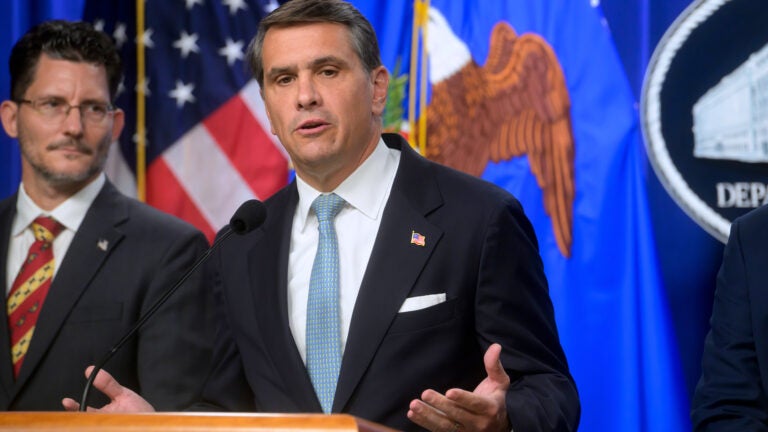
EPA Administrator Lee Zeldin announces a rollback of pollution regulations at the White House, February 12, 2026.Saul Loeb/AFP via Getty
Get your news from a source that’s not owned and controlled by oligarchs. Sign up for the free Mother Jones Daily.
This story was originally published by Slate and is reproduced here as part of the Climate Desk collaboration.
Recently, millions of Americans have faced orange skies and air-quality alerts. The struggles many people had with the smoke are a sad reminder of the importance air quality has for our health. Yet the Trump administration has done everything in its power to make our air less clean. Now it is adopting new, stealthier strategies to weaken clean-air standards.
During its first year, the second Trump administration used a “shock and awe” approach to environmental deregulation. In an effort to erase climate policies, the Environmental Protection Agency claimed that climate change was not a serious problem, pointing to a report by hand-picked climate skeptics. The criticisms of the National Academy of Sciences and other prominent scientific organizations were so devastating that the EPA abandoned its reliance on the report when it eliminated key greenhouse gas standards, instead basing its decision primarily on shaky legal arguments.
The agency is now routinely determining that the benefits of reducing air pollution are too uncertain to quantify or value at all.
In the second year of this term, the Trump administration has shifted gears, taking another legally indefensible approach that is less visible but even more pernicious because it extends to all pollutants, not just greenhouse gases. The EPA is now routinely determining that the benefits of reducing air pollution—that is, life-saving health benefits for Americans—are too uncertain to quantify or value at all in regulatory decisionmaking.
The administration is doing this without any analysis or citation to scientific studies. Extensive peer-reviewed science has used sophisticated techniques to quantify the impacts of pollution reductions and account for related uncertainty. And the EPA has relied on these findings for decades, including during the first Trump administration and other Republican administrations. But, beginning this year, EPA administrator Lee Zeldin has decided that every health benefit from air pollution reductions is too uncertain to count—and every regulatory cost dispositive.
The EPA announced its new approach in January in a rule on emissions from gas turbines, stating that it would no longer value public-health benefits from reducing fine particulate matter and ozone—two of the most prevalent and damaging air pollutants. The agency referenced uncertainties in how different concentrations of pollutants translate into negative health impacts like premature deaths; uncertainties in mortality valuations, which assign a dollar value to these deaths; and uncertainties in growth and discount rates, which are used to translate future impacts to present values. But the EPA’s longstanding techniques already accounted for these uncertainties.
As a result of its new approach, the EPA no longer estimates the number of lives saved or diseases and hospitalizations averted. It is assigning no value whatsoever to these environmental benefits, thereby ignoring the very health concerns the agency was created to address.
Later, the EPA doubled down on its new approach when it repealed one vehicle emission rule and delayed another one. It similarly did not consider these adverse health consequences in an air pollution regulation for coal and oil power plants, another air pollution regulation for wood products, and, earlier this month, in relaxing emissions test procedures for heavy-duty vehicles.
When the EPA first announced its new approach in January, Zeldin insisted that even though the agency would not assign a dollar value to averted deaths, it would “still be considering lives saved when setting pollution limits.” The subsequent regulatory proceedings confirmed that Zeldin’s statement was false.
The EPA, whose actions here are plainly illegal, is basing some of its cost analyses on disputed industry claims.
Moreover, the EPA did not restrict its approach to particulate matter and ozone. The agency also refused to assign any benefits to the reduction of pollutants like nitrogen oxides and sulfur dioxide. And, similarly, in multiple proceedings, it ignored the benefits of reducing the emissions of greenhouse gases, including carbon dioxide, methane, and hydrofluorocarbons.
On the cost side of its regulatory analysis, the EPA’s approach is entirely different. The EPA is continuing to fully quantify and consider the compliance costs for affected industries, even though those costs are subject to many of the same uncertainties as the benefits. For instance, like health benefits, compliance costs are borne at different times and must be translated into present value (using the same discount rates that the EPA had found too uncertain to use for benefits).
The EPA is basing some of its cost analyses on disputed industry claims, as long as they align with the administration’s favored deregulatory narrative. To justify weakening requirements to reduce hydrofluorocarbons and other potent greenhouse gases in new refrigeration equipment, the agency relied on unverified assertions about costs from certain supermarkets and other regulated entities, even though major refrigeration trade associations opposed these claims and explained that the EPA action would in fact raise compliance costs.
Without any empirical evidence, Zeldin claimed that the EPA’s action “will be felt directly by American families in lower grocery prices.” But the refrigeration rule did not impose any costs on regulated entities until future replacements of refrigeration equipment may be needed. Recent increases in grocery prices have been driven largely by supply-chain disruptions and rising energy costs arising from the war in Iran. Any cost savings from this rule, therefore, were unlikely to be felt in the near term.
The EPA’s actions are plainly illegal. Agencies cannot put a thumb on the scale by taking account of a rule’s costs but not its benefits, particularly when there are established techniques for valuing the benefits.
Because there is no “big ticket” action like last year’s questioning of climate change, the EPA’s approach has largely gone under the radar. Zeldin appears to be following John Oliver’s adage that if you want to do something harmful, “put it inside something boring” to avoid public scrutiny. But the American people will suffer greatly as a result of these illegal actions, in the form of additional premature deaths, asthma attacks, hospitalizations, and other serious health consequences.