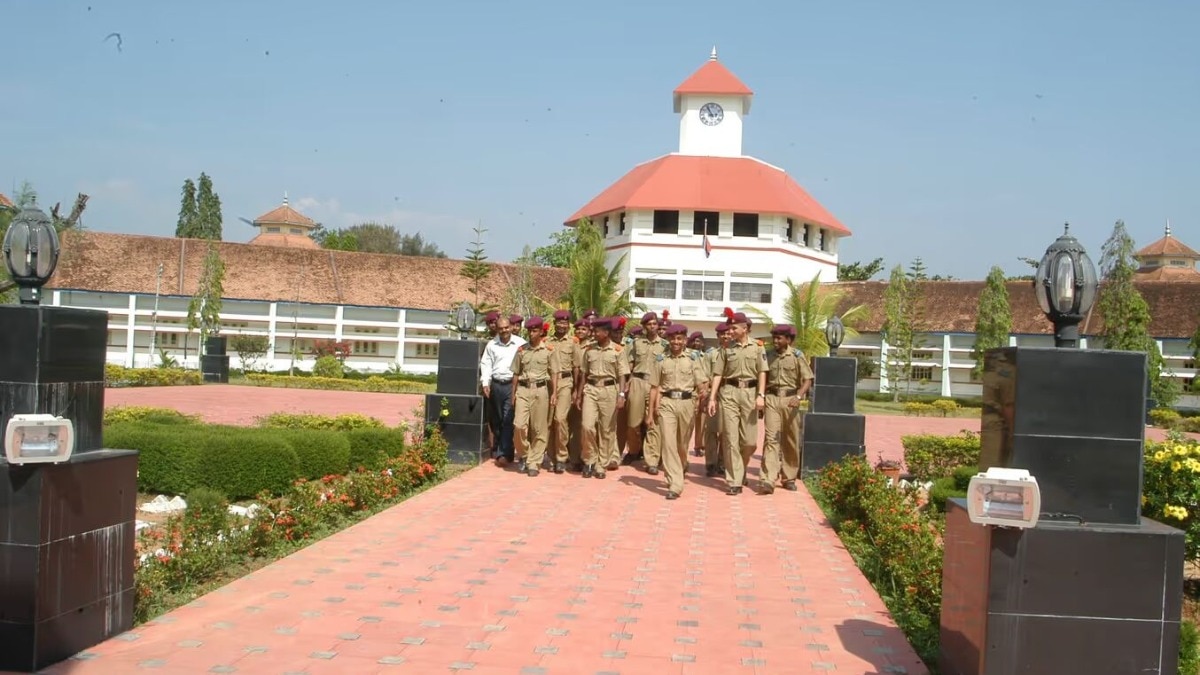
Top defence sources have rejected Congress MP Rahul Gandhi’s allegations that new Sainik Schools are being handed over to institutions linked to the RSS, maintaining that the selection process under the Public-Private Partnership model is transparent and involves multiple layers of scrutiny.
The clarification came after a heated exchange during a meeting of the Parliamentary Standing Committee on Defence, where Gandhi alleged that Sainik Schools were being “privatised” and their management entrusted to RSS-linked organisations.
“The process followed for the selection of New Sainik Schools under the PPP model is quite transparent,” a senior defence source told India Today.
A BJP MP strongly contested the allegation and asked Gandhi to substantiate it with documentary evidence, sources said.
Committee Chairman Radha Mohan Singh is learnt to have said that the panel would seek detailed information from the government on the role of private institutions in the management and functioning of the schools.
HOW NEW SAINIK SCHOOLS ARE SELECTED
The Union Cabinet approved the establishment of 100 New Sainik Schools under the PPP model in October 2021. Of these, 86 schools have been approved over three rounds and 79 are currently operational. Applications under the fourth round are being processed for the remaining schools.
NGOs, trusts, societies and private and government schools can apply to establish a New Sainik School under either the greenfield or brownfield category.
Applications are submitted through an online portal and first examined by a Documents Scrutiny Committee comprising five serving uniformed officers. The panel assesses whether an applicant meets requirements related to land, infrastructure, sports facilities and other basic criteria.
Schools clearing this stage are physically inspected by a School Evaluation Committee comprising the district magistrate or collector, the principal of a Navodaya Vidyalaya or Kendriya Vidyalaya in the district and the principal of the nearest Sainik School.
The committee verifies the applicant’s facilities and submits its assessment to the Sainik Schools Society.
The report is then examined by an Approval Committee comprising the honorary secretary of the Sainik Schools Society, a representative of the Department of School Education and Literacy and a Brigadier-rank officer, among others.
CRITERIA FOR APPROVAL
Defence sources said the shortlisting process considers geographical spread, district population density and the principle of approving one New Sainik School in each district.
Preference is given to existing brownfield schools over greenfield projects. Among brownfield applicants, schools with stronger academic records receive priority.
Boarding schools are also preferred over private day schools, the sources said.
New Sainik Schools may operate as day schools, residential schools or day-cum-boarding institutions. Day schools require at least six acres of land, while residential schools need a minimum of eight acres.
Defence sources said the scheme aims to mould young students into responsible citizens and maintained that the multi-stage selection process is based on objective criteria rather than political or ideological affiliation.
– Ends
Published By:
Aprameya Rao
Published On:
Aug 4, 2026 23:54 IST