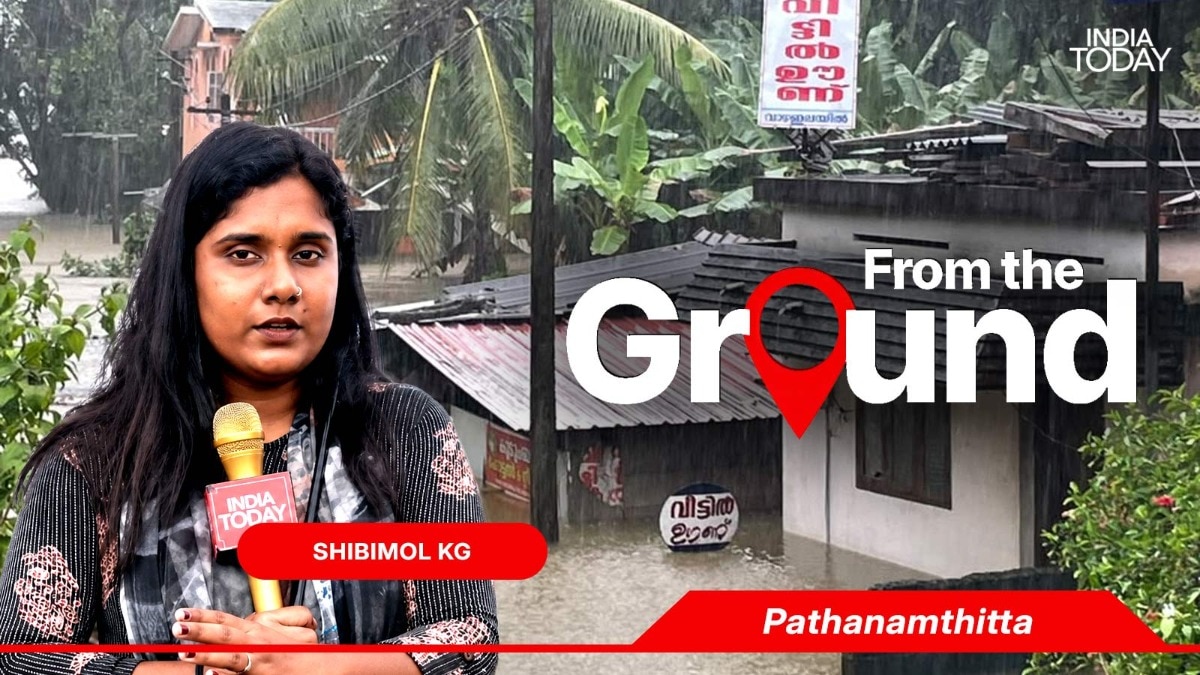
“Chechi?”
I called out to a woman standing outside her house along the road leading to the famed Aranmula Temple. We had reached the area to report on the severe waterlogging that had submerged the temple approach road and large parts of the premises, bringing movement to a standstill.
I was desperately thirsty. Every shop nearby was shut because of the flooding.
“Yes?” she replied, stepping outside.
I asked if I could have a glass of water. She smiled, said “of course” and invited me inside. I hesitated because I was drenched from hours of reporting in the rain, but she insisted.
Her house stood on slightly higher ground, with a sloping entrance. Looking at it, I assumed it had escaped the flooding. “The water wouldn’t have entered this house, right?” I asked while drinking the water.
“It did. Yesterday.”
Her answer caught me completely off guard.
She pointed to the sofa where I was sitting. “In 2018, the water had reached this level.”
For her family, this was the first time since Kerala’s devastating floods of 2018 that floodwater had entered their home. Then she pointed towards the house opposite. “That belongs to our relatives. They’ve shifted to a relief camp. The water there rose to the level of the dining table.”
As I stepped out, I turned around for one last look at the living room where I had just been sitting. I tried to picture muddy floodwater filling the space, swallowing the furniture and everything around it.
That’s the strange thing about covering floods. You can stand waist-deep in water all day and still fail to comprehend what it means for those who live there. The real devastation begins inside people’s homes.
From Aranmula, we headed to Ranni, one of the worst-hit towns after overnight torrential rain. I had seen drone footage before arriving, but nothing prepared me for the scene on the ground.
Police had barricaded the road leading into the flooded locality. Beyond the barricades, I waded through water that rose above my waist to report from the heart of the inundated neighbourhood.
A little further ahead, I saw a family taking shelter on the upper floor of their house. The ground floor had disappeared beneath murky floodwater.
“We don’t want to leave everything behind and move to a relief camp,” an elderly woman called out from upstairs. “Once the rain stops for a while, the water will go down.”
It is a dilemma we encounter repeatedly while covering floods. Many residents hesitate to leave because they fear returning to find their homes looted or further damaged. Others simply cannot imagine abandoning everything they own.
For families living in Kerala’s flood-prone low-lying areas, relief camps have become an unfortunate annual reality rather than an emergency measure.
Then came one of the most frightening moments I have experienced while reporting.
As I made my way back through the flooded street, I suddenly spotted a live snake cutting swiftly through the current just a few feet away. For a split second, I froze. Then instinct took over. I hurried through the water as fast as I could while keeping an eye on the snake. Thankfully, it slithered onto the gate of a nearby house before disappearing inside the compound.
Despite years of covering floods, this was the first time I had come face-to-face with a snake in floodwater. The fear is always there whenever you step into submerged streets. That day, it became real.
The neighbourhood itself was unnervingly silent. Every house was locked. Every family had left. With floodwater stretching across deserted lanes, the area felt abandoned.
A short distance away, I found a man hurriedly carrying goods to the first floor of a commercial building. He ran a business on the ground floor. “The stock downstairs is soaked. Most of it is damaged,” he said without pausing. “We didn’t get any warning or proper directions. Had we known earlier, we could have shifted everything to a safer place.”
Like many others, he wasn’t just counting financial losses. He was trying to salvage whatever little remained before the water claimed that too.
About two kilometres away, a relief camp had been set up at MS Higher Secondary School. Inside, families who had fled their homes just hours earlier were trying to settle into temporary lives. “We are 10 families, around 25 people, staying here,” said Mini, who had arrived from a nearby apartment complex.
“We got a call from our panchayat member saying the water level was rising and asking us to leave immediately. We informed all our neighbours and rushed here. We came wearing only the clothes we had on. There wasn’t even time to collect our belongings.”
For Mini, displacement has become painfully familiar. “This happens almost every year,” she said.
Then came the sentence that stayed with me long after we left. “I just hope there is a permanent solution. Going back, cleaning and making life normal again is a task.”
That, perhaps, is the part of a flood most people never see.
Television cameras capture swollen rivers, submerged roads and dramatic rescues. But when the rain stops, another battle begins – scrubbing layers of mud from homes, salvaging damaged possessions, reopening shuttered shops and trying to rebuild routines that the water washes away every monsoon.
By the time we drove out of Ranni, the downpour had finally eased, and the floodwaters had begun to recede in parts.
For us, the assignment was ending. For the people of Pathanamthitta, it was only the beginning. Their next few days would not be about surviving the flood, but about reclaiming their homes, their livelihoods and, somehow, a sense of normalcy.
– Ends
Published By:
Priyanka Kumari
Published On:
Aug 5, 2026 00:01 IST