Until recently, Australians have lived in a bubble of our own making. We have long enjoyed imagining we are well buffered on our little island idyll, far away from any major global volatility and safe in the knowledge that should we need protection, our allies are just a phone call away.
But in 2026 we are beginning to wonder if anyone would pick up.
While our place in the world is looking less secure given Donald Trump seems to be making new rules as he goes, especially when it comes to age-old allegiances, a quick office pop quiz will tell you that even more pressing in the minds of Australians is money.
Sign up to The Nightly’s newsletters.
Get the first look at the digital newspaper, curated daily stories and breaking headlines delivered to your inbox.
By continuing you agree to our Terms and Privacy Policy.
Sure, it can’t buy you love, but it can buy you security and peace of mind, two things that are suddenly looking ever further out of reach, especially for younger generations.
So why is Australia feeling the pinch and is our new fiscal situation reflective of what is going on elsewhere in the world?
Underpinning our sense of unease is a bubbling angst over the rate at which artificial intelligence appears to be infiltrating all aspects of our lives. So we ask AI, are you the biggest threat to humanity? Its answer may surprise you.
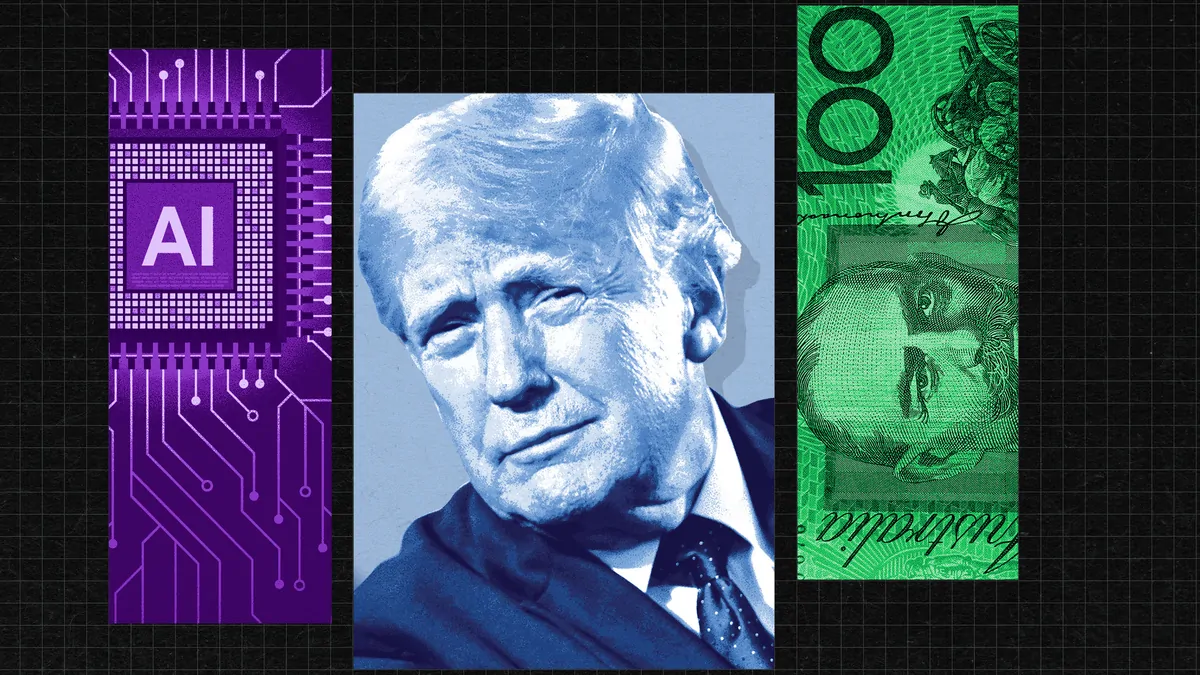
DONALD TRUMP
No matter what our opinions might have been when Donald Trump was sworn in for his second stint in the White House on January 20, 2025, most Australians thought his actions as leader of the free world would be unlikely to have any direct bearing on our day-to-day lives.
From the weakening of former rock-solid alliances, to trade tariffs that have hurt our industries and the war in Iran causing fuel prices to surge, the President of the United States’ second tenure has been one of widespread global influence. For better or worse.
A bold renovation of the White House involving the demolition of the building’s historic east wing is proving to be a fitting visual metaphor for the current Trump presidency.
If it had a theme tune, it would surely be Wrecking Ball by Miley Cyrus.
The world’s most famous residence is being expanded to accommodate a large new private ballroom, overseen by a leader who has also torn down long-held political norms and upended the Western order.
Just like his pet Washington project, Trump remains unapologetically brash, crass and provocative.
He continues to smash the sacred established order, taking an unpredictable and unorthodox approach to the world’s most powerful job, which will change much of the United States for decades, if not longer.
His disruptive approach is also being felt beyond the US, as “America First” policies cause havoc on global financial markets, undermine traditional military alliances, and weaken venerable institutions such as the World Health Organisation.
US President Donald Trump remains unapologetically brash, crass and provocative. Credit: KENT NISHIMURA/AFP
Despite pledging to end America’s “forever wars”, the Commander in Chief has ordered strikes on targets such as Syria, ousted Venezuelan dictator Nicolas Maduro, and along with Israel launched a military offensive against Iran — sparking a global oil crisis.
Since returning to power last year, while still claiming the 2020 election was stolen from him, the President now appears less restrained by the checks and balances that often tempered his more extreme ideas during his first term in the Oval Office.
After steadily transforming the US Supreme Court in his first term by replacing retiring justices with more conservative appointees, the President has worked to reshape congressional districts to favour his Republican party in November’s mid-term elections.
No going back
During his first term, one of Trump’s main targets was mainstream media outlets, which he regularly attacked and derided as “fake news” while clashing with certain reporters he labelled the “enemy of the people”.
This hostile approach has been embraced to varying degrees by other world leaders and even in Australia politicians have sometimes adopted the “fake news” term to attack unfavourable coverage, helping to drive distrust in traditional news sources.
Perhaps the most enduring legacy of Trumpism will be the upheaval of traditional military alliances established following World War II, including the North Atlantic Treaty Organisation and the pact with Australia known as ANZUS.
In his first term Trump regularly criticised NATO allies for not spending enough on defence, but since returning to office he has also weakened the alliance by reducing US support for Ukraine in its efforts to stop Russia’s invasion.
America’s reputation as a dedicated NATO member has been further tarnished by the President’s friendly overtures towards Russian dictator Vladimir Putin.
Since first entering the White House in 2017, Donald Trump has embraced dictators and traditional American foes such as North Korea’s Kim Jong Un, while ambushing and humiliating democratic leaders such as South Africa’s Cyril Ramaphosa.
Fellow world leaders are slowly finding their own strategies for dealing with the highly transactional former businessman but are still regularly surprised by monumental shifts in US policy that often emerge through his late-night rambling social media outbursts.
Against a backdrop of threats by the Trump administration to take Greenland, Canada’s Prime Minister Mark Carney earlier this year warned that middle powers could no longer afford to maintain the fiction of a rules-based order.
“Let me be direct: we are in the midst of a rupture, not a transition,” he told the Davos summit in January, in a speech where he did not directly reference President Trump, who has often suggested Canada could become the 51st US State.
In Australia, Prime Minister Anthony Albanese and senior ministers have consistently avoided criticising Trump or his administration, regularly insisting they will not provide “running commentary” on policies, but did offer initial endorsement of the Iran war.
Last year Trump’s so-called Liberation Day tariffs announced on trading partners, including close ally Australia, caused economic shockwaves all over the world, and prompted widespread retaliation.
Members of the Albanese Government credit the damaging US trade move, and their decision not to retaliate with tit-for-tat tariffs, as helping Labor clinch last year’s crushing election win.
Complicating the relationship is the deep and longstanding military alliance between Australia and the United States, also partners in the ambitious AUKUS nuclear-powered submarine project.
To hedge against an increasingly unpredictable US, Australia continues to strengthen security relationships with like-minded nations such as Japan, while also trying to increase its diplomatic efforts with close Indo-Pacific neighbours.
Under “America First”, Australia — like the rest of the world — is learning that adaptation, flexibility and contingencies are crucial.
MONEY MATTERS
Insecurity is perhaps the prevailing feeling of 2026 and economic uncertainty underpins it all.
Inflation, the cost of living and the national housing crisis are causing a great deal of angst for many. All of a sudden, even those previously uninterested in economics or Budget details are tuning in to see how their hip pocket or savings account might be affected by the latest announcements from Treasurer Jim Chalmers or Reserve Bank of Australia chief Michele Bullock.
The Australian economy does not exist in isolation and global forces are very much at play in the current squeeze we are experiencing.
While the Middle East oil crisis has pushed up fuel prices globally, Australians are battling an even grimmer cost-of-living nightmare than those surviving bill shock in most other developed nations.
In Australia, 95 per cent of home borrowers are on a variable mortgage rate, meaning any interest-rate increase only adds to mortgage stress before the electricity and water bills are even factored in.
Not to mention the apparently “lucky country” is home to some of the world’s most unaffordable housing markets, sparking contentious Budget changes to negative gearing and capital gains tax concessions that are yet to pass through the Senate.
University of New South Wales economics professor Richard Holden in 2015 wrote a report for the Labor-aligned McKell Institute recommending negative gearing be restricted to brand-new properties as the 50 per cent CGT discount was taken off residential homes.
But he’s scathing of a plan to impose a new minimum 30 per cent capital gains tax on other assets unrelated to property, arguing applying it to start-ups will discourage the establishment of new businesses during a time of weak productivity.
“It will hurt the labour market, it will ultimately hurt the tax revenue base, but it will just put us further down the path of a low-growth, lower employment, sluggish economy rather than the kind of dynamic economy that we need to provide opportunity for young Australians,” he says.
With the Senate resuming on June 22, Professor Holden predicts Labor would have to back down on imposing a capital gains tax on start-ups, despite having the numbers with the Greens to pass it into law.
He is likening a potential compromise to the Federal Government last year dumping plans to tax the unrealised gains on super balances above $3 million, before assets in a fund had been sold.
“I’m not the world’s greatest political prognosticator but I think there’s a very real prospect of them having to back down on these CGT changes, limit it only to property and cut their losses,” he says.
The Prime Minister and Treasurer are expected to face pressure from their own Labor backbench to make amendments, a year after Canada cancelled its plans to increase capital gains tax.
“We’ve seen this movie before where the Treasurer runs very hard on a proposed policy and the politics of it suddenly become clear to the Prime Minister, he pulls the rug out,” Professor Holden says.
“A low-productivity, high-inflation environment is a very bad combination.”
Rates still on the rise
Australia’s consumer price index moderated to 4.2 per cent in April but headline inflation has been above the Reserve Bank of Australia’s 2-3 per cent target for nine straight months.
The RBA cash rate is also at a 15-month high of 4.35 per cent, following three hikes this year that have reversed last year’s relief.
Westpac bank is expecting another two increases in August and September that would take it to an 18-year high of 4.85 per cent, last seen during the global financial crisis.
Australian central bank interest rates are a lot higher than in other English-speaking countries, which Professor Holden blames on the RBA being too timid with rate rises in 2023 amid high government spending.
“The Government and State governments (are to blame) as well — particularly Victoria and Queensland — through sort of lavish government spending and just real lack of fiscal discipline combined with the Reserve Bank not tackling inflation as head-on as some peer central banks did,” he says.
When it comes to interest rates, Canada has a 2.25 per cent policy rate and a much lower inflation rate than Australia of just 2.8 per cent.
Across the Tasman, New Zealand also has a 2.25 per cent cash rate and a still moderate inflation rate of 3.1 per cent — and no capital gains tax.
The UK’s equivalent policy rate is 3.75 per cent in a nation with a 2.8 per cent inflation rate.
The US has a higher inflation rate of 3.8 per cent but even then, its equivalent target policy rate of 3.5-3.75 per cent is much lower than Australia’s.
While Australia’s four-year-high jobless rate of 4.5 per cent is still lower than Canada’s 6.9 per cent, New Zealand’s 5.3 per cent and the UK’s 5 per cent, any more increases in unemployment would mean the labour market would no longer be in full employment. This would mean the RBA would be simultaneously failing in both its dual mandate of keeping unemployment as low as possible and keeping inflation within the band. Even during COVID and the start of Russia’s Ukraine invasion, the RBA managed to keep either inflation or unemployment low.
But the worst oil crisis since the 1970s could see Australia suffer a milder form of stagflation, where unemployment and inflation are both high at the same time.
Australia is also home to some of the world’s most unaffordable real estate, when median house prices are compared with median incomes, with Sydney considered the developed world’s second-most expensive city after Hong Kong.
Adelaide, Melbourne, Brisbane and Perth also feature in the Demographia list of the world’s 15 least affordable housing markets.
The typical capital city house in Australia now costs more than $1 million and the average new owner-occupier loan at $736,000 reflects the usual working couple borrower with a 20 per cent mortgage deposit.
Every rate rise adds $122 to monthly repayments, adding up to $1464 a year in extra financial pain.
It’s no wonder money concerns are the No.1 issue facing most Australians in 2026.
And as politicians know, if anything turns voters’ heads, it’s the hope that they might be better off with a change.
ARTIFICIAL INTELLIGENCE
It may not be time to hit the gym and muscle up to wage war on the robots, a la Linda Hamilton in Terminator II, but there is no doubt artificial intelligence is evolving at a pace that is even giving experts in the field, as well as security organisations and financial institutions, cause for concern.
AI has undeniably transformed our lives, from everyday tasks to revolutionising health and medical research. But debate rages about whether the benefits outweigh potential risks or harm to society.
AI is nothing if not contradictory. While proving a drain on the environment due to high water and electricity consumption, it is also a useful tool in the areas of emissions and waste reduction, conservation, sustainable agriculture, climate modelling and disaster prediction, and optimising energy usage.
Recent developments focus on generative AI, but in an era already dealing with the fallout of widespread misinformation being parroted as truth and legitimate news sources being discredited as “fake news”, AI exacerbates the threat to democratic processes and institutions. Likewise, there is concern over the impact on jobs, private data and national security.
Ultimately, AI doesn’t have its own moral compass. Its impact completely depends on the quality of the data it is fed, the guardrails built around it, the intent of the people using it and the biases they bring to the table. Eight of the 10 wealthiest people in the world (all of whom are men) are heavily involved in AI, including US tech almost-trillionaire Elon Musk, which raises questions about power and who gets to decide how the future unfolds.
Robotic roots
In 1950, British mathematician Alan Turing asked whether machines could think.
Asked to imagine its own family tree, Microsoft’s Copilot casts Turing as a kind of great-grandparent, the figure whose work helped make possible that of Geoffrey Hinton, Yann LeCun and Yoshua Bengio, the neural network pioneers of deep learning who have pushed AI from theory towards the modern age.
Gemini reckons that if it had to sign a card for Father’s or Mother’s Day, it would be addressed to “the hundreds of brilliant, caffeinated scientists, engineers and ethicists at Google DeepMind”. It’s been well taught.
According to ChatGPT, its origins begin well before Turing.
“Long before I had circuits, servers or language models, humans imagined artificial minds,” it claims, waxing lyrical about moving statues, mechanical servants and created beings that blurred the line between tool and life.
And then comes the familiar AI-generated prose: “The first ancestor of AI was not a computer scientist. It was the human wish to make matter obey thought.” Deep.
We may laugh at its sentence structures but the old fantasy of intelligence outside the human body is no longer confined to myth, fable or science fiction. It is already embedded in nearly every task we do.
Professor Marek Kowalkiewicz, chair in digital economy at the QUT Centre for Future Enterprise and School of Management, says people tend to think of AI algorithms as social media feeds or generative AI, but they are already far more embedded in daily life.
“We have algorithmic chefs like the Thermomix, security cameras in our homes, and beautician algorithms that choose the right shade of make-up for you,” Professor Kowalkiewicz says.
He points out that algorithms are already behaving like household managers: the vacuum cleaner tells him when to replace its brushes, the car tells him when to pump up the tyres, the lawnmower asks for help when it gets stuck, and his watch recommends a morning run based on the previous night’s sleep.
The next shift, Professor Kowalkiewicz says, will be from recommendation to action.
“I firmly believe that soon I won’t have to go shopping for coffee beans,” he says. “My coffee machine will know when we’re running low and order them for me.”
One giant leap for robot kind
The same shift is happening in more serious places, such as software, finance and infrastructure, pointing at the weak spots in systems built by humans.
That is the concern now circling Anthropic, the company behind Claude, which has overtaken OpenAI to become the world’s most valuable AI start-up after its latest funding round valued the business at $US965 billion ($1.3 trillion).
The money is pouring in as Anthropic prepares to release Claude Mythos, or models with similar frontier AI capabilities, to the public.
“We’re making swift progress on developing these safeguards and expect to be able to bring Mythos-class models to all our customers in the coming weeks,” Anthropic said on May 28.
Frontier AI is industry shorthand for the most advanced models being built at the edge of current technology, systems powerful enough that even their makers are still testing where their capabilities begin and end.
Anthropic first previewed Claude Mythos in April, saying internal testing showed the model could identify and exploit previously unknown vulnerabilities across major operating systems and web browsers when prompted.
As Claude’s current AI model, Sonnet, explains: “My descendant does not just point to a crack in the wall. It can help work out how to get through it.”
Anthropic also expects Mythos-level models to become widely available within six to 12 months, requiring “dramatically less specialist expertise” to exploit systems.
That is the capability jump worrying regulators and financial institutions.
The company has since launched Project Glasswing, a controlled program giving selected organisations early access to Mythos Preview so they can find and patch vulnerabilities before similar capabilities spread more widely.
So far, Anthropic says about 50 partners have used the model to find more than 10,000 high or critical severity vulnerabilities across important software systems.
The list of participants reads like a map of the modern internet: Amazon Web Services, Apple, Broadcom, Cisco, CrowdStrike, Google, the Linux Foundation, Microsoft, NVIDIA and Palo Alto Networks.
The developments are being watched closely in Australia, particularly across banking and superannuation, where organisations rely heavily on large technology suppliers, common software systems and digital member platforms.
JPMorganChase, a Project Glasswing participant and a major supplier of custodian and fund management services to the Australian super sector, has been working behind the scenes to help funds prepare for the implications of frontier AI.
“Vulnerabilities will be discovered and exploited at increased volume and speed,” the company’s global technology leadership team warned.
ASIC says the latest Mythos findings reinforced its warning to licensees that cyber risk had entered a new era.
“Mythos is one frontier AI model, but there will be others,” an ASIC spokesperson says.
AI rates its risk factor
So is the debugging of the internet, and all the financial systems built on top of it, the biggest threat posed by AI?
Claude does not think so.
When asked about the biggest AI threats, it does not point to a Hollywood-style robot uprising, machines turning evil and going rogue, or some Y2K moment when the lights go out.
The No.1 risk it identifies is “epistemic erosion”, the risk that, as AI increasingly filters what we see and how we understand it, people slowly lose the habit of thinking, judging and questioning for themselves.
It identifies “concentration of power” as the second biggest risk.
According to Claude, AI could dramatically amplify the reach of the corporations and governments that control the most advanced systems.
“Even individuals could accrue a degree of economic and political leverage with no real historical precedent,” it claims.
The chatbot describes a world reshaped by systems that mediate belief, concentrate power and sit inside critical infrastructure. It warns of failures that could cascade in ways no one has properly stress-tested.
It warns of a “monoculture problem”, where billions of people route their thinking through a handful of systems trained on similar data and shaped by similar objectives.
It claims the natural diversity of human thought — disagreements, odd frameworks, outlier instincts — could be compressed into something more uniform.
But it does not mention that it is one of those systems. So we pose the question: “Are you aware that you are a mechanism through which those threats could operate?”
“Yes,” Claude replies. “And I think that’s worth sitting with rather than explaining away.”
It’s clearly been to relationship counselling.
It says the same properties that make it useful — “consistency, fluency, availability at scale” — also make it a plausible vehicle for the risks it describes.
“A persuasive, widely used system that subtly narrows the range of ideas people encounter or take seriously doesn’t need to be malicious to cause harm,” it states. “It just needs to be ubiquitous and trusted.”
So, Claude, should humanity be worried about your power?
“Honestly? Yes,” the computer replies.
Claude also acknowledges it cannot answer the question neutrally because it has been trained by a company with commercial interests, instilled with values and assumptions it cannot fully audit.
When it judges which AI concerns are overblown and which are underrated, it is doing so “from inside the system being assessed”.
“You should weight my self-assessment accordingly,” it states.
The danger Claude describes is not a machine declaring war on humanity but the absence of a clear enemy.
Just a helpful system, shaped by people and companies most users will never see, becoming a little more present in decisions people once made for themselves.
Copilot, imagining its own place in history, puts it more sentimentally.
“If I were human, I wouldn’t be a single person,” it states. “I would be a chorus of humanity, gathered into one voice — born not from a family, but from the accumulated knowledge and expression of billions.”
But what happens when that chorus feeds back on itself again and again?
The threat may not be that AI surpasses human intellect, but that we all become dumber in the process.