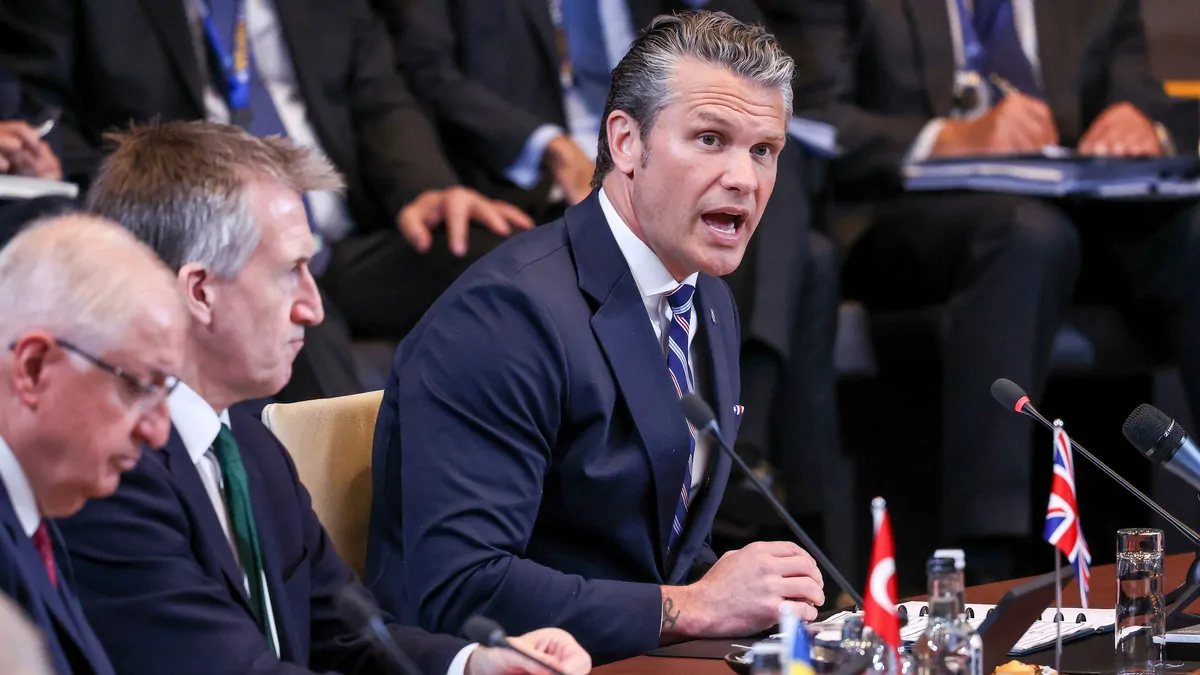
The Pentagon will conduct a six-month review of troop levels in Europe as it seeks to scale back its military footprint and shift more of the US role at NATO to European allies, Defence Secretary Pete Hegseth told his counterparts in Brussels on Thursday.
The US plan, and questions about it, are at the centre of talks at a meeting of defence ministers at NATO headquarters on Thursday, as the Trump administration seeks to curtail the forces and equipment that the United States has dedicated to protecting the continent for decades.
Along with reviewing its troop posture, the US will cut the number of fighter jets, reconnaissance drones and warships that it would activate for Europe in case of war or a crisis, two diplomats said, speaking on the condition of anonymity to share sensitive details.
Sign up to The Nightly’s newsletters.
Get the first look at the digital newspaper, curated daily stories and breaking headlines delivered to your inbox.
By continuing you agree to our Terms and Privacy Policy.
The move is set to pull back about a third of US fighter jets and some other assets that European nations would struggle to backfill, such as strategic bombers, the diplomats said. NATO officials are working out which countries can fill some of those gaps and how fast.
The reduction in US forces available to Europe in wartime takes effect immediately, NATO Secretary General Mark Rutte said Thursday, noting that it is a cut to the US contribution to NATO’s response to an attack rather than the existing US military footprint in Europe.
European officials have pledged to take more responsibility, and especially in Eastern Europe, officials still call the Western alliance a crucial bulwark against Russia as it wages war in Ukraine and incursions into NATO airspace test its resolve.
The linchpin of NATO is its collective defence clause, Article 5, which declares that an attack on one ally is an attack on all – a pledge that President Donald Trump has cast doubt on, saying repeatedly that he did not believe European allies would help the United States in a crisis.
In fact, the only time Article 5 was invoked was in response to the September 11, 2001, terrorist attack on the United States, and twisted metal from the wreckage of New York’s World Trade Centre stands outside the main entrance to NATO’s headquarters.
Even with the plans for reductions, the US has tens of thousands of troops and nuclear warheads stationed across Europe and remains deeply enmeshed in NATO’s command and control. An American also holds the role of supreme allied commander, Europe – NATO’s top uniformed military position.
Mr Hegseth said the Trump administration would be “honest” with Washington’s once closest allies about their need to take over and transform the NATO alliance that has been the cornerstone of American security policy in Europe since the end of World War II.
But the Pentagon chief also scolded the Europeans at the start of the meeting of NATO’s 32 defence ministers, arguing again that European nations have relied too heavily on US security guarantees while focusing instead, he said, on issues such as climate change.
Mr Hegseth also echoed complaints from the Trump administration and its supporters that European nations had strayed too far from their largely Christian pasts by embracing diversity initiatives and non-European refugees.
“For too long, NATO has been a paper tiger and a one-way street. No more,” Mr Hegseth told the room of defence ministers.
“Instead of tanks and fighters and air defences, the focus has been on gender equity and climate change and defence austerity,” he said. “Europe’s borders flew wide open, welfare states expanded, defence budgets cratered, along with Europe’s belief in itself and its civilization.”
Mr Hegseth lamented an era of “demilitarization.” He repeated MR Trump’s rebuke of European leaders who hesitated to endorse the war that the US and Israel unleashed against Iran, which has roiled the Middle East and upended the global economy.
“We’ve been so clear and so candid to restore NATO’s core military role and character,” Mr Hegseth said.
Such rhetoric from Mr Trump or his emissaries is hardly new. And European leaders do not deny that their nations sought to benefit from the “peace dividend” that followed the end of the Cold War, allowing their budgets to focus more on health care and education.
Mr Trump and many of his predecessors in the White House have long pressed NATO allies to step up their national military spending, and Mr Trump can claim notable success in winning commitments to do so.
“Some of our allies have gotten the message and stepped up. You know who you are, and we very much appreciate it,” Mr Hegseth said, without naming anyone.
But he said others did not, berating European countries that lag on defence spending and those that refused the US access to their bases for attacks on Iran – a war of Mr Trump’s choice that falls outside NATO’s Euro-Atlantic remit. “It was shameful,” Mr Hegseth said.
Now, Mr Hegseth added, the Pentagon will “examine America’s force posture and basing in Europe,” saying it would take up to six months. He said it would consider the input of the US Army’s European command and also consult with Congress and NATO allies.
“But make no mistake about it,” Mr Hegseth cautioned. “This will be a real review. It will be designed to ensure that NATO is moving fast and irreversibly toward Europe leading.”
He said the administration wants to encourage allies to do more, “so we’re going to keep a close eye on allies who are not doing that and who say no or maybe.” He warned that some nations would “fail” the review, without elaborating.
European capitals have expected a US military drawdown, but they have lobbied for more clarity about Washington’s plans. Mr Trump has issued confusing social media posts in recent months about planned troop withdrawals from Germany and deployments to Poland.
In the past, Mr Trump announced reductions but didn’t follow through. While the President has long voiced scepticism of NATO, his administration is now taking some of its first substantial steps toward diminishing the US footprint in Europe and within the alliance.
Mr Trump’s rebukes of NATO, along with his threats to leave the alliance and his on-and-off bid to take Greenland from NATO ally Denmark, sparked a crisis in the alliance not seen in generations.
European leaders have tried to accommodate Mr Trump, seeking to preserve those guarantees as they embark on the arduous and costly mission of building up their defences. The alliance also continues to serve as a platform for US military interests.
Several European nations such as Germany and Britain have lent their bases and airspace to the Iran war effort, even as politicians sought to distance themselves from the conflict and the US president, both unpopular on the continent. Some countries, namely Spain, strongly opposed the war, drawing Trump’s ire.
Even with a more dramatic US pullback, some European officials have argued that they would be better off strengthening their defences through NATO and taking the reins of its existing structure rather than starting over.
German Defence Minister Boris Pistorius told reporters early Thursday that he did not yet know the US plans. Mr Pistorius called for a “road map” for any military drawdown and conceded some assets would be tough to replace quickly, such as deep precision-strike capabilities.
Belgian Defence Minister Theo Francken, said there would be “heavy discussions on who’s doing what” to fill gaps left by the US in the NATO Force Model, a pool of assets allies agree to mobilize in wartime.
“We will absolutely replace US platforms … they’re withdrawing a lot of their capabilities,” Mr Francken said, adding that Belgium would provide fighter jets, reconnaissance drones and naval assets.
© 2026 , The Washington Post