On the Market
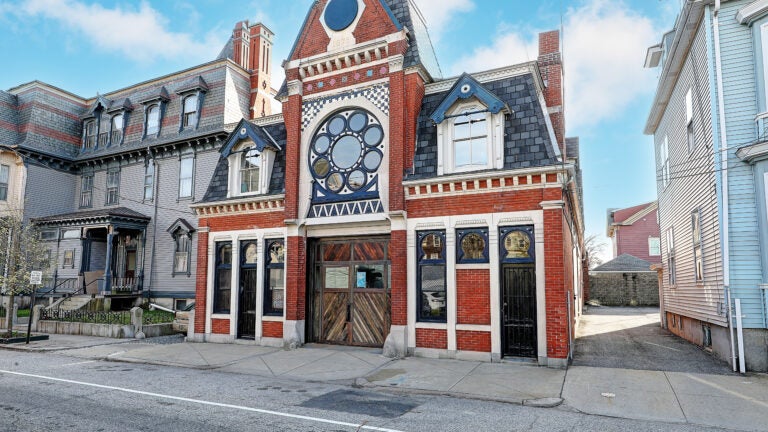
With a hayloft and a creepy back story, the Barnaby Castle Carriage House will appeal to those who want something unique.
159 Sutton St. in Providence. Christopher Whirlow
One of Providence’s most notorious properties is on the market for $2.5 million.
Jerothmul Bowers “J.B.” Barnaby was a Providence magnate who established J.B. Barnaby & Co. clothing store. His High Victorian mansion has gone down in history as one of the city’s most recognizable buildings, thanks to its intriguing architecture and haunting back story. But it’s the unique carriage house, which just hit the market, that many people find to be the most fascinating.
In April 1891, Barnaby’s wife, Josephine, was killed after drinking from a poisoned bottle of whiskey she had received in the mail while vacationing in Colorado, according to the Providence Preservation Society. After a widely publicized trial, her physician was convicted of her murder. Since then, Barnaby’s legacy has carried a unique sense of intrigue.
159 Sutton St. in Providence. – Christopher Whirlow
Tucked on the west side of Providence, the three-bedroom, five-bathroom carriage house at 159 Sutton St., which was completed in 1875, is a 6,480-square-foot brick and granite building that functioned as the stable for J.B. Barnaby’s horses. Today, the first floor, which greets you with its two large garage doors in the front, has performed a variety of functions over the years, ranging from a yoga studio to an art gallery. There are also two half-baths on the first floor and a parking garage.
The yoga studio. – Christopher WhirlowThe garage. – Christopher Whirlow
To the left is the door that leads into the former tack room, which features floor-to-ceiling mahogany walls and a high shelf with intricate carvings that feature Barnaby’s initials over the entrance door. The porcelain tile floor features an intricate and colorful mosaic pattern.
The tack room. – Christopher Whirlow
The door on the right leads up to the second-floor residence, where yellow pine floors run throughout. One of the most prominent features of the building, which was converted into a residential space in 1997, is the 10-foot rosette center window on the second floor that’s surrounded by Italian tiles. It anchors the main living area, which flows naturally into the neighboring dining space.
“It’s kind of centered on the front wall, so anywhere you stand, you can see that,” said Paula Morrison of Residential Properties Ltd., who has the listing.
The living area and rosette window. – Christopher WhirlowThe living area. – Christopher WhirlowThe living and dining area. – Christopher Whirlow
Head through double French doors to find another unique feature, the historic hay lift. Still functional, it was once used to lift carriages. Now, it’s ideal for moving furniture.
The kitchen features two spacious islands, one for cooking and the other for dining. There are stainless steel appliances, granite countertops and a breakfast bar in the far corner of the room.
The dining room and sitting area are separated by the hay lift. – Christopher WhirlowThe hay lift is in front of the kitchen. – Christopher WhirlowThe hay lift. – Christopher Whirlow
There are three bedrooms. The massive primary bedroom suite, which features cathedral ceilings and stunning exposed beams, has its own bathroom with a soaking tub and tile shower. A dressing area features a walk-in closet. Double doors open out to allow natural light to stream in and lead out to the roof.
The second floor is equipped with central air and has solar panels.
The primary bedroom. – Christopher WhirlowThe primary bathroom. – Christopher WhirlowThe dressing room. – Christopher Whirlow
Megan Johnson
Megan Johnson is a Boston-based writer and reporter whose work appears in People, Architectural Digest, The Boston Globe, and more.
Address Newsletter
Our weekly digest on buying, selling, and design, with expert advice and insider neighborhood knowledge.