

Home Improvement
The 7,588-square-foot residence built in 1810 is a designated National Historic Landmark
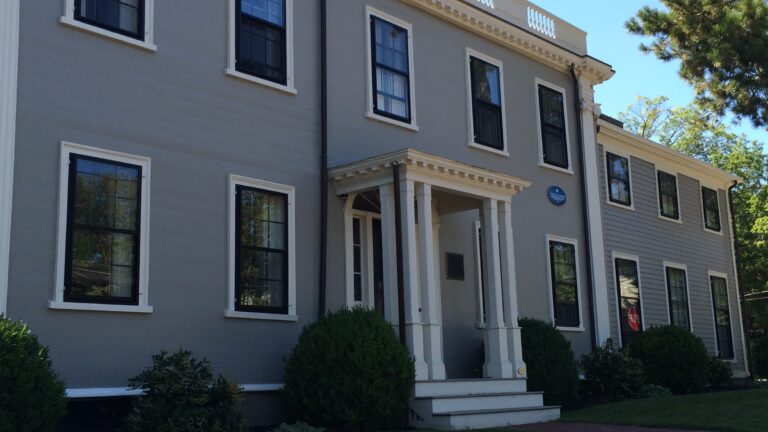
The Asa Gray House in Cambridge was built in 1810. Charlie Allen renovated the exterior by adding and restoring windows and doing work to the roof. Charlie Allen Renovations
Historic homes remind me of how lucky we are to live in a part of the country where history abounds. Not just homes, but historical factories, grist mills, and dams that all help tell the story of our country and how it was built — a fitting tribute as we approach our nation’s 250th birthday.
Many registered buildings are still open to the public; however, a great many homes are privately owned and are in a town or city historic district. While many of us can admire and enjoy the rich history these homes provide, it can be a different matter entirely to own one.
For one thing, you may pay more for a historical home. Most are in well-preserved historic districts and are thus out of reach from developers. As a result, these neighborhoods will remain unchanged and are often inhabited by like-minded neighbors who are proud of their role as caretakers. The homes tend to maintain their value in an otherwise volatile real estate market given their limited supply.
But there can be some monetary advantages as well. There could be tax breaks on the property for owning and maintaining an important part of the town’s history. If the home is on the National Register of Historic Places, there could be federal tax advantages as well. Many towns and even the state have preservation grants that could help subsidize exterior renovations. These come with strings attached as the project must follow the guidelines of the local historical commission. The grants can also put covenants on the property, dictating what can be done to the exterior and sometimes even the interior of the house in perpetuity, though historical commission approval will almost always be confined to the exterior of the building and further refined to what can be viewed from a public way.
Renovating the Asa Gray House in Cambridge
We worked on an important home in Cambridge, the 1810 Asa Gray House on Garden Street, designated a National Historic Landmark. Asa Gray was a prominent 19th century botanist and professor at Harvard. He was not the original owner. As a matter of fact, the house is not even in its original location. It was surprisingly common back then to physically move a house to another location.
This was an interesting project that involved both the renovation of an interior artist’s studio in a connected outbuilding as well as some exterior work. The studio work was confined strictly to the interior space and therefore did not need historical commission approval — with one exception. The living room had an entire wall of very old and distressed mahogany cabinets that had been used by Gray to germinate seeds for his botanical studies. The house had a covenant of some kind dictating that these cabinets could not be removed or altered; they essentially are now a permanent fixture of the house. So, while we did work in the living room, we could not touch these cabinets. That was an interesting twist that we had never seen before in a privately owned historical home.
While all the interior work was designed to the owners’ specific needs, we worked with the historical commission to make repairs and alterations to the exterior. A large part of the exterior of the project was changing or repairing original windows and adding modern storms. The new windows could be a modern, energy-efficient double pane that matched as closely to the originals as possible. Narrow muntins or panes and a black exterior. The original windows that we refurbished had to have antique or “seeded” glass that mimicked the older quality glass that was used in that period.
The storm windows were the subject of much discussion. These had to have as narrow a frame as possible to allow as much of the older windows to be visible. These were also black to match the original period color of the day. The result was a cohesive look to the façade, and the owners were thrilled.
The gutter and roof line trim also had to be repaired and/or replaced. The Asa Gray House had an added challenge: a balustrade across the roof perimeter just above the gutter. The balustrade is essentially a very short railing detail that wraps around the roof.
To repair the roof and reline the gutters with copper, we had to dissemble the balustrade, repair the roof and line the gutters, then reinstall the balustrade. But much of the balustrade was rotted so we had to have many of the components custom milled to match the original. This also worked out well as the owners had a modern leak-proof roof and a façade detail that looked like the original.
All in all, it was a great collaboration with the city, the owner, and us as general contractors to improve a home’s resistance to the elements while also preserving its place in the historical fabric of the city. All of it took time, and none of it came cheap, unfortunately. Detailed, often custom-built parts and pieces can add up quickly. The exterior portion on this house cost over $100,000. Most extensive work done to the exterior of a house like the Asa Gray House will be in the six figures.
If you are embarking on a project in a period historic home, here are some of the vendors we used:
JP Moriarty, Somerville: Custom milled period home fittings. Not only can they produce the parts you need, but they are also a tremendous resource for old house architecture.
Longleaf Lumber, Cambridge: Reclaimed wood for flooring or timbers. Like JP Moriarty, they are a wealth of information that should help achieve your design goals.
Restoration Resources, Boston: Vintage interior house parts can be a challenge, but we have one of those, too, right here in the Boston area. You can find vintage doors, windows, fireplace mantels, window and door hardware, and almost anything else that may have adorned an old New England property. It’s fun just to browse, even if you aren’t looking for anything in particular.
Mark Philben is the project development manager at Charlie Allen Renovations in Cambridge. Send your questions to [email protected]. Questions are subject to editing. Subscribe to the Globe’s free real estate newsletter — our weekly digest on buying, selling, and design — at Boston.com/address-newsletter.
Address Newsletter
Our weekly digest on buying, selling, and design, with expert advice and insider neighborhood knowledge.
