World Cup
After decades of hosting high-profile international soccer games, the region finally got to see the agony of penalty kicks, and the joy of an upset victory.
Matías Galarza celebrates after calmly hitting his penalty kick in the shootout to help Paraguay upset Germany in the World Cup Round of 32. Hussein Hammouda/Boston.com
June 30, 2026 | 8:39 AM
5 minutes to read
FOXBOROUGH — After guiding Paraguay to the greatest World Cup win in the South American nation’s history, head coach Gustavo Alfaro probably said more words in his nearly 50-minute postgame press conference than Bill Belichick uttered in that same room in 20 years.
Alfaro, the 63-year-old Argentine who took over coaching the Paraguayan national team in 2024 (against the advice of his friends, he freely admitted), was clearly in a gregarious mood. Yet “The Professor” was not, he insisted, getting ahead of himself, reiterating the “humble and patient” approach he’s instilled in his team.
Paraguay battled long odds and even longer spells during Monday’s Round of 32 World Cup matchup with Germany in which they did not have the ball. They survived nervy moments defending what felt like irresistible German set piece pressure, and later overcame a blown two-shot lead in a penalty kick shootout.
That doesn’t even take into account that Paraguay lost its opening game in this tournament 4-1 against the co-host U.S., an unmitigated disaster that appeared to have ended their run before it even began.
And yet, Alfaro’s team has endured.
“We can have thousands of defects, but we have a heart that never gives up,” he said at one point, casually dropping one of his many pearls of wisdom through the marathon postgame press conference that felt more like an inspirational speech.
It was heart that got them to extra time in the first place, resisting an escalating wave of German attacks in the latter stages of the second half.
It was sheer nerve that won them the match.
“The reality is that we build together, beyond the fact that we may have differences of opinion, which is valid, because I am a person who greatly values differences of opinion. I am very stubborn,” Alfaro acknowledged. “I argue until they prove me wrong. And if I’m wrong, I change my mind.
“I don’t die with my [opinion], I live with mine, and to live is to change, because when you die, they put you six feet under with the dirt. I want to live,” Alfaro explained. His team lives on in this World Cup, advancing to the Round of 16 (where they will face the winner of Sweden-France).
Almost instantly after the final whistle, Paraguayan president Santiago Pena posted an all-caps update to his nation: “PARAGUAY NEVER GIVES UP! IT’S A HOLIDAY, DAMMIT!”
¡PARAGUAY NUNCA SE RINDE! ¡¡FERIADO CARAJO!! 🇵🇾
— Santiago Peña (@SantiPenap) June 29, 2026
“It’s really difficult to get a national holiday, so I say the power of football is wonderful,” Alfaro said. “That’s why people should enjoy it, all of Paraguay should enjoy it.”
Exactly how much Alfaro and his team knew about Foxborough prior to playing on Monday is unknown, but what’s beyond doubt is that a previously random spot on the map to most Paraguayans will now be viewed by its soccer fans as hallowed ground.
“For me, without a doubt, it was the greatest victory of my coaching career,” Alfaro said. “That’s what I told the players: Thank you, thank you for giving me an unforgettable day. I stood there for a moment staring and contemplating the field of this stadium because my eyes and senses weren’t enough to fill me with this space, this atmosphere, this feeling, and this absolute demonstration of love that the players gave for the national team.
“I hope we have others,” he added.
Having experienced the Tartan Army takeover, stale England, and electrifying France in the World Cup so far, Paraguay and Germany provided the “Boston Stadium” (Gillette Stadium) crowd with the thing they most wanted to see: genuine heart-wrenching drama.
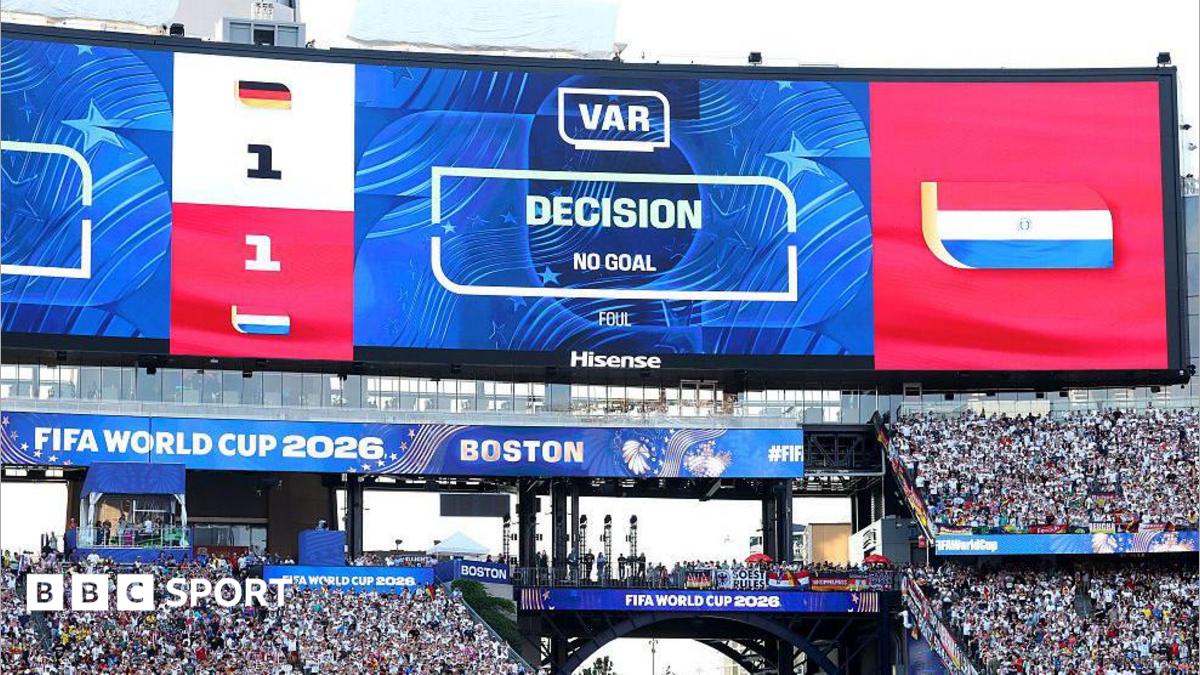
While it didn’t look like it in a fairly mundane first half (and a perfectly average second half), the game was destined for high-stakes tension in extra time after the score was tied 1-1 at the end of 90 minutes.
And after a would-be winner from German center-back Jonathan Tah was disallowed in the first period of extra time because of a controversial video assistant referee (VAR) decision, destiny seemed to point the way to that devastating separator of ties: penalty kicks.
So often the author of upsets, a penalty kick shootout became the setting for one last twist: After Germany quickly fell behind in the shootout following saves from Orlando Gill on Kai Havertz and Nick Woltemade, 40-year-old legendary German goalkeeper Manuel Neuer — having come out of international retirement for this tournament — reached back one last time to bring his team level.
Yet after Paraguay’s Antonio Sanabria missed the goal entirely and Neuer extended every inch of his 6-foot-4 frame to make a fingertip save on Fabián Balbuena, the Germans did what German teams never do, and squandered their golden opportunity.
Tah, having had his goal disallowed, completed a sour day by skying his penalty kick over the goal on an upward trajectory somewhere in the vague direction of Wrentham. It was the third German penalty miss of the day. Prior to Monday, Germany had only missed one penalty in a shootout in its World Cup history.
Every missed/saved Germany penalty in World Cup history:
1982 Semifinals – Uli Stielike
2026 R. of 32 – Kai Havertz
2026 R. of 32 – Nick Woltemade
2026 R. of 32 – Jonathan Tah
Unprecedented for the Germans 😮 pic.twitter.com/MNX1e7NSpf
— ESPN FC (@ESPNFC) June 29, 2026
Alfaro understood that his team could only take a circuitous route to such an upset.
“The thing is, it’s our nature,” he said of the up-and-down drama. “If we don’t suffer, it’s useless.”
And at the end of a monumental effort, having fought and indeed suffered mightily — mostly without the ball — for a majority of the 120 minutes, the Paraguayans finally had a chance to achieve victory. With perfect technique (and ice water in his veins), center-back José Canale calmly wrong-footed Neuer and dispatched his penalty into the open net to clinch one of the finest hours of Paraguayan sports.
Foxborough has been searching for a moment like this since it first hosted World Cup games. Even going back to 1994 — when Italy beat Nigeria in extra time, the only other local World Cup game to require it — there wasn’t this level of drama. Finally, thanks to Paraguay and Germany, the promise of such a moment was delivered.
The stakes were part of it. On one side stood Germany, four-time champions, a historical powerhouse in the sport. On the other side, Paraguay, with one knockout round win in its World Cup history.
Alfaro obviously recognized this, summarizing it in his inimitable way.
“With all due respect, [the Germans] are trained in top-level academies in Europe. We have come from the red earth,” Alfaro said. “The jersey we wear has the stripes of red soil, playing barefoot on that land with the sacrifices of the parents to try to get the kids to train.
“If we’re all parents, who wouldn’t want their kids to fulfill a dream?”
Having walked the long way from the red soil to the (temporary) grass of “Boston Stadium,” Alfaro’s team wrote their names — and, by extension, Foxborough — onto a famous page in World Cup history.
“Twenty six players went on the pitch,” he said, “and when they left, they were legends.”
Hayden Bird
Hayden Bird is a sports staff writer for Boston.com, where he has worked since 2016. He covers all things sports in New England.
⚽ Get the latest World Cup news
Receive updates on the 2026 FIFA World Cup