Local News
The decision follows months of advocacy from residents who raised concerns about privacy, surveillance, and data sharing.
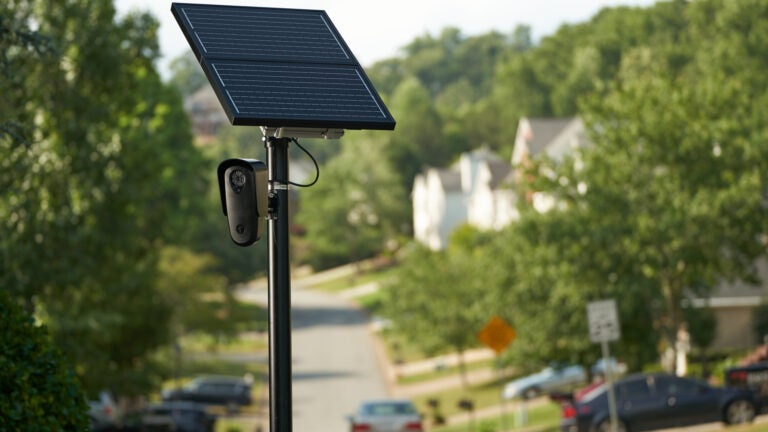
A Flock Safety license plate camera. Flock Safety
The Framingham Police Department has decided not to renew its contract with Flock Safety, ending the city’s use of the company’s automated license plate reader camera system after months of public debate and resident advocacy.
The city’s access to the Flock system will be shut off June 30, when the current contract expires, and the cameras will be decommissioned, Framingham Police Department Administrative Lt. Rachel Mickens said in a statement to Boston.com Wednesday.
“We will continue to balance technology and public safety needs with transparency, accountability, and the privacy concerns of the community,” Mickens wrote.
The decision marks a significant victory for residents who spent months urging city officials to abandon the surveillance technology, arguing that it threatens privacy and civil liberties while lacking sufficient oversight, according to Kate Merritt-O’Toole, a member of Framingham Fights Back. The group is a community organization that describes itself as a place for Framingham residents to “organize and mobilize to protect democracy and our neighbors.”
“We’ll take our wins where we can get them,” she said. “We’re happy that we’re going to have some more time to educate [officials] on how the technology is evolving and what a lot of these vendors are planning to do with this data.”
Framingham Fights Back received confirmation Monday evening that the contract would not be renewed, Samantha McGarry, another member of the group, told Boston.com.
Mickens said Flock will coordinate with the city to schedule the removal of the cameras.
In a Flock Safety “Security Claims & Facts” sheet, the company says the system is “relentlessly focused on data integrity and security,” utilizes strict encryption, and prevents access by foreign entities. Critics, however, argue the system enables mass surveillance by collecting and storing information about residents’ movements.
“There is no evidence of inappropriate access or sharing of data,” Mayor Charlie Sisitsky said in an initial statement to Boston.com, adding that his administration and the police department remain “committed to ensuring any public safety technology is utilized in a manner that is transparent and accountable.”
A spokesperson for the mayor later sent a revised statement that read, in full: “Framingham Police Department’s contract with Flock Safety will not be renewed at this time.”
“We are also committed to addressing concerns raised by community members and elected officials,” Sisitsky added. “Any future decision regarding the Flock Safety program will be made following additional discussions with the Police Chief and City Solicitor.”
Framingham is the latest Massachusetts community to move away from Flock’s technology. Cambridge, Watertown, and neighboring Natick have also ended contracts with the company, citing concerns over data sharing and oversight.
“I personally support the ending of the Flock contract and having them on our streets,” Framingham City Council Chair George King wrote in a statement to Boston.com. “However, people need to remember they are everywhere. Stores like Home Depot and Lowe’s have them in their parking lots, so they are coming off our streets but not disappearing by any means.”
Flock Safety did not respond to requests for comment.
Framingham residents spent months advocating against Flock cameras
Since February, Framingham residents have urged city officials not to renew the contract. Residents raised those concerns through public meetings, letters to city officials, and testimony before the city council, Merritt-O’Toole said.
“At three to four meetings that I’ve attended, there hasn’t been one single Framingham resident that stood up in favor of using automatic license plate readers,” she said.
Advocates began organizing after sharing concerns not only about the cameras themselves, but also about how data collected by the system could be shared and used, Merritt-O’Toole said.
“They’re such an egregious violation of our First and Fourth Amendment rights,” she said. The Fourth Amendment protects against “unreasonable searches and seizures.”
She also pointed to concerns about Flock’s participation in data-sharing networks that can be accessed by federal immigration authorities and other agencies. While Flock Safety states on its website that it does not collaborate with ICE, various advocates maintain the system has been used to target individuals.
“There’s so many loopholes around that,” said Merritt-O’Toole. “This data, who knows where it’s going, and more importantly, how is that data being entered into other systems of databases, such as publicly available information.”
Following an April 27 public meeting on the surveillance system, residents sent a letter warning that the city was asking the public to accept “sweeping ‘dragnet’ surveillance system based primarily on trust” with insufficient safeguards and oversight.
“This is not simply a question of whether police use Flock or similar ALPR technologies with good intentions,” the letter stated, referring to automatic license plate readers. “It is a question of whether Framingham should permit the mass collection and storage of residents’ movements — and whether any system with this level of surveillance power can exist without strong, independent oversight.”
Merritt-O’Toole said advocates initially struggled to obtain updates from city officials and received no response to their first letter.
On June 15, city officials released a “Transparency & Accountability” document outlining steps they said had been taken in response to public concerns.
Officials said the city solicitor’s office was reviewing contract language and that the police department had already limited information sharing through the Flock system to Massachusetts law enforcement agencies only, with out-of-state law enforcement requiring case-by-case approval.
For Merritt-O’Toole, this week’s contract decision demonstrates the impact residents can have when they remain engaged.
“This sends a very good message that if you take the time and organize and have multiple people involved … follow the rules of engagement, showing up at city council meetings, writing letters, whatever — if you’re persistent about it, for the most part, they will listen,” she said.
After Framingham cancels Flock contract, what comes next?
Even with the contract set to expire June 30, advocates say their campaign is far from over.
They want assurances that the cameras will be removed promptly, that data collection will cease, and that the city will not replace Flock with a similar surveillance system, Merritt-O’Toole said.
“There’s little faith that Flock will stop its data capture,” McGarry said in a statement.
In a letter sent Tuesday to city councilors, McGarry thanked city officials for listening to residents’ concerns while reiterating opposition to automated license plate reader technology.
“We appreciate the dialogue, but we want to be unambiguous about where we stand as this process continues,” she wrote. “We do not want or need AI mass surveillance disguised as public safety, especially when there is no empirical data to prove its impact.”
Meanwhile, city officials are preparing to debate a proposed “Trust in Local Law Enforcement” ordinance that would establish rules governing the use and oversight of automated license plate reader technology in Framingham, according to John Stefanini, chair of the Rules Subcommittee. The ordinance will be discussed at a June 30 meeting.
“We have been cataloging and reviewing community concerns to protect civil rights, while better understanding the important needs for our police department that use this as a local law enforcement tool to protect and serve our local community. It is a tough balancing act,” Stefanini said in a statement to Boston.com.
“Going forward, we will not allow the use of public resources to collect license plate data unless we have complete control and use of the data exclusively for local law enforcement purposes,” Stefanini added.
Merritt-O’Toole said she views the ordinance as a sign that city officials have not abandoned the idea of using license plate reader technology altogether.
“What the city’s doing is they’re trying to position themselves to have proper documentation in place so that if they were to enter into another agreement with another automatic license plate reader company, that they have all their i’s dotted,” she said.
FC Ordinance to Enhance Trust in Law Enforcement 2026-010-02B by samantha.genzer
This story has been edited to include an updated statement from Sisitsky.
Sign up for the Today newsletter
Get everything you need to know to start your day, delivered right to your inbox every morning.