

Local News
As we sit between the heat of summer and the cold of winter, no matter what you call it, we’re likely not done with summer just yet.
Two minutes and 49 seconds. That’s how much daylight we’re losing each day as we approach the autumnal equinox on Sept. 22.
By some definitions, though, we are still experiencing summer, because the word “summer” doesn’t necessarily mean a fixed state. For meteorologists, summer is June, July, and August, and that’s how we get our data on precipitation, humidity, and temperature. Astronomically, we’ve still got less than a week until we get to the equinox. At that point, we are officially in astronomical autumn, the season between astronomical summer and astronomical winter.
For you and your family, summer might end before Labor Day when the kids go back to school, or it might linger longer, maybe until early October.
Temperature runs on a different clock. Bodies of water like the ocean and lakes hold onto heat longer than the air. This is one of the reasons why, this time of year, if you go swimming, the water still feels relatively warm, maybe very similar to what it felt like even just a couple of weeks ago. Even the planet itself holds onto heat longer than the sun would dictate. This is called seasonal lag, and even though we are well past the maximum amount of solar radiation, which occurred back in June, we can still have bouts of heat and humidity. Even October has produced 90-degree heat: The years 1963, 1954, and 1881 all recorded a high temperature of 90 degrees during October.
Two years ago, Boston reached 82 degrees in November!
If you look at temperatures over the course of the year, you would likely see temperatures generally increasing through late July or early August and then starting to fall back. But there would still be spikes even in the downturn. Some of these bursts of warm weather come after an early autumn chill.
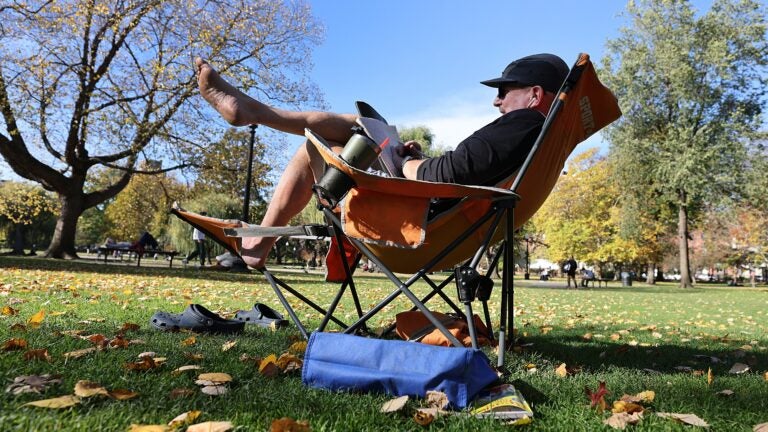
Different tribal nations had their names for what’s sometimes called “second summer,” that burst of warm fall weather that can occur. For example, the Abenaki called it Man’s Summer, or Nibubalnoba. You might also hear other names, things like “another summer,” “lateness warmth,” or “person’s summer.” Today most meteorologists use the term “second summer,” which describes the same thing without the linguistic baggage.
Sometimes the second summer doesn’t come until after a hard frost, and that’s something we might not see until mid-October or even November. In that case, I prefer to think of second summer as a stretch of warm weather usually occurring after the equinox.
What the weather outlooks say
First, we’ll see a little warmup this week, especially on Thursday when it will feel muggy, but then temperatures dip again.
One thing worth noting is that the long-range outlooks — both the 8- to 14-day and the 30-day forecasts — keep the chances of significantly above-average warmth in the middle of the country rather than here in the Northeast. This may mean that, although we can see some warm weather heading into October, a super warm second half of September and start of October is less likely.
El Niño is now within reach of a super strong event and continues to strengthen at a pace not seen to this point in the season. Because of El Niño, our autumn may be particularly warm. You might not call the mild air likely to linger through autumn “summer,” but it’s more likely than not to be a warmer-than-average fall.
Daylight, and the decrease of it, is one of the most predictable aspects of autumn. But as we sit between the heat of summer and the cold of winter, no matter what you call it, we’re likely not done with summer just yet.
