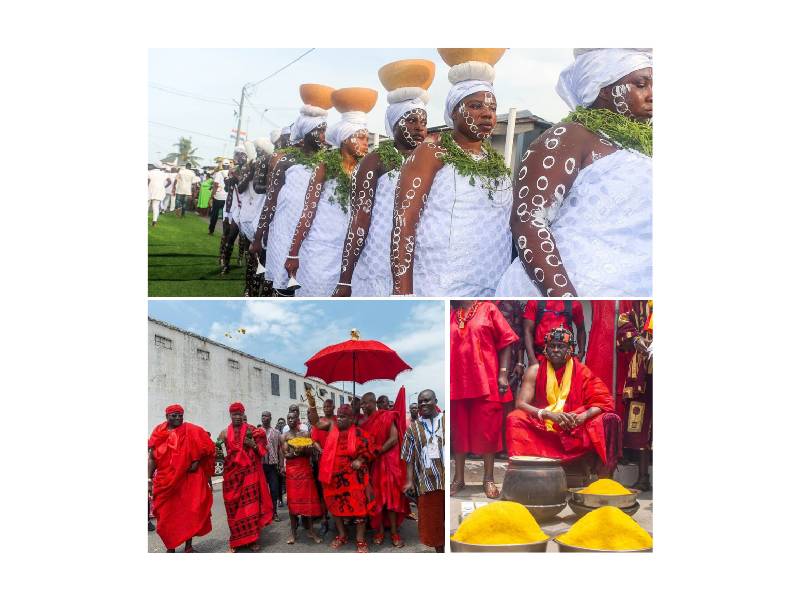
Collage Courtesy of FunTimes Magazine
There is a city where, once a year, drumming stops, loud music is banned, and the community slows down, not in mourning, but in preparation. And then, weeks later, things return to normal as people celebrate the new Ga year. That city is Accra, Ghana. And that festival is Homowo.
The Homowo festival is a vibrant and significant cultural celebration observed by the Ga people of Accra, the capital city of Ghana. It is a time of immense joy, gratitude, and reflection, where the community comes together to honor their rich heritage, commemorate their migration, and give thanks for a bountiful harvest.
The word “Homowo” translates to “hooting at hunger” in the Ga language, reflecting the festival’s core theme of overcoming scarcity and celebrating abundance. The origins of Homowo can be traced to the Ga people’s migration from Notsie, present-day Togo. It serves as a reminder of their ancestral roots and the challenges they overcame throughout history.
The festival commemorates a time of famine endured during the Ga people’s migration and early settlement along the coast of what is now Greater Accra, but it was eventually followed by a bountiful harvest, and the community ate, laughed and mocked the famine that had tried to break them.
The festival takes place in August and September, with the main event on the first Saturday of August. The dates may vary each year as the festival is determined by the Ga Mantse (the King of the Ga people) and the traditional priest.
This year, the 2026 ban on drumming and noise‑making ran from May 4 to June 4, 2026, as announced by the Ga Traditional Council. This formed part of the traditional purification period leading into Homowo. The Council emphasized that the ban was a legally recognized customary practice under Ghana’s 1992 Constitution and is meant to promote peace, solemnity, and spiritual reflection across the Ga state.
On the annual ban on drumming and noise‑making, Nii Ayikoi Otoo, President of the Ga‑Dangme Council, explained:
“This ban is a sacred tradition observed to maintain peace, solemnity, and spiritual reflection as the Ga people prepare for Homowo, a festival that commemorates resilience, unity, and thanksgiving for a bountiful harvest.”
One of the essential rituals of the Homowo festival is the preparation and consumption of a particular dish called “Kpokpoi.” Kpokpoi is made from maize, palm nut soup, and other ingredients, symbolizing the essence of the festival.
Source: Google Africa
The dish is believed to bring prosperity, good health, and abundance to the community. Families and friends come together during the festival to cook and share Kpokpoi, fostering unity and a sense of togetherness.
The Homowo festival includes vibrant cultural performances, traditional music, dance, and storytelling. The beating of drums, rhythmic chants, and colorful attire create a lively and festive atmosphere. Traditional dances such as Kpanlogo, Adowa, and Agbadza are performed enthusiastically, showcasing the Ga people’s rich cultural heritage and artistic expression.
A significant aspect of Homowo is the cleansing ritual that takes place throughout the community. This involves sprinkling traditional foods like maize and palm nut soup on the streets and corners of the town.
The cleansing serves as a symbolic gesture to ward off evil spirits, misfortune, or bad luck, ensuring the well-being and prosperity of the community.
The Homowo festival provides an opportunity for the Ga people to express their gratitude for the blessings of the harvest and their cultural identity. It is a time of reflection on the community’s history, resilience, and unity. The festival also serves as a platform to promote tourism, attracting visitors from across Ghana and around the world to witness and participate in vibrant celebrations.
Beyond Accra, Homowo has continued to gain traction among Ghanaians abroad, especially in the UK, U.S., Canada, and across Europe. It has followed the Ga diaspora to every city they have settled in.
In Toronto, the Ga Adangbe Association (GADAT) has been hosting Homowo celebrations for years, complete with the full sacred rituals and customs, although in an adapted form. The festivities comprise a sunny picnic, Homowo at The Park, and a lively Homowo Dinner & Dance gala, both filled with music, food, and heartfelt reunion.
Source: Instagram / newinghanatourism
In the United Kingdom, the Grand Homowo UK Festival, organised by GaDangme UK & Ireland in partnership with the Ga Traditional Council, brings the full Homowo experience to British shores for Ga people who cannot travel to Ghana for the main event. The festival is hosted with the blessing of the Ga Mantse himself and features traditional rituals, music, food, and community gathering.
Across the US, it is celebrated in various communities, including Portland, Oregon.
This year, the Ga Homowo Carnival will be held from August 6 to August 9, 2026, in the Ga Mashie enclave of James Town and Bukom. The 2026 edition marks a historic milestone, commemorating 200 years of the Ga victory in the Battle of Katamanso.
The festival’s evolution blends tradition with modern community life, supporting the well‑being of young people. A good example of this intersection is the annual Ga Homowo Health Walk. Organized by the Ga Traditional Council in partnership with the Okintin Klan and corporate sponsors like Bills Microfinance, the August 2026 walk is projected to draw over 5,000 participants through the principal streets of Jamestown.
Speaking on the broader, long-term impact of these festive initiatives, Nuumo Nikoi Amasah II, Klan Wulomo of the Okintin Klan, noted:
“This walk is more than tradition. It is about health, unity, and setting an example for the next generation. I encourage every Ghanaian to join us.”
As the Homowo festival continues to evolve, efforts are made to preserve its traditions while embracing modern influences. Contemporary elements, such as cultural exhibitions, fashion shows, and art displays, are incorporated to showcase the Ga people’s creativity and adaptability.
It also promotes understanding, unity, and respect for Ghana’s diverse cultural heritage. Through this festival, the Ga people pass down their traditions and values to future generations, ensuring the preservation and continuation of their rich cultural legacy.
The Homowo festival is not only a time for celebration but also a reminder of the resilience and strength of the Ga people. It is an opportunity for them to connect with their cultural heritage, reinforce community bonds, and express gratitude for the blessings of the harvest season.
Minna Davies is a creative writer and a thespian with a degree in theatre arts from the University of Lagos. He has been privileged to have some of his works featured on Nigeria’s big stages. It is important to dream, but if no one gets to see it, it is as good as dead.