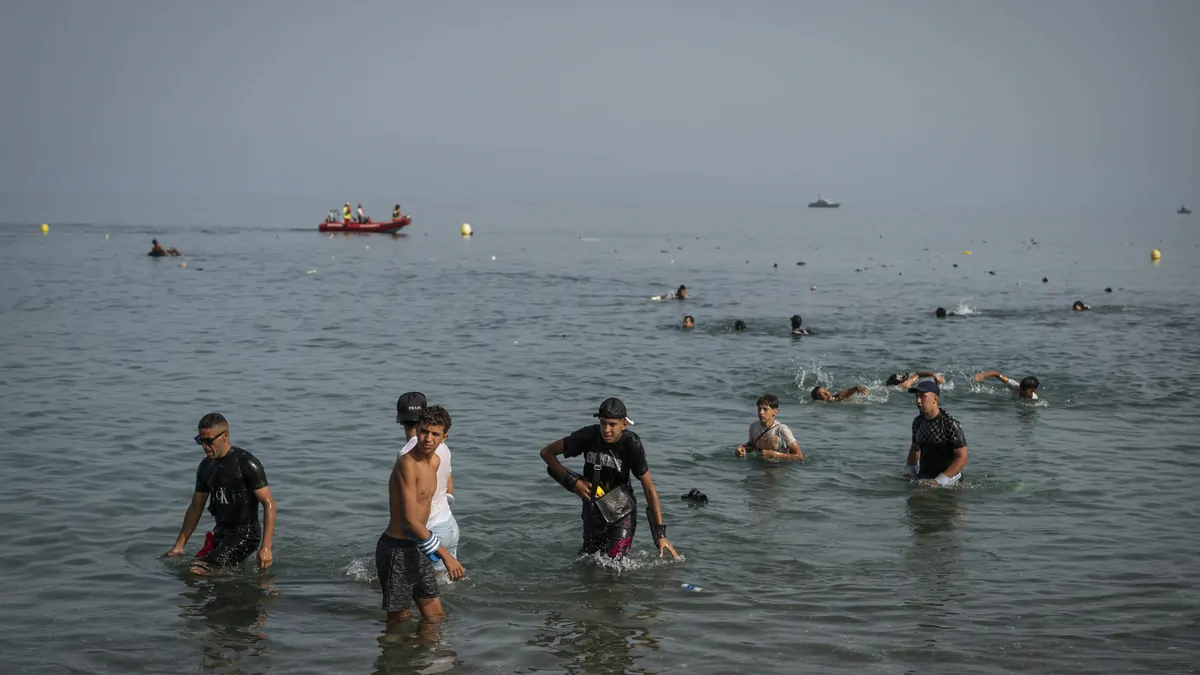
When more than 70,000 migrants rushed into a Spanish exclave on the North African coast, the crisis followed a familiar pattern: desperate people being used for political purposes.
It is not yet clear how so many people spontaneously breached the border late last month and crossed into Ceuta, a tiny Spanish territory surrounded by Morocco and the sea, and the crisis may not be over.
Mysterious social media posts are urging another push on August 15.
Sign up to The Nightly’s newsletters.
Get the first look at the digital newspaper, curated daily stories and breaking headlines delivered to your inbox.
By continuing you agree to our Terms and Privacy Policy.
The unusually high number of people crossing on a single day raised suspicions that the incident was orchestrated. Some politicians in Spain have pointed a finger at Morocco and at Israel. Spanish Prime Minister Pedro Sánchez is a fierce critic of Israel’s war in Gaza.
They say that even if the rush on Ceuta was an organic movement sparked by social media – as some have suggested – the Moroccan government may have calculated that it suited its purposes to allow the incident to unfold.
“It seems as though there is an open door and that anyone wanting to put pressure on us can use migration as a geopolitical weapon,” Belgian Prime Minister Bart De Wever, a conservative, said last week after the Ceuta influx. “It is clear that Europe must close its borders.”
After a diplomatic spat with Spain in 2021, Morocco eased border controls, allowing about 8,000 people into Ceuta. Spain and Morocco have insisted that the latest incident was not a rerun. They blamed disinformation, and human traffickers capitalising on a recent Spanish Supreme Court ruling that makes it harder to expel migrants arriving by sea.
The political fallout of the recent rush on Ceuta is escalating.
A dispute between Spain, governed by a progressive coalition, and conservative-led Italy has sharpened after Rome imposed border controls on flights and ferries from Spain after the Ceuta breach. The countries are part of Europe’s passport-free travel zone. But Spain has now imposed the same restrictions on Italy, disrupting the flow of people, a cornerstone of the EU’s single market.
“Italy does not accept ultimatums or impositions from abroad about national security and border control,” Italian Prime Minister Giorgia Meloni’s office said in a statement after Spain’s move.
There have been other recent cases in which countries have used migrants for their own purposes.
In 2021, Belarus, an ally of Russia, funnelled asylum seekers into Europe by granting tourist visas en masse, then pointing the migrants to Lithuania, Latvia and Poland, in what the EU labelled state-sponsored hybrid warfare.
That same year, Nicaraguan strongman Daniel Ortega, moving to pressure Washington, granted visa-free travel to migrants from Cuba and other countries seeking entry into the United States. Cuba is now citing the risk of a new surge in migration as one reason the Trump administration should ease its intense pressure on Havana.
In 2015, Turkish President Recep Tayyip Erdogan threatened to put Syrian refugees fleeing civil war “on buses” so they could flood Europe if the EU didn’t provide financial aid.
The recent Ceuta crisis is driving a wedge between Spain and other EU countries; on August 1, 22 European leaders, led by Italian PM Meloni and Danish Prime Minister Mette Frederiksen, issued a joint letter rebuking Spain.
The letter denounced “policies that can serve as pull factors, such as the regularisation of very large number of irregular migrants” – a reference to Spain’s decision this year to grant legal status to hundreds of thousands of undocumented migrants.
A Spanish soldier guards migrants going back to Morocco after crossing the border between Spain and Morocco on July 31, 2026 in Ceuta, Spain. Credit: Adri Salido/Getty Images
That policy makes Sánchez a leading European foil to President Donald Trump’s tough approach on migration and an outlier among Western leaders, who have shifted toward stricter controls.
Spanish officials called the criticism political opportunism, saying there was no evidence that the legalisation policy, which cannot be applied to new arrivals, played a role in the Ceuta border emergency.
Still, Spanish authorities raced to build a 1,640-foot floating barrier to deter further incursions into Ceuta, while also stressing Spain’s success in cutting irregular migration. In the current climate, no one wants to be seen as soft on illegal migration, not even Sánchez.
The continental panic over Ceuta illustrated the extent to which migration has become an explosive issue in Europe as well as in the United States, where Trump and his aides quickly seized on the incident to bash Spain.
Some officials and analysts warn that the Ceuta case has shown EU adversaries how migration flows can stoke division in the bloc.
Spanish authorities, in a six-page report that did not name any alleged hostile actor, have warned of new calls on social media in Morocco for another rush on Ceuta on August 15, according to RTVE, Spain’s state-owned broadcaster.
Migration experts have voiced scepticism that traffickers were responsible for the rush on Ceuta, questioning how they could have monetised a situation in which many people swam onto the beach or walked across the border.
“I don’t see the business model,” said Anna Terrón Cusí, a former Spanish secretary of state for migration. “Why would a criminal gang do something from which they will not get any earnings?”
Dozens of people were killed, with many bodies found in the water. Many more are missing, and Moroccan families have posted alerts on social media in search of loved ones.
In interviews with The Washington Post in Ceuta, several migrants said Moroccan authorities allowed them to pass unhindered. Ibtissam Sarji, 34, a baker and waitress who joined the rush, said Moroccan guards told her they would stop her if she tried to cross by land, but not if she swam.
“‘Don’t enter by land, go through the sea,’ that’s what they shouted at us,” Sarji said.
A former senior Spanish security official familiar with the investigation into the Ceuta crisis said authorities were probing Morocco’s role despite officially defending Rabat.
“This was a demonstration of power,” the official said, speaking on the condition of anonymity to describe internal discussions. “It was a form of hybrid strategy.”
“Ever since Morocco became an independent state, it has sought to recover Ceuta and Melilla,” the official said, referring to another Spanish exclave. “It considers both cities to be Moroccan territory and has consistently tried to pressure Spain into giving them up.”
A recent visit by Sánchez to Algeria, Morocco’s adversarial neighbour, fuelled speculation about whether other diplomatic tensions were a factor.
Most of the nearly two dozen migrants interviewed said they were spurred on by social media posts. They poured in on July 30, a national holiday in Morocco, believing there would be fewer border guards.
Several said they believed that changes in Spanish law would make it harder for the Madrid government to send them back, a possible reference to the court decision. None referenced Spain’s legaliastion plan for undocumented migrants already living and working in the country, which would not have applied to these new migrants anyway.
Most were sent back rapidly to Morocco, and EU officials stressed that virtually nobody entered mainland Spain or the rest of Europe. Ceuta is outside Europe’s visa-free travel zone, and reaching European soil requires document checks and an hour-long ferry ride across the Strait of Gibraltar.
The crisis, however, became a rallying cry for anti-migrant parties across Europe as well as the White House. It fed into a far-right narrative that mostly male, non-White asylum seekers are storming Europe’s borders.
Nicola Procaccini, an Italian member of the European Parliament who is a close Meloni ally, pushed back against the notion that the right was “piling on” while Spain suffered a security crisis. Procaccini insisted that Spain’s legalisation plan was a “huge mistake.”
“It’s obviously a message to the rest of Africa … you can have the legal status (in Spain and then spread around Europe as you want,” he said. “We should be doing exactly the opposite.”)
Magnus Brunner, the European commissioner for internal affairs and migration, said the EU did not see a link between Ceuta and Spain’s move to regularise migrants already in the country, who largely hailed from Latin America. Still, he said Spain’s policy was sending the wrong signal.
The EU is adopting some of the same tactics as Trump to deter asylum seekers, as Europe’s embattled centrists contend with far-right parties gaining ground using the migration issue.
In recent days, the EU has dialled back some of its criticism of Madrid, seeking to limit public discord. EU interior ministers at a meeting last week expressed solidarity with Spain.
Migration is not the only issue on which Sánchez stands out from his counterparts. He has irked some NATO allies for refusing to bring national defence spending up to the level requested by the Trump administration.
But the Spanish leader has also warned for months that Europe, in its rush to bolster its eastern border against Russia, is neglecting security risks on its southern frontiers, including from migration.
Spanish and EU officials have avoided publicly blaming Morocco, which they see as a partner on border control.
In the crosshairs are people like Younes Murad, 28, a chef from Morocco who said he swam for six hours to reach Ceuta. “Our families are poor,” he said. “I have a college degree and no job.”
Murad said he had tried to reach Ceuta for about a month. It finally worked that last week of July, when the border seemed open. By that weekend, as the Ceuta crisis unfolded, he was being sent back to Morocco.