When you get a chance, such as after getting to the end of this review, go and seek out a series of online videos called Sorkinisms.
You’ve probably seen them before, they’ve been around for more than a decade but they never get old.
These supercuts of Aaron Sorkin’s work by Kevin T. Porter highlight the screenwriter’s penchant for certain lines of dialogue (“Don’t talk to me like I’m other people!”), repeated dramatic flourishes and just an overall vibe of earnestness.
Sign up to The Nightly’s newsletters.
Get the first look at the digital newspaper, curated daily stories and breaking headlines delivered to your inbox.
By continuing you agree to our Terms and Privacy Policy.
You can always recognise Sorkin’s work not just because of the rhythms of his words but from a moral certainty that runs through it. He is an optimist, he believes in a better America, a better world and the better angels of human nature.
So he writes to that belief. He writes about the voracious greed of Facebook and the ethical vacuum that is Mark Zuckerberg because Sorkin seems to believe that we deserve better.
That is the foundation of The Social Reckoning, an indictment of the social media giant in driving division and disinformation to serve corporate profits, yes, but, more significantly, as a war cry for action and change.
The Social Reckoning is a follow-up to his screenplay for the superb The Social Network, except this time, Sorkin is also in the director’s chair.
The Social Reckoning is a follow-up to 2010 film The Social Network. Credit: Sony Pictures Releasing
He’s not as polished or as accomplished as David Fincher, who directed the predecessor, but this is a solid, engaging film that holds your attention. Although Sorkin can’t help but heap on the cheese.
It also has a raft of good performances, particularly from Mikey Madison as Frances Haugen, a socially awkward Facebook data engineer turned whistleblower, and the heart of The Social Reckoning.
The film is based on The Facebook Files, a series of articles by Wall Street Journal reporter Jeff Horwitz, who, with Haugen, exposed Facebook as knowingly amplifying extreme, dangerous and hateful content for the sake of increasing engagement.
This included internal studies which showed shocking statistics for instances of increased body image issues in teenagers on Instagram, Facebook algorithms which recommended to users extremist groups, and knowledge of drug and human traffickers on the platform.
Haugen at the time was working for the company’s now disbanded Civil Integrity Unit, which had been charged with making the social media network safer for its users without needing to worship at the altar of engagement growth.
The Social Reckoning is a dramatisation of Haugen and Horwitz’s (Jeremy Allen White) working relationship, and how they built the WSJ expose.
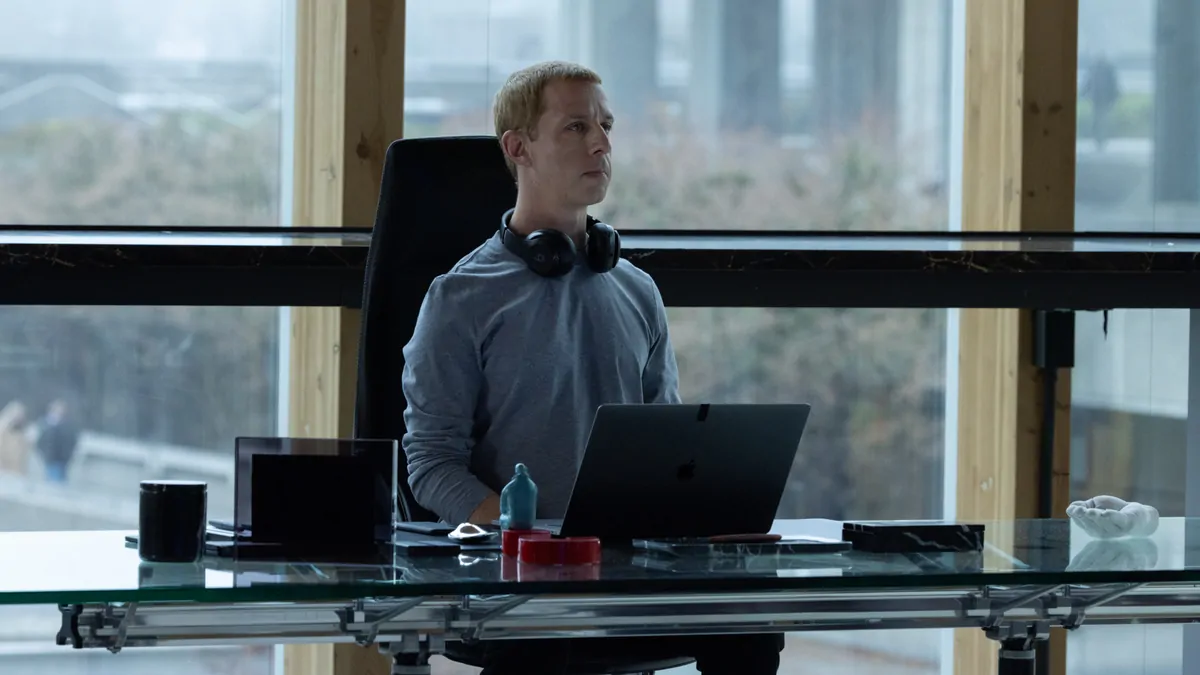
That main storyline is intercut with scenes of Zuckerberg (Jeremy Strong, a voice twin for the real deal) preparing for a Congressional testimony with his team, which includes a crisis management expert (Wunmi Mosaku), a media relations manager (Billy Magnussen) and a contrarian former adviser (Bill Burr) on what would turn out to be the day of the January 6 riots.
The timelines have been muddied for dramatic effect so that it would dovetail into those dramatic images to emphasise an (but not the) endpoint of Facebook’s unethical practices.
These scenes with Zuck, in which he is challenged, specifically, about refusing to fact-check the truth of political advertising, functions as a mock debate.
It’s satisfying to see Zuck’s moral failings so bold-faced out in the open, but what’s less gratifying is the sense that the whole film is that same rhetorical exercise.
It doesn’t matter if we see a fictional Zuck in a humbling moment because Facebook continues to be not the utopian ideal of human connection that Haugen originally espoused.
It’s an even more powerful instrument for corruption, deception and manufactured outrage, run by someone whose motto of “move fast and break things” meant in practice to never being accountable for the destruction.
Sorkin wants to leave his audience with a trigger to do something but it’s probably already too late.
Mikey Madison and Jeremy Allen White in The Social Reckoning. Credit: Sony Pictures Releasing
These revelations are five years old, and the vast majority of Facebook active users are at least tangentially aware of all the damage the platform is doing to the world and to everyone on it.
But the dopamine hits of the scrolls, the likes and the reshares are too addictive. How many cinemagoers will delete their accounts as the end credits roll?
It’s not just Facebook, which you might dismiss as the domain of Baby Boomers and racists, neither mutually exclusive nor on the decline. It’s Meta’s whole suite of products including Instagram, WhatsApp and Threads. It’s also YouTube and TikTok, and X and Reddit. And the rest.
Haugen’s document leak resulted in hearings and lawsuits, but is Facebook a nicer, safer place to be? Is it now a good global citizen which prioritises wellbeing and the social compact?
Or has it only devolved to kissing the rings of despots for ad money and favourable regulatory environments, and forging ahead with pervert glasses and AI?
We all know the answer to that, and some of its ethical, if not felonious, algorithmic crimes will seem small compared to what AI may (or will) herald, even if it’s all connected.
So, yes, enjoy The Social Reckoning, because there are definite pleasures to be had in spending two hours in Sorkin’s world of moral certainty.
It’s only when you leave it do you remember that the real world, and all the chaos Zuckerberg and his fellow tech barons are about to unleash, is far more horrifying and less rhetorical.
The Social Reckoning is in cinemas