The war in Ukraine has often been compared to World War I for its brutal infantry assaults and heavy casualties. Yet the idea that it could, by any measure, surpass a conflict so long and bloody that French soldiers hoped it would be “the last of the last” once seemed unthinkable.
That is just what happened on Thursday. The war in Ukraine — which reached 1,569 days, or more than four years and three months — has now outlasted World War I.
When President Vladimir Putin of Russia sent his troops into Ukraine in February 2022, he believed the country would fall within days. After Ukraine pushed the Russians back and the conflict settled into a war of attrition, even many of those fighting could not imagine it would last this long.
Sign up to The Nightly’s newsletters.
Get the first look at the digital newspaper, curated daily stories and breaking headlines delivered to your inbox.
By continuing you agree to our Terms and Privacy Policy.
“I thought maybe two or three years, and then politicians will find some kind of consensus,” said a Ukrainian soldier who, for security reasons, gave only his call sign, France, a nod to his time in the French Foreign Legion.
But the war has raged on, and, with peace talks stalled, it shows no sign of ending soon. Polls suggest that about half of Ukrainians believe it will not end before next year, which would push it closer to another threshold: the duration of World War II, which lasted six years. And there are many Ukrainians who would argue that the current war really began in 2014 when Russian troops seized Crimea.
Historians caution that drawing parallels with the two world wars has limits. The global scale of those conflicts, involving many theatres and armies, makes comparisons about casualties and firepower difficult. Ukraine did not exist as a country during World War I.
Still, the war in Ukraine, like World War I, is likely to rank among the most consequential conflicts in modern European history, said Yaroslav Hrytsak, a Ukrainian historian. Both wars transformed Europe’s geopolitics by reshaping military alliances and driving a defence buildup not seen in decades.
Military analysts also note that both conflicts reshaped the nature of warfare through the introduction of new technologies — planes and tanks a century ago; drones across the air, sea and land today. In both cases, the advances made war only more brutal for humans.
“In many respects, this war in Ukraine is the one that most closely resembles World War I,” said Michel Goya, a former French colonel and a military historian.
The comparison begins with the opening phase of both wars. In 1914, the Germans launched a rapid offensive toward Paris in the hope of securing a swift victory. Russian forces had the same objective when they raced toward Kyiv, Ukraine’s capital, in 2022. In both cases, the attackers came close to their target but were ultimately driven back.
Eventually, both wars settled into mostly static fighting along a largely frozen front. When soldiers on the Ukrainian battlefield hunkered down in trenches and bunkers in late 2022, historians described it as a return to World War I-style trench warfare.
A Ukrainian soldier sits on shells while waiting for orders, in his fighting position in the direction of Chasiv Yar in Donetsk, 2024. Credit: Anadolu/Anadolu via Getty Images
Scenes from the trenches of eastern Ukraine closely echoed those in northern France a century earlier. Ukrainian and Russian troops were often separated by just a few hundred yards, sometimes close enough to see one another. Assaults began with artillery barrages to pin down the opponent, followed by the storming of enemy trenches by infantry squads.
“In general, when the front freezes, you’re back to World War I,” Professor Goya said.
In both wars, he added, it was the intensity of firepower, mainly artillery, that forced armies to turn to trenches. “You bury yourself to protect yourself,” he said.
That calculus later changed in Ukraine with the introduction of a new class of weapon: drones. Networks of open trenches were rendered unsafe as drones monitored the battlefield around the clock and struck with greater precision than artillery shells.
Now, Ukrainian soldiers say, survival depends on going smaller and deeper. Instead of sprawling trench systems, troops shelter in dugouts housing no more than a handful of soldiers. Such bunkers are small enough to be difficult to spot from the sky and deep enough to withstand strikes. A soldier operating on his own will often dig a position barely larger than a foxhole.
In a recent interview near Ukraine’s southern front, a Ukrainian commander, who also only gave his call sign, Sour, for security reasons, recalled how his troops had to storm a well-fortified Russian dugout four times before forcing the soldier inside to surrender. The dugout had right-angled corners reinforced with metal sheets designed to absorb an explosive shock wave, he said.
The commander, who leads the 5th Centre of the International Legion, part of Ukraine’s military intelligence forces, said he took the captured Russian soldier to his unit’s training ground and asked him to dig a similar position so he could study how it was built.
“In this environment, the people who dig survive longer and stay safer,” France, the Ukrainian soldier, said.
As drones have come to dominate the battlefield, World War I-style opposing trench networks, separated by a narrow buffer zone, have given way to a miles-wide contested combat area scattered with dugouts. In this “kill zone,” any movement is quickly targeted by drones.
Large-scale troop assaults of the kind seen a century ago have become all but impossible under the constant gaze of drones. Such assaults have been replaced with attacks by just one or two soldiers.
A Ukrainian serviceman of the 22nd Brigade prepares to fly a Leleka reconnaissance UAV drone near Chasiv Yar in the Donetsk region. Credit: GENYA SAVILOV/AFP
Tanks, first introduced in 1916, were still a feared weapon in the first years of the war in Ukraine. They are rarely used now because their size makes them easy targets for drones, though some tanks have been retrofitted with protective metal cages that turn them into “Mad Max”-style vehicles.
While the battlefield today bears less and less resemblance to that of a century ago, the scale of the destruction looks remarkably similar.
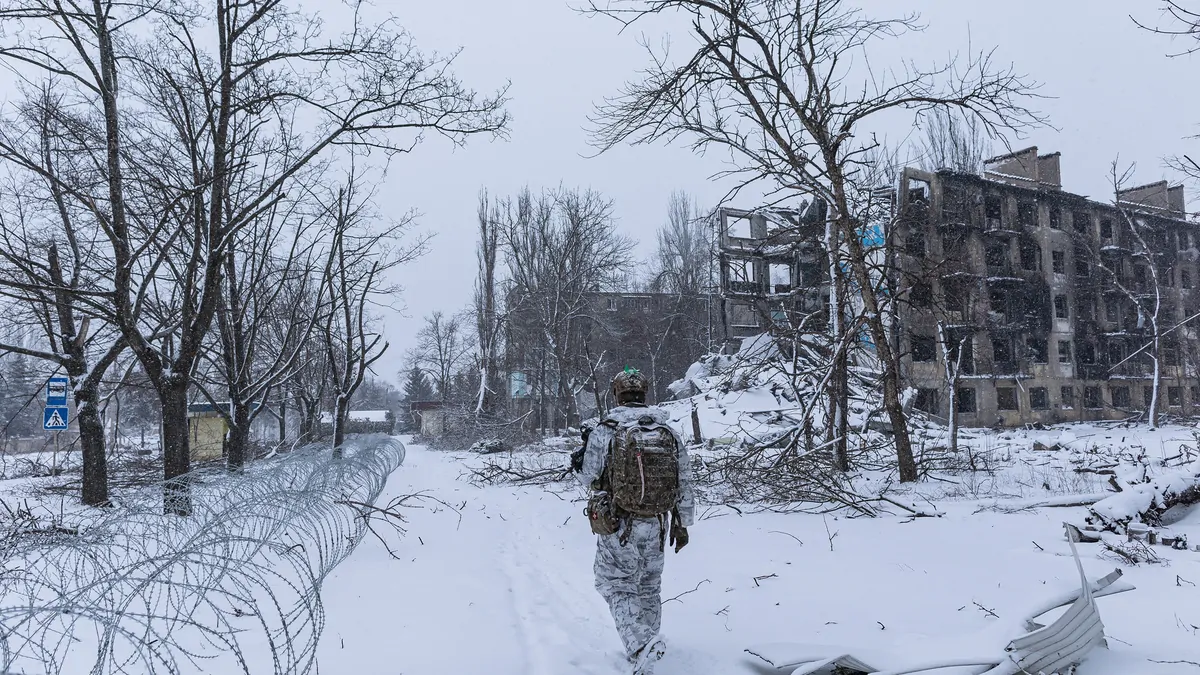
In Ukrainian command posts near the front, live footage from reconnaissance drones shows scenes reminiscent of World War I battlefields: splintered trees, ruined houses and fields pockmarked by shell craters.
Casualties are difficult to compare, given the difference in scale between the two wars. A century ago, millions of soldiers were sent into battle across multiple fronts in Europe. Today, the forces involved number in the hundreds of thousands. Roughly 9 million to 11 million soldiers died in World War I, compared with about half a million in Ukraine so far.
Still, military analysts and officials, including Admiral Pierre Vandier, who holds the post of Supreme Allied Commander Transformation in NATO, say drones have made the Ukrainian battlefield lethal at levels comparable to World War I. Admiral Vandier made the comparison after a study trip to Ukraine this spring.
So grinding is the fighting in Ukraine that Russian advances have at times been slower than those in some of World War I’s most deadlocked battles.
Russia’s offensive on Pokrovsk, an eastern Ukrainian city it recently fully captured, progressed at an average pace of about 75 yards per day, slower than in the bloody Battle of the Somme during World War I, according to an analysis by the Centre for Strategic and International Studies, a Washington-based think tank.
The question now is whether either side can break the deadlock.
In World War I, the Allies prevailed by combining economic pressure on Germany through a tight naval blockade with military pressure through relentless offensives.
Ukraine’s strategy to end the war carries some echoes of that approach.
Drone strikes on Russia’s oil assets, the backbone of its economy, are designed to curb Moscow’s ability to finance its war effort. Kyiv lacks the manpower to replicate the offensives of World War I, but it has flooded the battlefield with small attack drones in the hope of inflicting unsustainable losses on the Russian army.
“This is World War I, but with drones,” Professor Hrytsak, the historian, said.