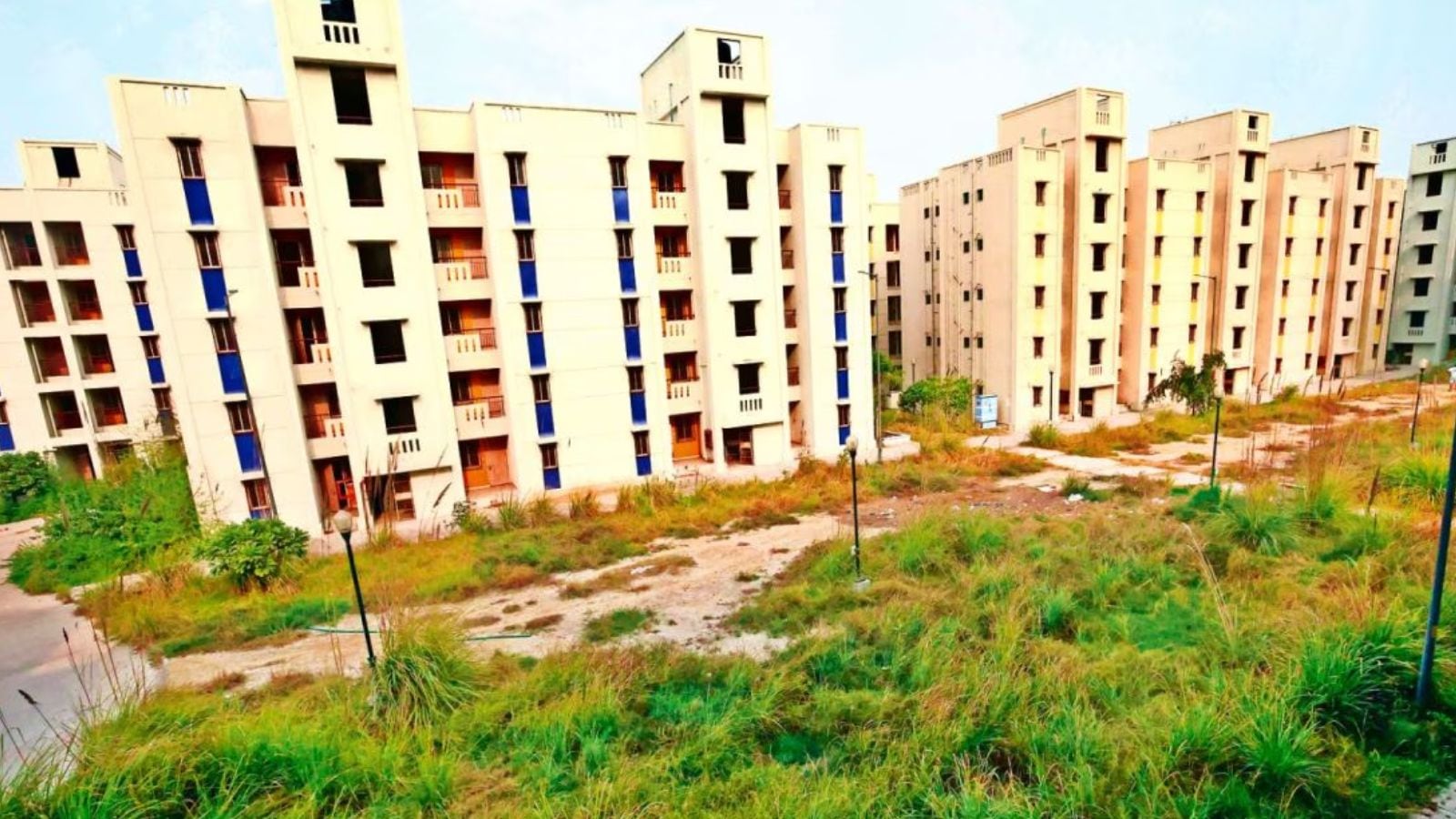
With more than five lakh people living in the unauthorised colonies in the Yamuna floodplain’s O-Zone, eco-sensitive areas along the river where construction is prohibited, the Delhi government has started work on a possible rehabilitation plan and has identified 18,084 flats meant for the economically weaker sections (EWS) across six locations in the Capital even as at least 1 lakh units are needed, The Indian Express has learnt.
Last month, the Delhi High Court on May 23 had observed that residential colonies in the O-Zone are “completely impermissible”, while noting that 91 unauthorised colonies in the area continue to enjoy temporary protection from punitive action until December 31 under the National Capital Territory of Delhi Laws (Special Provisions) Second Act, 2011. This was after the Centre submitted that occupants of the 91 unauthorised colonies are protected from demolition until December 31.
Sources have now told The Indian Express that the Delhi government is coordinating with the Ministry of Housing and Urban Affairs (MoHUA) for the rehabilitation efforts, which involve housing under the Delhi Urban Shelter Improvement Board (DUSIB). The existing units are spread across six locations — Sultanpuri, Savda Ghewra, Bhalswa, and three sites in Dwarka.
A total of 108.61 acres of land is available with DUSIB for rehabilitation, with the largest in Bhalswa having 7,400 EWS units. Savda Ghewra is another major rehabilitation site where 37.81 acres of land is available with 7,620 units. Dwarka’s three sites — spanning around 12 acres in total — have more than 2,000 dwelling units whereas Sultanpuri has 6.85 acres land with 1,060 dwelling units.
A senior government official told The Indian Express, “The Delhi government is upgrading and repairing the current EWS flats using funds under the Pradhan Mantri-Unauthorised Colonies in Delhi Awas Yojana. The relocation will likely take place in Burari, Sultanpuri, and Savda Ghewra. The work is going on and we are expediting it so that the flats are ready.”
These units were built earlier under EWS housing and slum rehabilitation schemes, including the Jawaharlal Nehru National Urban Renewal Mission, but many remained vacant or unoccupied for years, according to officials. Government records show that low occupancy was linked to restrictive eligibility norms, lack of peripheral infrastructure and residents’ apprehension over losing livelihoods after relocation.
On Tuesday, Chief Minister Rekha Gupta announced that no demolition would be carried out on existing constructions in the colonies and maintained that the High Court’s concerns were related to only fresh or ongoing construction activity.
Story continues below this ad
As per the May 23 order, D Thara, Additional Secretary MoHUA, told the court as cited in the 23 May order, “…There is discussion in respect of rehabilitation of these villages and residents as well. Since there are approximately 5 to 6 lakh people living in these 91 colonies, which would translate into at least 1 lakh houses, a detailed strategy would have to be worked out.”
The MoHUA had also clarified to the court that under the National Capital Territory of Delhi Laws (Special Provisions) Act, the unauthorised colonies within the O- Zone are temporarily protected from punitive action until December 31. No ownership is granted in such land, as per existing regulations.
Recent court submissions have also shown that fresh unauthorised construction in JagatPur Village, Wazirabad Village, Ram Ghat in Wazirabad and New Aruna Nagar near Majnu Ka Tilla have been recorded, alongside enforcement activity in recent months including demolition drives by the DDA in Madanpur Khadar, Jhangola and Revenue Estate-Indraprastha, reclaiming around seven acres.
Bhim Singh Rawat, an environment activist and a member of the South Asia Network on Dams, Rivers and People, a nonprofit, said the “status of O-Zone must be kept intact”. He added that the floodplain has “many layers”, including old villages. Farmers and nursery workers who have lived with periodic floods were made more vulnerable after embankments came up, he claimed. He said the embankments and subsequent infrastructure such as bridges, roads, flyovers and barrages have already narrowed the river and its floodplain, while also enabling large-scale encroachment by unauthorised colonies and government-backed constructions, including areas such as Sonia Vihar, Batla House, Jaitpur, Akshardham and the CWG Village. “Permanent construction must be removed considering overall structural safety of buildings, flood impact on people and safeguarding the hydrological as well as ecological functions of Yamuna floodplain,” Rawat said, adding that any removal of encroachment requires “a holistic and humane approach” with detailed relocation planning, beginning with “government-created and sponsored encroachments”.
Story continues below this ad
The O-Zone has remained in headlines since the National Green Tribunal’s (NGT) landmark judgement on January 13, 2015, in the Manoj Misra v. Union of India case.
In a submission to the tribunal, the DDA on February 26 this year said it mapped out that the total delineated O- Zone spanned 9,700 hectares of land. Within this sensitive ecological boundary, there are 90 officially mapped unauthorised colonies occupying approximately 807 hectares, it said. Of this, 3,969.54 hectares is directly owned by the DDA in this zone, and roughly 184.2 hectares are actively encroached upon by these unauthorised settlements. To finalise the eviction boundaries and prevent any new illegal constructions, the DDA also told the NGT in April this year that it is conducting a comprehensive drone survey to map 165 square kilometer area, covering the entire 22-km stretch of the Yamuna floodplain and its buffer zones within the city.