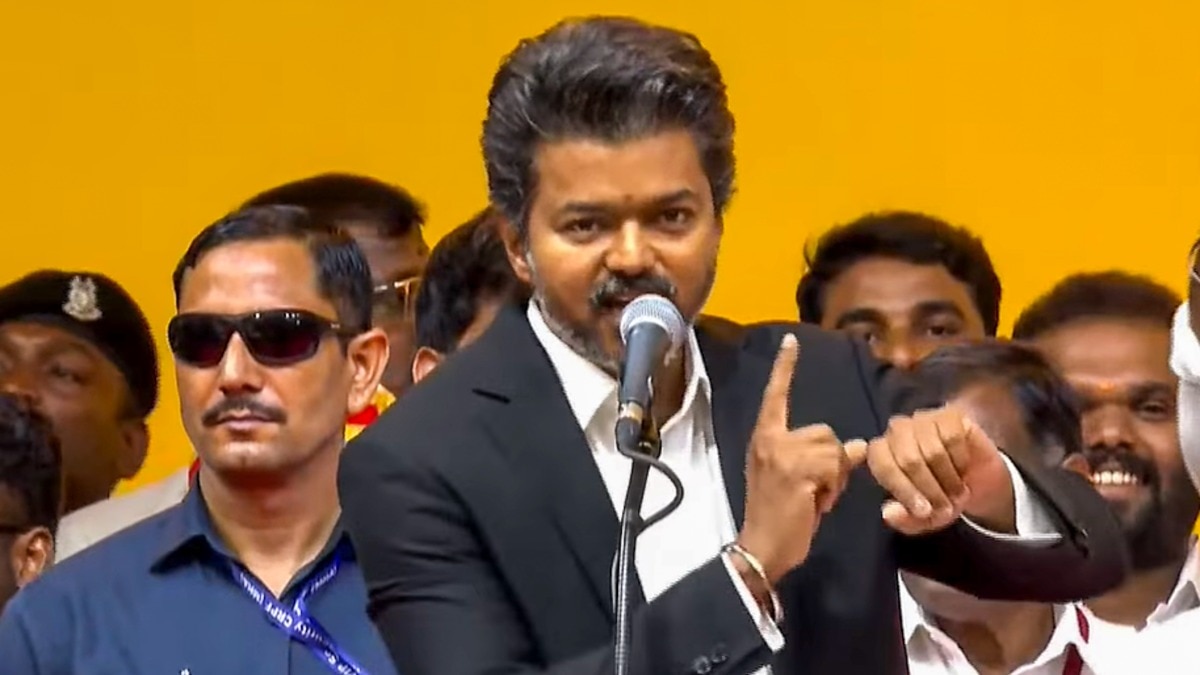
After being sworn in as the Chief Minister of Tamil Nadu, Tamilaga Vettri Kazagham (TVK) Chief C Joseph Vijay on Sunday said that he would release a White Paper on Tamil Nadu’s fiscal health. From the dais, Vijay attacked the previous DMK government and accused it of leaving Tamil Nadu with a debt of Rs 10 lakh crore. He signed an executive order on the very stage, granting 200 units of free electricity every two months to domestic consumers. While CM Vijay berated the DMK coalition over fiscal mismanagement, his schemes could come as a drag on the coffers if revenue streams aren’t developed.
Take for example, the free electricity scheme signed on by Vijay. The poll promise of the TVK will cost the government Rs 1,730 crore per year, according to an order by the Tamil Nadu Energy Department. Vijay has made several other promises that would cost the state’s exchequer nearly Rs 1 lakh crore per year. Several economists believe that the TVK White Paper should be the biggest red flag for Vijay, who has to erect guardrails to prevent a state with good growth going into an economic tailspin.
The poll promises are big. Vijay promised direct cash transfers like Rs 2,500 a month for women heads of households, Rs 4,000 for unemployed graduates, and Rs 2,500 for diploma holders. Among these, Vijay’s TVK also assured six free LPG cylinders per household every year, Rs 15,000 annually to curb school dropouts, gold and saree as marriage aid, Rs 5 lakh as new start-up loans, and Rs 25 lakh for business launch loans. To fulfil these promises, CM Vijay will face an increase of over 52% from the Rs 65,000 crore spent by the previous DMK government on welfare schemes and subsidies in 2025-56, according to an analysis by The Indian Express based on budget numbers.
White Papers are nothing new in Tamil Nadu’s recent political history. DMK chief MK Stalin released a White Paper on Tamil Nadu’s fiscal health in 2021 after taking over as the chief minister.
The 2021 White Paper detailed a “dire” fiscal situation, projecting an outstanding debt of Rs 5.7 lakh crore by the end of Financial Year 2021-22. It highlighted a severe revenue deficit, blaming the previous 10-year rule of the AIADMK for structural flaws.
Now, in 2026, after the end of the five-year rule of the DMK, Vijay has alleged that Tamil Nadu’s debt has reached up to Rs 10 lakh crore.
CAN VIJAY’S WELFARE SCHEMES WIDEN TAMIL NADU’S FISCAL DEFICIT?
As per Tamil Nadu’s previous budget, the state’s total revenue receipts stand at Rs 3.31 lakh crore. Revenue receipt is the money earned by the government. The government pays salaries and pensions, runs schools and hospitals, and builds infrastructure assets (which is capital expenditure) from that money.
The proposed welfare expenditure of Vijay’s government will be equal to one-third of Tamil Nadu’s total revenue receipts. That could place significant pressure on the state’s finances, leaving little room for capital expenditure in a state already burdened with debt at 26% of Gross State Domestic Product (GSDP).
If Vijay decides to fund the schemes entirely through higher spending without additional revenue mobilisation, the fiscal deficit could widen from the budgeted 3% of GSDP in 2025-26 to nearly 3.5-4%, according to an analysis by The New Indian Express.
Due to the lack of available state-level data, the estimated cost above does not account for the projected expenditure on the cooperative farm loan waiver and the legally guaranteed MSP procurement of paddy and sugarcane promised in the TVK manifesto.
Tamil Nadu is the state that is known for its welfare-driven politics. The DMK and the AIADMK, which governed the state for several decades, normalised the freebie culture. What started as targeted welfare measures gradually turned into a competitive cycle of populist promises. Vijay’s TVK has not done anything different from this model, it has just taken it a step further.
DMK’S STALIN ACCUSES VIJAY OF TRYING TO DECEIVE VOTERS
CM Vijay, in his maiden speech after taking charge, requested the people of Tamil Nadu to have some patience with his poll promises.
“I request you to please be patient with me. Give me some time. This is your government,” he said. “We need to figure things out. I’ll release a white Paper on the status of the state’s financial health. I wish to be transparent and take it forward from there,” Vijay added.
After taking the CM’s oath, Vijay issued three executive orders: providing 200 units of free electricity every two months for domestic consumers, creating a special ‘Singappen’ rapid response police force for women’s safety, and establishing anti-narcotics units across the state.
Former CM of Tamil Nadu and DMK Chief MK Stalin responded to Vijay’s allegations. He asked why Vijay made the poll promises if he was aware of the state’s financial health.
“People should not immediately assume that the government lacks funds. The money is there. What matters is the political will to spend it for the people and the capacity to govern effectively. Despite challenges such as Covid-19, floods, and what we saw as neglect from the BJP-led Union government, we implemented numerous welfare schemes over the past five years,” Stalin said in a post on X while congratulating Vijay for assuming the CM’s post.
Stalin also accused the new CM of trying to deceive the people of Tamil Nadu by diverting the issue.
“We clearly explained the financial position of the Tamil Nadu government in the February budget itself. Didn’t you know that? It was only after that you gave various promises to the people? Don’t deceive the people who voted for you again and try to divert the issue! You, who came to power saying, ‘I will only give promises that are practically feasible,’ are now just stepping into government administration. I believe that, just like us, you too will surely soon learn the nuances of how to fulfil the promises made to the people. Along with the people who voted for you, I too expect the same,” Stalin added.
People are discussing the state’s debt vis a vis Vijay’s poll promises.
“It’s going to be a very difficult job for Vijay to get funds for most of his welfare schemes,” one person posted on X.
People alleged that Vijay had promised 200 units of free electricity for all consumers during the campaign, but had now imposed restrictions on eligibility for the scheme.
REPORTS FROM CENTRE, RBI REPEATEDLY FLAGGED FREEBIE BURDEN
The Economic Survey 2025-26, presented by the Union Finance Minister Nirmala Sitharaman in January, warned that the rising trend of freebies in states has begun to deliver an adverse visible economic cost.
The report suggested that the unconditional cash transfers (UCTs), rolled out aggressively by states, ballooned more than fivefold between the financial years 2022-2023 and 2025-2026. The report argued that states had failed to deliver durable gains in nutrition, education, or poverty reduction due to heavy announcements of cash transfers. Around half of the states running these UCT schemes were already in revenue deficit, like Tamil Nadu, and were borrowing to finance consumption rather than asset creation, the report added.
The Reserve Bank of India (RBI) has also flagged major concerns on the rising freebie culture and its impact on the economy.
In its report, State Finances: A Study of Budgets of 2024-25, the RBI observed that several states have introduced measures such as farm loan waivers, free electricity, free public transport, unemployment allowances, and direct cash transfers to women. The central bank warned that such expenditure could strain state finances, reducing the resources available for building critical social and economic infrastructure.
These states also include those ruled by the BJP, which is in power at the Centre.
States such as Punjab and Rajasthan have sought special financial assistance, debt relief, enhanced borrowing limits, or bailout-like support from the Centre amid mounting fiscal pressure stemming from subsidies and welfare spending. Punjab repeatedly approached the Finance Commissions and the Union government between 2019 and 2024 seeking debt relief, special packages, and higher borrowing limits. Rajasthan, grappling with rising DISCOM (an electricity utility company) debt and subsidy burdens, also pushed for central support for its power sector liabilities.
However, no Indian state has received a formal bailout explicitly aimed at rescuing “freebie-driven” deficits. The Centre’s support has largely been indirect and conditional, through standard grants, tax devolution, relaxed borrowing norms, or sector-specific relief measures such as lower-interest loans for DISCOMs.
Tamil Nadu has seen stellar growth driven by industrialisation, entrepreneurship, and export-led development, supported by strong infrastructure and administrative stability. But investors value fiscal discipline, and it could turn out to be a cautionary note for them. The debt of Tamil Nadu is already Rs 10 lakh crore, according to CM Vijay. If the TVK’s poll promises are introduced, the estimated debt could rise beyond Rs 4.5 lakh crore in the next five years. That’s why the TVK’s White Paper could be the red flag for CM Vijay.
– Ends
Published By:
Avinash Kateel
Published On:
May 11, 2026 14:59 IST