

Crime
A full jury was sworn in Friday morning before opening statements were delivered. The trial of Matthew Farwell will continue Tuesday.
Editor’s note: This article includes descriptions of violence, suicide, and the sexual abuse of children.
Opening statements were delivered Friday in the trial of Matthew Farwell, the former Stoughton police detective accused of killing Sandra Birchmore.
Farwell allegedly killed Birchmore while she was pregnant in early 2021 and staged the scene to appear as if it were a suicide. Federal prosecutors say he did so to cover up a lengthy sexual relationship with Birchmore that began when she was 15-years-old.
-
Matthew Farwell appears in court as potential jurors are questioned in the Sandra Birchmore case
-
Jury selection begins Tuesday in the trial of Sandra Birchmore’s alleged killer. Here’s a quick primer on the case.

A state investigation initially ruled Birchmore’s death to be a suicide, but a subsequent FBI investigation led to Farwell’s indictment in 2024. The Office of the Chief Medical Examiner officially changed the manner of Birchmore’s death from “suicide” to “undetermined” earlier this year.
Farwell is facing charges of killing a witness or victim and killing an unborn child.
He maintains Birchmore died by suicide, and has pleaded not guilty.
Jury selection began on Tuesday, with hundreds of prospective jurors filling out questionnaires. They were called back and questioned by Judge Denise Casper and attorneys for both sides throughout the week. A full group of 16 jurors, which includes four alternates, was sworn in Friday morning before opening statements were delivered.
No evidence was presented Friday. The trial is set to continue Tuesday.
Catch up on the case here.
The prosecution
Assistant U.S. Attorney Torey Cummings delivered the opening statement for the prosecution.
Cummings began by describing the night that Farwell allegedly killed Birchmore in February 2021. Farwell had a “real problem” because his wife was on the verge of giving birth to his third child, and Birchmore was potentially on the verge of telling more people about their relationship, she said.
“He had sex with Sandra when she was 15 years old,” Cummings stressed, as she went back to the beginning of the prosecution’s narrative.
Farwell, as an instructor in the Stoughton Police Explorers program, was supposed to be “mentoring” Birchmore. Instead, he committed statutory rape and continued to meet her for sex over the next eight years, according to the prosecution. Farwell “worked hard to keep Sandra quiet,” but as she got older, she started to understand that he had “victimized her.” Birchmore started to tell others about the abuse, and Farwell knew he had a problem that he had to deal with, Cummings said.
“He killed her so that she couldn’t talk about what he had done to her,” Cummings said, adding that Farwell saw Birchmore’s baby as a “physical manifestation of his crimes.”
Cummings showed jurors a photo of Birchmore in the explorers program, identifying her as the “littlest one” at the end of the line. Cummings spoke about how Birchmore struggled in school, and had trouble making friends. Her mother, who had serious chronic illnesses, enrolled Birchmore in the program so that she could find positive role models and structure. Birchmore loved the program and was “enamored” with police officers, the prosecutor said.
Cummings walked jurors through Farwell’s early decision to “tutor” Birchmore as he normalized sexual contact with her. Cummings referred to a message Farwell allegedly sent to Birchmore where he stated that he “absolutely” would have had sex with her in 2012, before she was even 15. Farwell made Birchmore feel special, giving her the attention she craved, Cummings said.
She described the nature of the sex between Farwell and Birchmore, how it centered on themes of domination, strangulation, and rape fantasies. Cummings repeatedly referenced and showed apparent messages between the two, saying that they exchanged more than 40,000 messages over the years.
Birchmore had talked for years of her desire to be a mother. When she was 22, she told Farwell that she wanted him to be the father of her child because he took her virginity and was her best friend, according to Cummings.
When Birchmore learned that Farwell’s wife was pregnant with their third child, she immediately texted him. She told him that she was going to expose what he had been doing, unless he agreed to impregnate her, Cummings said.
Birchmore was beginning to understand Farwell’s abuse, Cummings said. When a friend asked Birchmore what she thought Farwell would do, she allegedly responded: “not my problem. He took my virginity before I was 16.”
Farwell eventually agreed to impregnate Birchmore in order to “silence” her. When their initial attempts did not work, Birchmore changed the terms of their deal. Farwell was not happy about this, but he continued trying to appease her to keep her quiet, Cummings said.
Cummings referenced an image of a poster that Birchmore had made for Farwell after learning that she was pregnant in December 2020.
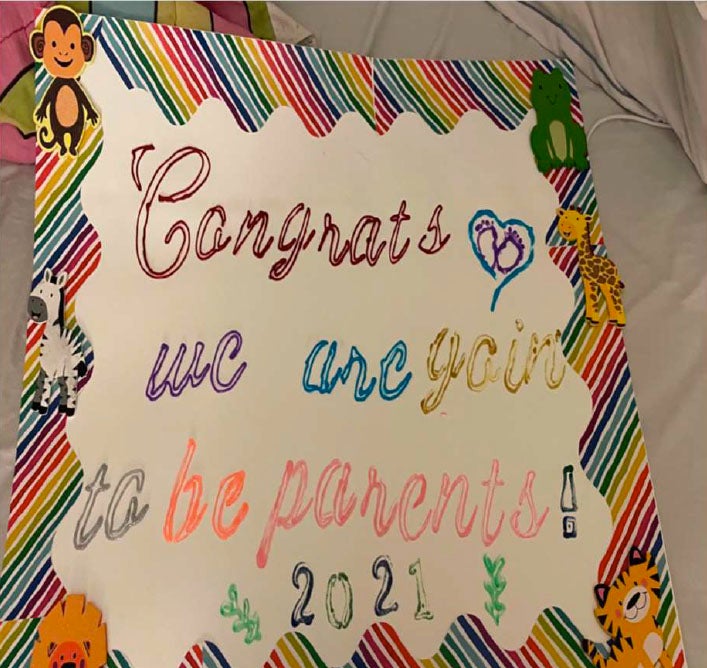
In messages responding to the news, Farwell told Birchmore that she was “truly the worst person on the face of the earth,” the prosecutor said.
Cummings described how Farwell acted cold towards Birchmore and tried to distance himself. But on Jan. 20, 2021, he realized he had not “maintained her silence” when a friend of hers called the Stoughton police station to report their relationship.
“It was no longer a matter of whether his crimes would be exposed, it was a matter of when,” Cummings said. “He needed a way to silence her, permanently.”
Cummings described how Farwell’s demeanor changed after that, shifting to kindness in order to placate Birchmore as he allegedly planned her murder.
The prosecutor then walked jurors through Birchmore’s actions on her final day alive, including how she searched for venues for a baby shower and paid to take an entrance exam for a nursing program. Cummings also described the alleged murder and Birchmore’s injuries. She spoke about how Birchmore sent some 600 text messages that day, and was constantly using her phone. Yet after Birchmore died, there was no suicide note.
“The girl who told everyone about her life left no note,” Cummings said.
The prosecutor ended her opening statement by talking about the Norfolk County Crime Prevention and Control Unit’s initial investigation of Birchmore’s death. Investigators did not fact check what Farwell said, and allowed him time to delete key text messages, Cummings said.
She told jurors that they will hear testimony from medical experts who will say that Birchmore’s injuries are far more consistent with a homicide than a suicide. DNA evidence will also show Farwell’s connection, she added.
Farwell counted on the public writing off Birchmore’s death as a suicide, Cummings said.
“You won’t be able to,” she told jurors.
The defense
Attorney Kimberly Stevens delivered the opening statement for the defense.
“Matthew Farwell is a man who had an affair. He’s made regrettable mistakes. He’s human,” she said. “Matthew Farwell did not kill Sandra Birchmore. He did not.”
Stevens sought to persuade jurors that Birchmore was suicidal. She read text messages from Birchmore to Farwell, in which Birchmore described not being able to sleep, being stressed, and wanting Farwell to visit her. Birchmore apparently searched the internet to try to determine the color of the “suicide ribbon.” She also looked at an image online that said: “can I just die for a day. I just want to see who will cry when I’m gone,” Stevens said.
The defense emphasized that Birchmore had spent Thanksgiving and Christmas alone. She described Birchmore as being worried about her pregnancy, saying she searched the internet for medical advice.
“She’s worried. She’s stressed out. She’s freaking out. She’s pulling up imagery of suicide,” Stevens said.
Stevens described how Birchmore apparently began taking psychiatric medicine at the age of 6, and dealt with “social and emotional” issues. Birchmore attempted suicide once before, when she was in her early teenage years, Stevens said.
Experts will testify about “risk factors” for people who are suicidal, Stevens said. One of these factors is pregnancy, but the “biggest” is prior suicide attempts, she added.
Stevens spoke about the death of Birchmore’s mother, and how she then lived with her aunt. That relationship was “rocky,” and Birchmore at one point reported that her aunt had told her to kill herself, according to Stevens.
Birchmore “fantasized” about having a baby and creating the home she never had. There was an “unquenchable desire” to be a mother within Birchmore, Stevens said.
“Perhaps she wanted to be wanted, to matter,” Stevens said.
At the time of her death, Birchmore was also reportedly having financial troubles. She had borrowed money from friends who were now demanding to be repaid, and had only $2.90 in her bank account at the end of January 2021, Stevens said.
The defense also referenced William Smock, a doctor who specializes in emergency medicine that has determined Birchmore died by homicide. Smock’s testimony is expected to be a key piece of evidence for the prosecution. Stevens argued that Smock is not an expert in forensic pathology, and therefore unqualified to determine the manner and cause of Birchmore’s death.
Stevens then spoke about how Birchmore’s body was found. She emphasized that Birchmore’s leggings were not pulled down, and that there were no drag marks on the carpet in her apartment, both of which would apparently be true if Farwell had killed her and moved her body.
Farwell’s DNA was totally excluded from material under Birchmore’s fingernails on both her hands, Stevens said, adding that Birchmore would have scratched and clawed at him if she were being strangled to death.
According to Stevens, Farwell went to visit Birchmore on Feb. 1, 2021 to break up with her. Surveillance video from her apartment building’s lobby shows Farwell masked and hooded because he was having an affair, Stevens said, not because he was there to kill her.
Ultimately, Stevens said, Birchmore took her own life in an “impulsive act of despair.”
Sign up for the Today newsletter
Get everything you need to know to start your day, delivered right to your inbox every morning.
