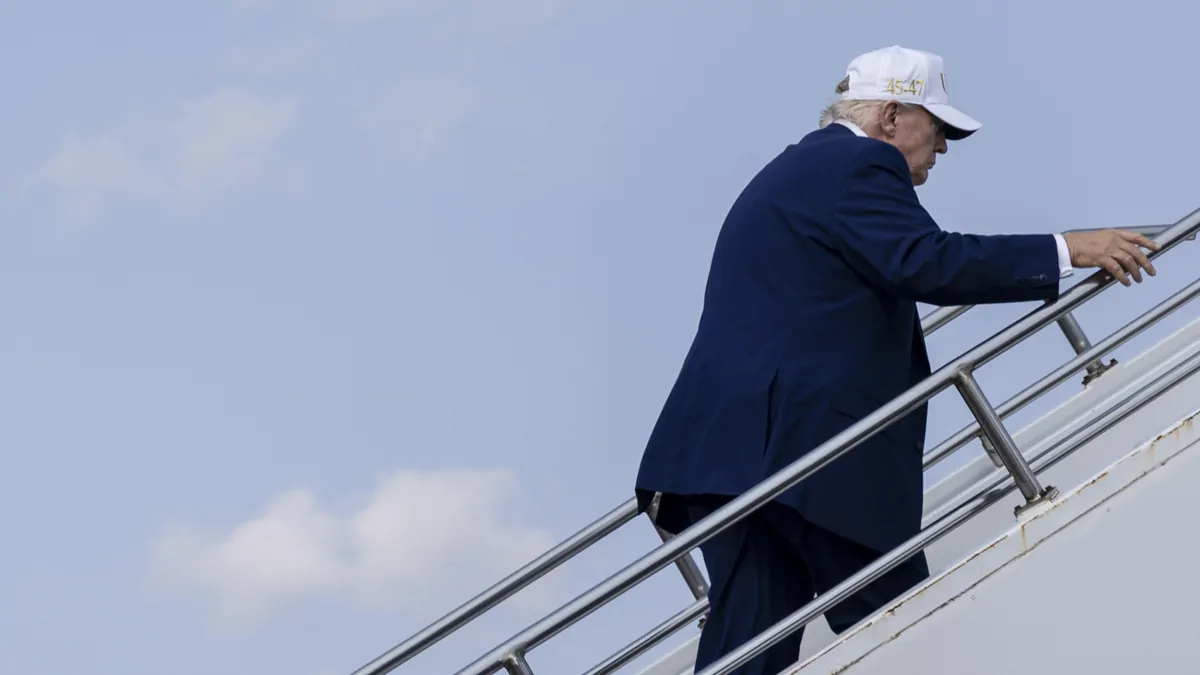
US President Donald Trump may want to let go of the Middle East. But it won’t let go of him.
Over the weekend, Mr Trump said his new strategy was to be “low-keying it” in Iran, a suggestion that he wants to pressure the country into making a favourable deal without taking major military action. But a stark reminder of the limits of US power in the region came from Israel, where Prime Minister Benjamin Netanyahu declared Sunday he was “ruling out” Mr Trump’s peace plan for the Gaza Strip.
The two Middle East conflicts have underscored Mr Trump’s eagerness to declare success and his inability to impose his will on them, despite the enormous military firepower that he has been able to deploy.
Sign up to The Nightly’s newsletters.
Get the first look at the digital newspaper, curated daily stories and breaking headlines delivered to your inbox.
By continuing you agree to our Terms and Privacy Policy.
Mr Trump is “clearly trying to find a pathway as the midterms approach to downgrade all of this,” said Brian Katulis, a senior fellow at the Middle East Institute, a Washington think tank. Instead, Mr Katulis went on, “reality is slapping him in the face.”
Mr Trump faces depleted weapons stockpiles, an Iranian regime determined to impose pain on the United States, an Israeli prime minister battling for re-election and American voters reeling from high prices induced by the Iran war. The November midterms keep ticking closer, steadily raising the political costs of the turmoil to the President and Republicans.
Mr Trump laid out his low-key approach to Iran in a brief interview with the news website Axios on Sunday. Rather than make new military threats, he said that “we are just watching Iran with its huge inflation and the fact they have no money.” He added, “It will work out. It always works out. It’s like a chess game.”
“Now, can they make trouble? Yeah, they can make trouble,” Mr Trump told reporters in the Oval Office Monday, acknowledging Iran’s ability to keep harassing commercial ships in the Strait of Hormuz. “But they’re broke.”
In describing the Iranian regime as suffering from economic pressure, Mr Trump evoked his own predicament. The average price of a gallon of gasoline remained above $US4 this week ($5.67, or $1.50 per litre) more than $US1 above the price when the United States and Israel began bombing Iran on Feb 28.
Polls show even Republicans growing disenchanted with the Iran war, and Mr Trump’s political movement has fractured over his decision to launch military action.
“I don’t think the President has very good options,” said Suzanne Maloney, an Iran specialist and Vice President at the Brookings Institution in Washington. “The pressure points for the Iranians are, while real, more endurable and bearable than those that are impacting the US economy and the strategic calculus of the administration.”
A White House official said in a statement Monday that Mr Trump’s “bold actions” on the battlefield in Iran and in diplomacy over Gaza “will strengthen American security for years to come”.
“The failed Obama and Biden policies were defined by appeasement,” said Olivia Wales, a White House spokesperson. “The successful Trump policy is defined by American strength.”
In Gaza, Mr Trump trumpeted a “historic breakthrough” July 30, a multi-phase deal under which the militant group Hamas would eventually disarm and Israel withdraw from the Palestinian enclave. Writing on his Truth Social website, in all capitals, he hailed an “amazing development” that “everybody said could never be achieved”.
Donald Trump and Israeli Prime Minister Benjamin Netanyahu at White House last month Credit: Anadolu/Getty Images
But in the days after Mr Trump announced the plan, Gaza saw an increase in deadly Israeli bombings. On Sunday, Mr Netanyahu, who earlier this year went into the Iran war alongside Mr Trump, emphatically rejected the US President’s plan: “I want to be clear here — Israel is ruling out the 15-point document.”
The Gaza episode was, to some analysts, another reminder of diminished American influence in the Middle East in the wake of the Iran war, which has dragged into its sixth month with none of Mr Trump’s expansive goals appearing close to being accomplished. Many Israelis have seen Mr Trump’s pursuit of a peace deal with Iran as a betrayal, giving Mr Netanyahu a political incentive to be seen as standing up to the President as he seeks re-election in October.
In Iran and Israel, Mr Katulis said, Mr Trump has “misread the regional power dynamics.” Mr Katulis also pointed to the new defence pact among Turkey, Saudi Arabia and Pakistan as a sign of countries looking to hedge their bets amid uncertainty over the future of American power in the Middle East.
In Iran, for all of Mr Trump’s efforts at finding a way out, a renewed flare-up of violence could come at any moment. The US military has kept up its naval blockade of shipping to Iranian ports and said Saturday that it had redirected 53 commercial vessels in recent weeks, along with disabling two ships and boarding two others. Mr Trump’s enormous buildup of US military force in the region, including two aircraft carrier groups, has remained in place.
“These tools are not low-key,” said Behnam Ben Taleblu, an expert on Iran at the Foundation for Defence of Democracies, a Washington think tank that is hawkish on Iran, referring to the US sanctions and blockade. “Iran is likely not going to take them lying down.”
Ships anchored in the Strait of Hormuz this week. Credit: Ali Saeedi/Getty Images
The United Arab Emirates said Saturday that an Iranian attack had targeted a tanker belonging to one of its state-owned oil companies as it crossed the Strait of Hormuz, the major artery for oil shipments out of the Persian Gulf. The Houthis, an Iranian-backed militia in Yemen, have threatened to block Saudi oil shipments through the Red Sea.
A senior Iranian official said Saturday that Iran would reopen the strait only if the United States met a sweeping list of demands, including lifting sanctions and the blockade. The official, Mohammad Bagher Zolghadr, also demanded war reparations, prompting Mr Trump to post on Truth Social on Monday that “I am likewise demanding compensation from Iran”.
Iran’s compensation, he said, would need to cover people killed and wounded in Iran’s “many conflicts” as well as Iranian protesters killed by the regime. He said he had instructed officials to seek that compensation in “any, and all, future negotiations.”
Iran and the United States are not known to be negotiating directly, though Secretary of State Marco Rubio said last week that Iran and neighbouring Oman were holding talks with US input. Online, some of the loudest supporters of Mr Trump’s initial decision to bomb Iran continued Monday to push for new attacks.
“For those here and elsewhere living in a fantasyland, there will need to be further military action,” Fox News host Mark Levin wrote on the social platform X.
“Economic pressure alone won’t cut it.”
© 2026 The New York Times Company