“For district-level football, there is nothing else like Neville D’Souza ground. If this goes away, there would be nothing left,” said Mumbai-based lawyer and football enthusiast, Tushar Sinha. He has played at the ground in Bandra West as an amateur, and has been closely involved with Mumbai football since 2013.
That’s what is at stake as the 8,450-square-metre football ground faces a proposed change in land reservation from a playground to a convention and exhibition centre. In effect, the move by the BMC would remove the plot’s legal protection as a playground and allow it to be developed as a convention or exhibition centre, subject to final State approval.
Sinha grew up near the ground in Bandra, and has been a part of fan clubs supporting Mumbai Football Club and the Indian team. Speaking to India Today Digital, he recalled how he watched the Neville D’Souza ground evolve from an exhibition space into a professional-standard football facility.
Like thousands who have honed their football skills at this Bandra ground, Sinha is concerned about losing one of the few spaces where children, amateur players and young footballers can experience something close to professional football. It has a FIFA-standard artificial turf, stands, dressing rooms and other facilities associated with a professional football venue.
While the BMC has approved the proposal, but the reservation change still requires the Maharashtra government’s approval. Meanwhile, the Bombay High Court has restrained the BMC and the State government from taking further steps.
“Children in Mumbai have been playing on mud grounds, on Azad Maidan and Oval Maidan, all their lives. Finally, they got a grass ground which is actually a professional-level turf,” he said.
And the alternatives, he argued, are not really alternatives for the majority of players. “Even if you see Andheri Sports Complex and the DY Patil stadium, these don’t really cater to district-level games. An Indian Super League team can play there, but that doesn’t mean they are accessible to everyone,” he said.
“We keep complaining that we have never played the World Cup, and that we are very far away from that. But that’s because most of our guys don’t really play professional football on a professional ground,” Sinha told India Today Digital, explaining that children in Europe and other footballing nations get access to such facilities from a young age.
“As opposed to a European kid who would be playing 100 games professionally by the age of 18, our boys play maybe 10 by that age,” he said.
That gap, he believes, is where a ground such as Neville D’Souza becomes extremely important in a megacity like Mumbai.
The Bandra Reclamation ground spans 8,450 square metres and was inaugurated in 2018. Its FIFA-standard artificial turf was named after legendary Indian footballer Neville D’Souza. (Image: Getty Images)
NEVILLE D’SOUZA GROUND IS A PROFESSIONAL-LEVEL FIELD FOR THE NEXT GENERATION
The Neville D’Souza ground, inaugurated in its present form in 2018, has FIFA-standard artificial turf, stands, dressing rooms and other facilities associated with a professional football venue. It has been used for local and district-level competitions and has provided a home for young players across age groups.
The ground is named after legendary Indian footballer Neville D’Souza, who became the first Asian to score a hat-trick at the Olympics, against Australia at the 1956 Melbourne Games.
Sinha remembered when the land parcel was very different.
“When I was a kid, this used to be our [local community’s] exhibition ground. We used to have handloom exhibitions on this ground, and other smaller fairs and fetes. This [the ground in its current form] is a very recent development,” Sinha said, adding, “It was like a boon for local footballers… It gave kids the opportunity to feel like a professional footballer.”
“They had dressing rooms, a coach’s stand and a stand for parents. I remember kids coming and telling us, ‘One day we’ll be playing for Mumbai City FC.’,” Sinha told India Today Digital.
The ground also gave parents something that is often difficult to provide in India — a reason to take a child’s sporting ambitions seriously. “It has given parents the platform to actually achieve something. And it gives parents the platform to trust that their kid can play sports,” Sinha said.
India has a huge football-playing population and a growing fan base, but its national team has struggled to translate that popularity into sustained success at the highest level. India has never qualified for the FIFA World Cup through the modern qualification route, while its players remain largely absent from the biggest European leagues.
Sinha’s argument is that better players cannot simply be produced by asking children to dream bigger. “They need places to train and compete,” Sinha said.
Sinha pointed out that DY Patil is a FIFA-qualified venue, while Andheri Sports Complex is not FIFA-qualified. The distinction, he said, is important, because a professional stadium might exist in the city, but that does not mean it is available to children and amateur footballers who need regular access to quality facilities.
“For those trying to play professionally, there will be nowhere left to go if the ground is converted into a convention centre,” he said.
PROTESTS FROM FOOTBALLERS, POLITICAL OPPOSITION
The proposal has triggered protests from footballers, parents and coaches, as well as political opposition.
The BMC said the ground currently serves hundreds of clubs and youth teams, with thousands of sports students using the facility. The ground has also hosted competitions including the Maharashtra State Men’s Senior Football League, Mumbai Premier League and Nandkarni Cup.
Sinha said the football facility is itself relatively new, adding, “It’s just four or five years of letting kids play football and then converting it into an exhibition centre. It’s going back to square one.”
The controversy has now reached the Bombay High Court. The court has also questioned the BMC’s conduct after it was assured during an earlier hearing that no further steps would be taken on the recommendation until the next hearing. The bench subsequently expressed concern that the civic body appeared to have proceeded despite that assurance, warning that the “majesty of law” was at stake.
A well-placed source in Bombay High Court told India Today Digital that some of the lawyers involved in the case are themselves footballers and members of the Lawyers’ Club, so the legal battle reflects how deeply the issue has resonated within Mumbai’s football community.
“The lawyers representing the association are footballers themselves. They play in lower-level football clubs. It shows their passion to actually make this happen,” the source said.
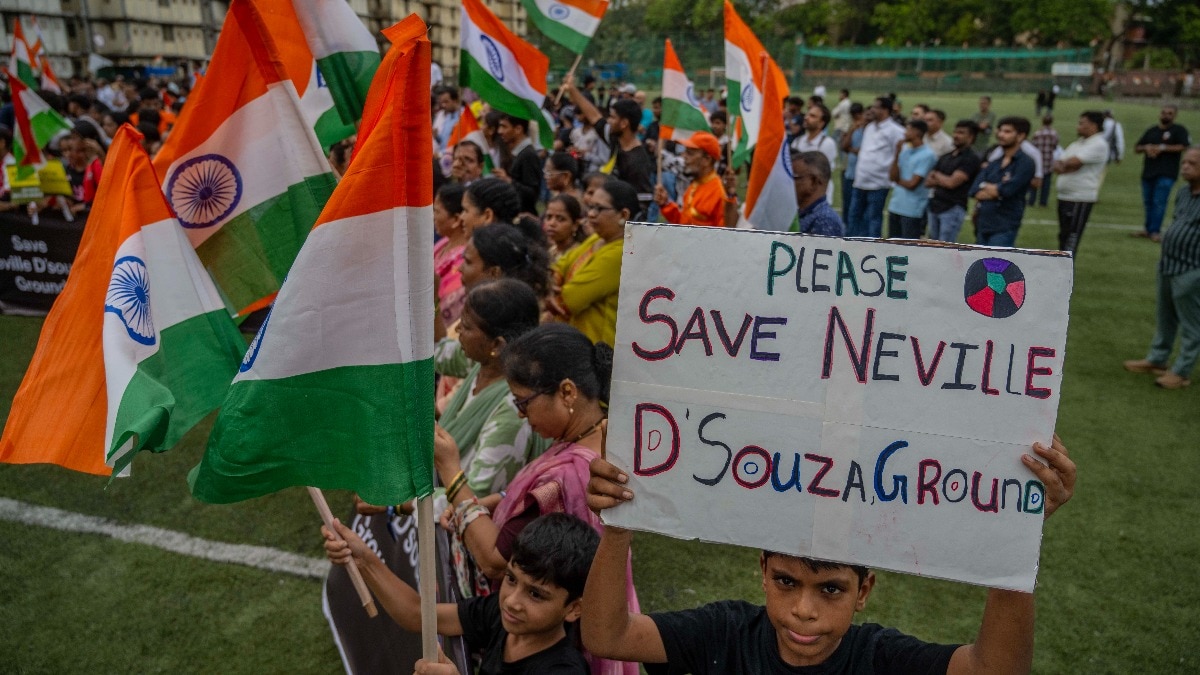
Shiv Sena (UBT) leader Aaditya Thackeray interacts with young protesters opposing the change in the reservation of the Neville D’Souza Football Ground. (Image: PTI)
THE BANDRA FOOTBALL GROUND BECOMES A POLITICAL BATTLEGROUND
What began as a fight over land reservation has now snowballed into a political row as well.
In July, Nationalist Congress Party (NCP) leader Zeeshan Siddique, a former MLA from Vandre East and currently an MLC, backed efforts to retain the ground.
“We must protect Neville D’Souza football ground. In the Maharashtra Assembly, I requested the government to make sure we protect the football ground in Bandra West used by thousands of footballers. We are always complaining about how the Indian football team doesn’t qualify for the FIFA World Cup or our Indian players don’t play in big international clubs, and then these stories come in front. How will our footballers play in the top flight of football if we take away their grounds?” Siddique said.
On Sunday, Shiv Sena (UBT) leader Aaditya Thackeray, who is also the president of Mumbai Football Association, led the “Mumbai Maidan Bachao Tiranga Andolan” at the Neville D’Souza Football Turf. He alleged that open spaces across Bandra West, Juhu, Andheri and Mulund were being targeted by the BJP-led government.
“We can’t represent the country without a ground. We have players but they need grounds. Hence, we urge the government to find a solution,” Thackeray said on Sunday.
The BJP has rejected the Opposition’s allegations.
On August 21 (Friday), BJP MLA from Vandre West and Maharashtra’s Minister of Cultural Affairs, Ashish Shelar accused the Shiv Sena (UBT) of distorting facts about the land’s ownership and intended use. Dismissing the allegation that the plot was being sold, Shelar questioned the origins of the ground’s name.
“Who gave the name Neville D’Souza to the ground? Was it the BMC, MHADA or the state government?” he asked, asserting that the facts would eventually come out.
Even as the BMC’s move triggered a row, a large number of football lovers came out in support of the ground.
Mumbai has no shortage of football fans. But enthusiasm alone cannot produce professional footballers. For children who grow up playing on small artificial turfs or sharing school grounds, access to a professional-standard facility can be the difference between merely playing the sport and imagining a future in it.
Taking away one of those rare spaces without creating an equivalent alternative risks undoing the progress made over the past few years.
– Ends
Published By:
Anand Singh
Published On:
Aug 26, 2026 09:00 IST