

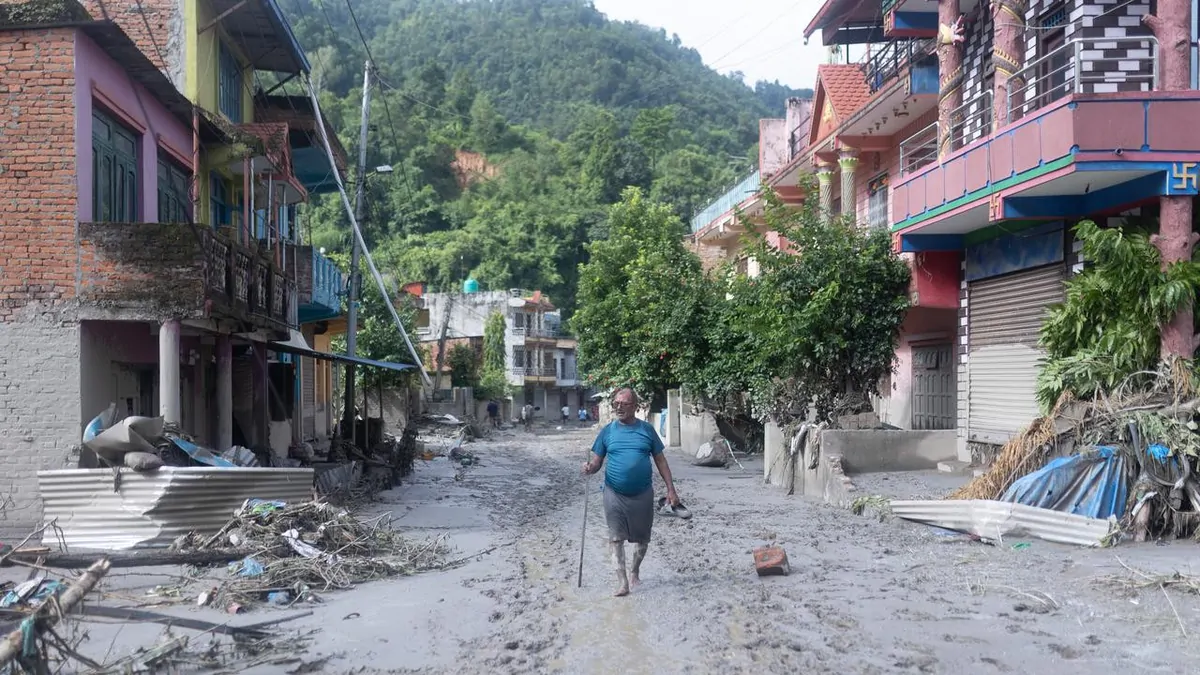
Forty-two Australians remain missing five days after a catastrophic glacier collapse unleashed deadly floods and mudslides across Nepal and China, as increasingly dangerous conditions hamper the desperate search for thousands of people.
The Australian Government said on Sunday evening it was continuing efforts to confirm the welfare of those unaccounted for, as the overall death toll from the disaster climbed towards 800.
Nepal’s disaster authority said 781 people had died and 2502 remained missing, while another 16 deaths and 546 missing people have been reported in China’s Gyirong County.
Sign up to The Nightly’s newsletters.
Get the first look at the digital newspaper, curated daily stories and breaking headlines delivered to your inbox.
By continuing you agree to our Terms and Privacy Policy.
Beijing has also reported that 261 foreign nationals from 23 countries remain unaccounted for in Tibet near a major border crossing with Nepal.
Rescuers are battling rugged terrain, fresh rainfall and rising river levels, with operations repeatedly suspended since Friday amid fears of further flooding. While a lake formed by the disaster had largely drained by Saturday evening, drones later detected another landslide 2.8km downstream which created a new dam and pool of water.
The torrent of ice, rock and debris that swept down valleys has killed nearly 800 people. Credit: AAP
Attention in Nepal has increasingly turned to five inundated hydropower projects, including the Upper Trishuli complex, where authorities received reports that around 350 people could be trapped inside a tunnel.
About 10,000 Nepali troops have joined specialist teams from China and India in the massive rescue operation. Heavy machinery was airlifted to the remote site on Sunday and crews reached the entrance of one tunnel, where they began clearing debris before teams equipped with oxygen and cameras could enter.
“It’s very tough because there’s a lot of debris and we cannot blast things to make our way through,” Nepal disaster management chief Dharam Raj Uprety said.
Australian aid is also being ramped up as survivors face an urgent need for shelter, clean drinking water, food and medical supplies.
The Emergency Action Alliance, comprising 15 charities, has raised more than $3.5 million, including $2 million from the Federal Government. Canberra has also committed another $2 million in assistance to be delivered directly to Nepal by the Australian Defence Force, taking the Government’s total humanitarian support for the disaster to $8 million.
Save the Children global media manager Amy Lefevre visited the devastated Nuwakot district on Saturday and described scenes of widespread destruction and confusion.
“It’s just mud everywhere, there’s also a lot of confusion and chaos,” she said.
“It’s just incredibly sad when you look around and you see someone’s shoes stuck in the mud, or people’s belongings strewn everywhere.
“It’s very much still a rescue operation but of course, today is day five, and I think the chance of finding people alive is slowly dimming.”
Save the Children has reunited 69 children with their families since Friday, but many remain separated from loved ones.
“We spoke to quite a few children who were either on their own or had been separated,” Ms Lefevre said.
“So one of the most urgent concerns that we’re seeing is the need to reunite families.”
For those awaiting news of the missing, the situation is becoming increasingly grim. Authorities have begun mass burials of unidentified victims as bodies deteriorate, while Nepal has requested international assistance with tunnel rescues, DNA testing and forensic identification.
In Australia, a public candlelight vigil will be held at Melbourne’s Federation Square on Monday evening to remember those killed in the disaster as the search for the 42 missing Australians continues.


