At Timure, a small trading town on Nepal’s border with the Tibet Autonomous Region of China, customs officer Rajendra Dhungana was overseeing the morning’s freight movement when the ground shook.
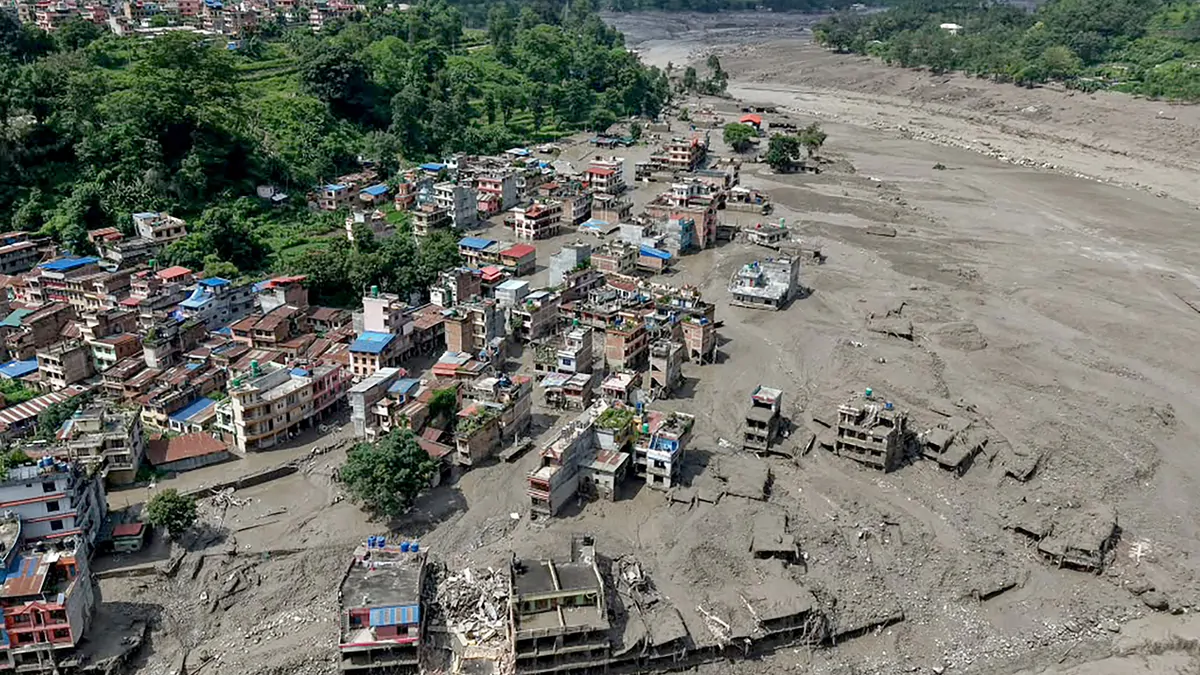
Three minutes later, at 8:40 am on 26 August, a wall of water tore through the valley, sweeping away trucks, cargo and a bridge that had only recently been built.
By evening, close to 100 people across Nepal were confirmed dead, and more than 750, including over 130 Indian nationals working or trekking in the region, remained unaccounted for.
BREAKING: At least 380 people missing after flash flood hits near Nepal-Tibet border pic.twitter.com/iCRpXJaBAe
— BNO News Live (@BNODesk) August 26, 2026
Nepal’s government called it one of the country’s worst disasters since the 2015 Gorkha earthquake, and within hours it had formally asked India and China for rescue support.
A flood born of an earthquake
The disaster began with a magnitude 4.4 earthquake, recorded by the US Geological Survey about 47 kilometres north of Gosainkunda inside Tibetan territory.
Officials suspect the tremor destabilised a glacial lake in the mountains feeding the Bhote Koshi and Trishuli rivers, releasing a sudden torrent through a glacial lake outburst flood, though the exact sequence is still being verified.
A suspected glacial lake outburst, possibly triggered by a 4.4-magnitude earthquake, sent a sudden torrent through Nepal’s Rasuwa and Nuwakot districts. Photograph: (Al Jazeera)
Such floods, caused when an ice or moraine dam holding back a mountain lake gives way, have grown more frequent across the Himalayas as glaciers retreat and monsoon patterns shift, with Nepal recording at least three since last year alone.
Rasuwa and Nuwakot districts bore the worst of it. A 42-kilometre stretch of road linking Betrawati to the Rasuwagadhi border crossing was washed out along with several concrete bridges, while eight operating hydropower plants with a combined capacity of 354 megawatts sustained damage.
Downstream districts, including Dhading and Chitwan, were placed on high alert, and nine South Korean nationals working on a hydropower project were among those reported missing.
What India has sent so far
India’s response took shape within hours, under the government’s Humanitarian Assistance and Disaster Relief framework that guides its aid to neighbouring countries during emergencies.
A first consignment of around 10 tonnes of relief material, including tarpaulins, blankets, solar lamps, hygiene kits and medicines, was flown to Nepal aboard Indian Air Force C-17 and C-130 aircraft, with helicopters kept on standby for evacuation work once ground access improved.
India rushed around 10 tonnes of relief supplies to Nepal by air, including blankets, medicines, hygiene kits and solar lamps. Photograph: (ANI)
Teams from the National Disaster Response Force were placed on readiness at the IAF station in Ghaziabad, prepared to be airlifted in as soon as Nepal’s disaster authorities formalised a request for search and rescue manpower, a sequence that mirrors Operation Maitri, India’s large-scale relief operation after Nepal’s 2015 earthquake, and the consignments sent after Nepal’s 2024 monsoon floods.
The same flood surge also triggered a domestic response inside India.
With the Central Water Commission warning that the wave could travel downstream through the Gandak river into Bihar and Uttar Pradesh, the NDRF activated 20 teams across the two states, in addition to nine already stationed in Bihar as part of routine monsoon preparedness.
The Sashastra Seema Bal placed its India-Nepal border formations on alert, keeping 11 rescue teams active and seven more on standby, while state disaster authorities in Bihar were directed to track river levels closely over the coming days.
Officials said further relief consignments, along with additional NDRF personnel, would be dispatched to Nepal depending on how the situation develops and what the Nepali government formally requests.
A wider, still-uncertain response
Nepal’s appeal was not directed at India alone. China’s Gyirong county on the Tibetan side of the border reported its own deaths and hundreds missing, and was managing casualties from the same disaster, while the World Bank indicated it could mobilise up to Rs 25 billion for emergency reconstruction and the European Union activated its Copernicus satellite service to map the affected areas.
As rescue efforts continue for hundreds still missing, India has kept IAF aircraft and NDRF teams ready for further operations. Photograph: (TOI)
Nepal’s authorities told parliament they were still confirming whether the earthquake and flood were directly linked, and that officials needed to verify the exact timeline before drawing firm conclusions.
Search and rescue operations continue in Rasuwa and Nuwakot, with the Nepal Army and armed police units working alongside international teams to locate those still missing.
Beyond the immediate relief effort, the disaster has reopened a longer conversation between Kathmandu and its neighbours about building a real-time, cross-border early warning system for glacial lake outburst floods, a gap that has repeatedly left mountain communities on both sides of the border with almost no notice before disaster strikes.