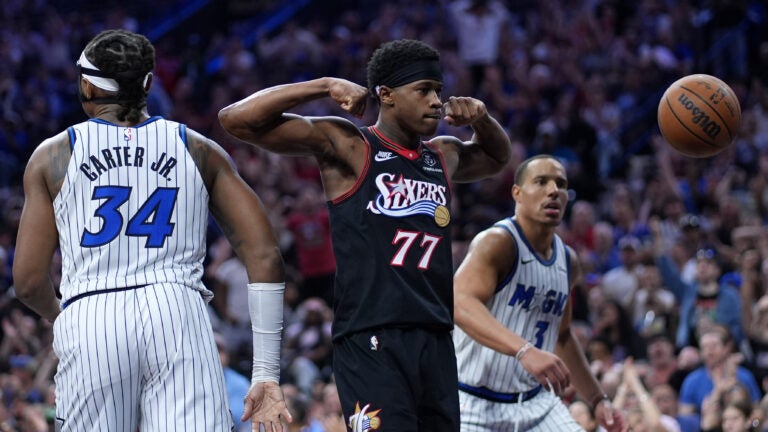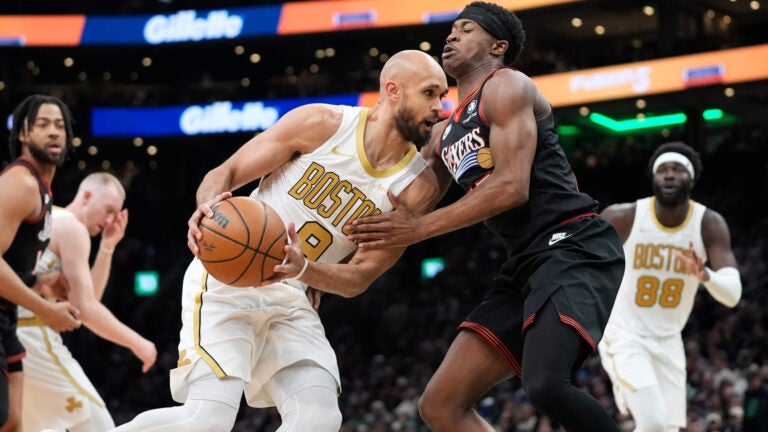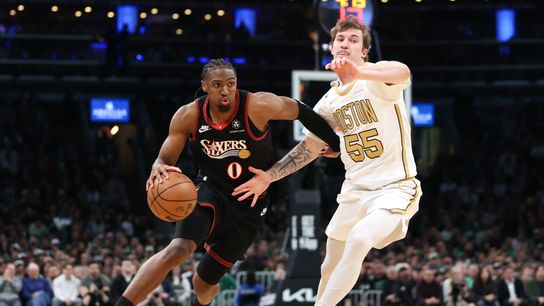
The Philadelphia 76ers have talented players. VJ Edgecombe scored 34 points against the Boston Celtics in his first-ever NBA game. Paul George has entered a renaissance of sorts in the last month. Andre Drummond is an elite rebounder, Kelly Oubre Jr. is a hard-nosed defender, and Quentin Grimes can catch fire.
But it all comes down to Tyrese Maxey.
With Joel Embiid sidelined, and sometimes, even when Embiid is healthy, Maxey is the head of the snake in Philadelphia. Stopping him — or, more aptly, managing his impact — will be the key to a Celtics series victory.
Boston and Philadelphia have played four times this season, but it’s hard to pull much from the first three meetings. All occurred on or before Nov. 11, and back then, the Celtics’ roster looked very different.
Josh Minott spent time guarding Maxey, Anfernee Simons was one of the Celtics’ help defenders, and Baylor Scheierman wasn’t in the regular rotation.
That leaves March 1 as the leftover game to pull footage from.
© Paul Rutherford
Tyrese Maxey drives past Jaylen Brown
The Tyrese Maxey conundrum
Scheierman got the Maxey assignment in that one — a game that ended in a 114-98 Boston win — and the Sixers star shot just 3-of-10 from the field when guarded by the Celtics’ second-year wing.
But it wasn’t all Scheierman. He wasn’t a one-on-one maestro in that game. In fact, Maxey got the best of him on a couple of occasions.
Step-in threes out of the pick-and-roll are the first danger point to watch out for. The Celtics gave these up in bunches in all four matchups, and if Maxey is making them, Philadelphia is dangerous.
Go over a screen that’s set high up the floor, that happens. But go under a screen, and Maxey is more than comfortable pulling up from deep range, too.
Jordan Walsh found success guarding Maxey on Nov. 11, especially down the stretch, but his up-and-down focus often results in Scheierman being higher than him on the depth chart.
Hugo Gonzalez has done a solid job at containing Maxey, too, but like Walsh, there are downsides. And even when Walsh, Gonzalez, or Scheierman successfully gets over the screen, takes away Maxey’s three-ball, and gets back in front of him, the Sixers star still has one final 3-point trick up his sleeve:
But 3-pointers aren’t the only damage Maxey can provide on the court. When Boston takes away his long-range attack, he can get downhill with ease.
His floaters in the lane are tough to stop, especially when bigs are backed up in drop coverage. The outstretched arms of Neemias Queta aren’t long enough, and Nikola Vucevic (and Luka Garza) often play such a deep drop that contesting Maxey’s floaters is nearly impossible.
And when Maxey drives to the rim in any capacity, he’s liable to make a circus shot. That’s just what the best players in the world do.
Add in his elite transition attack, and there’s a lot for the Celtics to worry about when it comes to managing Maxey’s impact in the first round.
So, how did they attempt to do so during the regular season?
Well, first and foremost, they didn’t let Scheierman do it alone. If the Sixers screened with someone other than the big man, they often switched (if it made sense). And they can employ that tactic in this series.
Outside of Queta, Vucevic, and Garza — all of whom Boston doesn’t want guarding the perimeter too often — anyone can switch onto Maxey. That’s part of what makes the Celtics’ defense so elite.
Obviously, Boston would rather have someone like Scheierman, Walsh, or even Derrick White checking the high-speed guard, but if Sam Hauser needs to switch onto him for a possession, the Celtics can live with that.
Why? Because again, it’s never a solo mission.
The Celtics also chose to “ice” the screen at times when Maxey had the ball in his hands. This is when a defense guards the pick-and-roll in such a way that forces the ball-handler to drive toward the sideline rather than the middle of the floor.
You can hear Joe Mazzulla call out “ice” on this play here. See how Scheierman immediately adjusts his positioning when he hears that? So, instead of Maxey getting double screens into the middle of the floor, he was forced to drive into the sideline.
This made him drive into an awaiting Queta and Hauser in the lane.
Now, those last two clips also presented another issue that is a product of Maxey’s dominance: Defensive rebounding. However, Philadelphia only averaged 9.3 offensive rebounds against Boston this year, and the Celtics’ defensive rebounding has improved substantially throughout the season.
With Jayson Tatum back in the fold and a newfound appreciation for attacking the defensive glass, Boston should be able to contain the Sixers’ offensive rebounding efforts.
Those two examples were a consequence of Maxey’s gravity, and those situations will pop up. But by and large, the Celtics have controlled the glass against the 76ers this year.
In the second clip, Queta helped up to the level of the screen. Boston used this tactic at times against Maxey, and when it worked, it worked. Here, Queta steps up just long enough to give Payton Pritchard time to recover and contest Maxey’s mid-range attempt.
But when it didn’t, it really didn’t. Queta has significantly improved as a perimeter defender. He can move his feet. Just not as quickly as Maxey can move his.
The key is the help in the middle of the floor.
On a lot of these clips, you can see someone like White or Hauser shift over from the wing or corner. They want to put just enough pressure on Maxey to make life difficult without giving up easy kick-out passes.
But it’s not always about actually getting an extra body on Maxey. It’s about simply showing him an extra body.
Scheierman does a great job of fighting around screens on this play. His last get-around attempt fell flat, and Maxey got an open pull-up three. That’s not ideal. But look at what’s happening in the middle of the floor.
White is shifted over into the paint. Gonzalez is acting as a last line of defense. Maxey had nowhere to go. No room to drive. All he could do was take a pull-up.
Ideally, Boston would force Maxey into a tough two-pointer or mid-range floater here, but Scheierman got stuck on Drummond after a valiant effort. The point is, they didn’t let him get all the way downhill.
Also, often unnoticed in box scores and highlight reels is ball denial. It’s small, but watch Scheierman adjust his body here. He’s barely looking at the rest of the play.
His one and only goal is to keep Maxey away from the ball. And if he does get it, he just wants to contain him.
But perhaps the biggest adjustment Boston seemingly made, compared to the two games in Philadelphia, was allowing Maxey to shoot more.
It sounds backwards, yes. Let the best player on the court shoot all the shots. But in reality, that’s exactly what happened on March 1.
Philadelphia only got 31 3-point attempts. And Maxey and Edgecombe accounted for 22 of them. In fact, throughout the entire course of the game on March 1, Maxey created eight half-court threes for his teammates.
Four were for Edgecombe. Two were for Oubre. Two were for Drummond, whom Boston is likely okay with shooting threes, especially if they are contested.
Yet the Celtics got a hand up on all eight attempts.
Philadelphia shot 1-of-8 on those shots, with the only bucket coming from Drummond. (Maxey did create an Edgecombe three that went in, but it came out of transition, as Boston was scrambling back on defense.)
Meanwhile, in the two games in Philadelphia, Maxey had a nine-assist game and a 14-assist game. Boston sent way more help at Maxey than they do now, and a huge part of that decision was seemingly personnel-based.
Xavier Tillman Sr. was playing rotational minutes, putting Boston in a pickle when it came to defending the rim. So, they sent help earlier.
Simons was on the floor, and the Celtics didn’t want to leave him on an island (or he got blown by), so, again, they sent help earlier.
Scheierman hadn’t established himself as an every-night piece. Queta still wasn’t playing 30 minutes a night, as he was getting used to playing heavy minutes.
And perhaps most significantly, the Sixers were able to run the pick-and-pop because Embiid was available, spacing the floor to the top of the key.
Now, things are completely different.
Tillman and Simons were traded at the deadline. Boston still has to worry about Vucevic and Garza in drop coverage, but replacing Simons and Minott with Scheierman, Walsh, and Tatum gives the Celtics’ perimeter guys a better chance.
And with Embiid out, Philadelphia doesn’t have a reliable pick-and-pop threat, making the Celtics’ life a bit easier.
Nowadays, Boston is much more wary when it comes to overhelping on Maxey. The Celtics don’t want to get burned on kick-out threes.
But they also strive to protect the rim above all else.
The solution? A blend of both.
Queta, Vucevic, and Garza protect the rim. But the Celtics also feed a steady stream of defenders into the paint early enough to thwart drive attempts while also giving their guys enough time to get back out to the 3-point line and prevent shots.
The result is a heavy dose of Maxey and Edgecombe shot attempts, but a locked-in approach to making those chances as difficult as possible.
-
Maxey loves step-in (and step-back) threes.
-
He’s a blur in transition and almost impossible to stop
-
Showing help can help prevent his drives
-
Containing his abilities as a playmaker worked in the latest game
© Bill Streicher
Paul George
The Paul George addition
There is one guy on Philadelphia’s roster whom the Celtics haven’t seen yet this season: George. He’s dealt with injury issues and a 25-game suspension for violating the NBA’s anti-drug policy, reportedly for taking “improper medication.”
The star veteran has been playing well lately. In his last 15 games, George has averaged 21.0 points, 5.7 rebounds, 3.3 assists, and 2.2 steals while shooting 47.2 percent from the field and 41.5 percent from deep range on 8.2 3-point attempts per contest.
His addition to the 76ers’ lineup will certainly throw a wrench into some of Boston’s plans. They can’t help off him as much, though living with George isolation possessions may be more worthwhile than dealing with Maxey one-on-one on a consistent basis.
If nothing else, his shot from beyond the arc gives Maxey one more guy to kick out to and the Sixers’ one more guy to trust with the ball in his hands.
© Paul Rutherford
VJ Edgecombe drives on Baylor Scheierman
The third head of Philadelphia’s three-headed monster, Edgecombe burst onto the scene this season by way of a 34-point master class on opening night in Boston. He followed that up with an efficient 17 points on Halloween.
However, since then, Edgecombe hasn’t been nearly as effective against the Celtics. He went 2-of-11 on Nov. 11 (though the Sixers won) and just 8-of-21 in the Celtics’ win on March 1.
In a way, Edgecombe’s shot profile is very similar to Maxey’s, though they get to their spots in different ways. The Sixers rookie likes to pull up for three off screens, drive to the rim, and create his own mid-range looks off the dribble.
But despite all those skills, Edgecombe’s desire to get out in transition may be his most dangerous offensive trait. He can score in isolation and drain threes, but more than anything, he runs.
Edgecombe is a ball of fire. He sprints around the court — in the full-court and half-court — seeking out scoring opportunities off cuts, drives, and pull-ups.
And the best way to slow down his transition attack, and Maxey’s, is for the Celtics to control their offense.
© Paul Rutherford
Jaylen Brown drives on Kelly Oubre Jr.
Offense vs. the 76ers
For as much offensive talent the 76ers have at their disposal, they don’t exactly have an elite front line of defense. And their back line isn’t great, either.
Maxey is quick, and he gets a ton of steals, but he’s small. One switch to get Jaylen Brown or Tatum onto him, and he’s in trouble.
Edgecombe stands up well, but there’s only one of him, and he’s prone to getting beat off backdoor cuts. As for George, though he was a DPOY finalist in his prime, he’s 35 years old now.
Philadelphia’s best defensive piece is Oubre, and there’s only one of him. It seems likely that he’ll be on Brown or Tatum, and Edgecombe (or perhaps George) will get the other assignment.
But the Sixers’ bigs are the biggest point of weakness for Boston to attack, especially because Philadelphia loves to send help.
Here, Drummond drops back because Brown drives back Dominick Barlow. Maxey gets lost in no-man’s land trying to stop Queta, and Hauser gets an open three.
On this play, the Sixers once again send two to the driver in the pick-and-roll, with Grimes helping from the corner to slow down Queta. But a skip pass from White to Hauser puts Grimes off-balance.
Hauser drives the closeout, finds an open White (who respaced) on the opposite wing, and Walsh gets the final swing pass for an open look.
Philadelphia’s defense goes into rotation very easily, and the Celtics have been able to take advantage of that. And even though they didn’t shoot the ball super well on March 1 (16-of-49 from deep; 32.7 percent), they found another way to dominate the Sixers.
© Paul Rutherford
Neemias Queta
Boston’s offensive rebounding
The Celtics have been one of the better offensive rebounding teams all season, and, despite having Drummond in the mix, the Sixers have been prone to getting shredded on the offensive glass.
In fact, the Sixers gave up the fourth-most offensive rebounds per game this season (12.1). Meanwhile, Boston’s 12.5 per game ranked seventh in the NBA. On March 1, led by Queta’s 10, the Celtics corralled 19 offensive boards, scoring 30 second-chance points (12-of-21 shooting).
Much like Edgecombe’s occasional lapse in focus that results in an opponent’s off-ball cut, the Sixers are predisposed to ball-watching. Rather than boxing out and getting a body on their opponent, they just watch the rebound.
On March 1, that allowed the Celtics to attack the glass.
Even when they had no business beating Philadelphia to the ball.
And when the 76ers weren’t ball-watching, Queta just beat them to the punch.
Queta finished the game on March 1 with a career-high 27 points to go along with 17 rebounds (10 offensive), two assists, one steal, and three blocks. He shot 10-of-14 from the floor and 7-of-10 from the free-throw line.
Defensive rebounding is a weakness in Philadelphia’s game that Boston will surely look to exploit throughout the course of the series.
© Paul Rutherford
Payton Pritchard, Sam Hauser, Andre Drummond, and Quentin Grimes
There is obviously more to the 76ers. They have other players who do other things that will pop up throughout the series.
Trendon Watford has been an all-around, do-it-all guy for the Sixers at times. Adem Bona’s energy and rim protection could catch Boston off guard. Grimes and Justin Edwards are a couple of makes away from going nuclear.
But as the Celtics prepare for their first-round matchup, Edgecombe, George, and most of all Maxey will be the focus.
Combined with preventing transition opportunities, taking advantage of mismatches, and crashing the offensive glass, that is Boston’s guide to taking on Philadelphia in Round 1.