It’s autumn in the Barossa Valley, and Maggie Beer has been at her farm, enjoying the crisp air and changing colours of her favourite season.
As she wanders past the quince trees, she picks up the fallen fruit. The smell fills her car on the drive home, conjuring in her mind the lamb dish she will prepare for dinner.
It’s hard to imagine that less than two years ago, Beer — an icon of Australian cooking, a woman whose love of food and flavour has shaped her entire life — didn’t want to eat.
Sign up to The Nightly’s newsletters.
Get the first look at the digital newspaper, curated daily stories and breaking headlines delivered to your inbox.
By continuing you agree to our Terms and Privacy Policy.
In August 2024, Beer fell down the stairs at home, breaking multiple bones and suffering internal injuries. She spent two weeks in the intensive care unit, including a stint being fed through a tube. Even after she was released, her appetite was missing. No delectable treat could turn her head, yet she knew she needed to eat to heal.
It was a confronting time for Beer, but also invaluable: she now knows first-hand the issues at the heart of improving nutrition for older Australians, which she has championed via the Maggie Beer Foundation for the past 12 years.
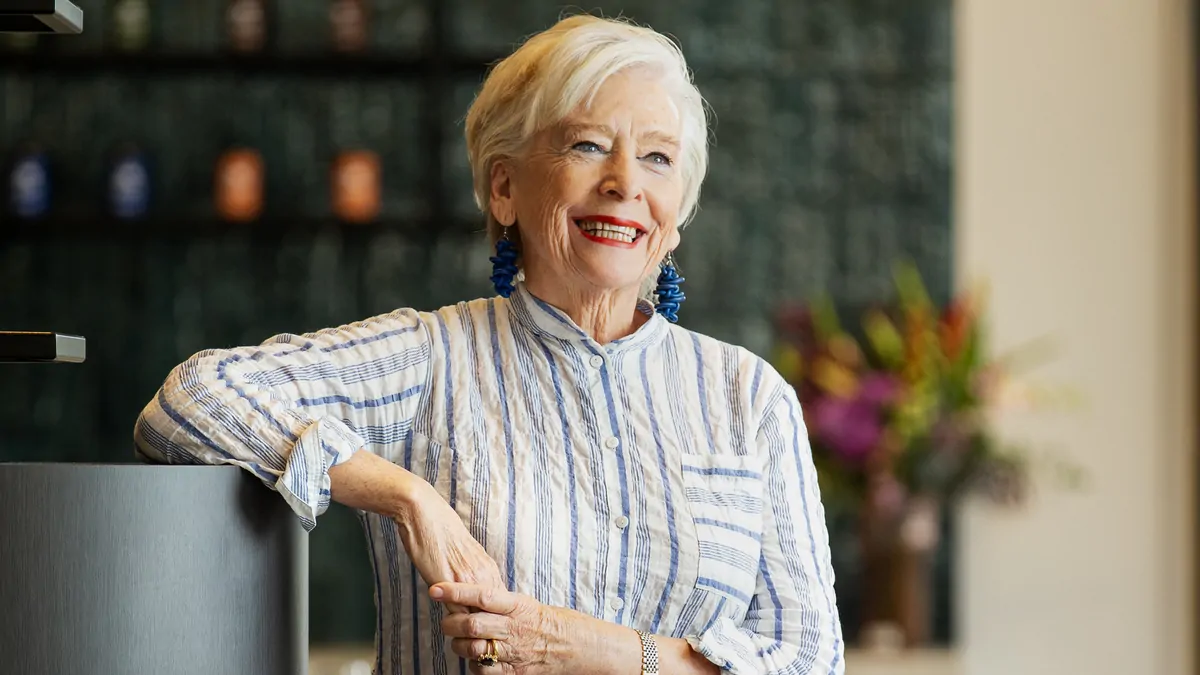
Beloved Australian cook Maggie Beer. Credit: Dragan Radocaj Photography/The Nightly.
“I always knew it intellectually, but once you experience it yourself and realise what it is like, you understand,” Beer tells The Nightly.
“I mean, food is so vital to me . . . but there was nothing that could tempt me, until the sense of smell finally got me. But I never thought I would actually experience it and I never realised (what it felt like) emotionally. Now I know what people are facing, when it comes to trying to get older people to want to eat something.”
The fall took a year to recover from, during which the perpetually-in-motion Beer was forced to rest. But now she is feeling stronger, she dismisses any suggestion of a quiet retirement.
“I am 81 but I’m not slowing down yet,” she says, with her trademark warm laugh. “I’m involved in as many things as I can be, but I also have wonderful people around me so that I can do the things that I’m good at.
“That’s been the secret of me being able to step back where I can, but still be very involved.”
Stepping back is not something Beer has historically been very good at. She is a self-confessed workaholic, who reached the point of burnout more than once while she and husband Colin built their renowned South Australian restaurants over more than five decades, including the acclaimed Pheasant Farm Restaurant and later The Eatery, Maggie Beer’s Farm Shop and her line of gourmet produce.
But at the foundation, she has gathered a “phenomenal” team — CEO Jane Mussared, COO Lesley Woods and project lead Jemma Gonzalez — who allow her to learn to loosen her grip.
“All my life I’ve been a control freak and unable to step back,” Beer admits, “because there have been times when we haven’t been able to find or afford the people in business life that we needed. But with the foundation, I have changed.
“There is no one in the foundation that sees it as a job. It is, at all levels, a commitment.”
Maggie Beer says her experience following a horrific fall helped give her fresh inspiration in her push to make life better for older Australians. Credit: Ross Swanborough/The West Australian
The Maggie Beer Foundation was born, at least in part, from its namesake’s inability to turn a blind eye.
Through her popular products, acclaimed restaurants and TV appearances — she shot to prominence on The Cook And The Chef opposite Simon Bryant, who describes her as a “force of nature” — Beer’s profile grew into that of national treasure.
In 2010 she was named Senior Australian of the Year.
In those 12 months, Beer received 900 speaking requests, so she pragmatically focused only on those “where I felt I could do something”. One was to a conference of the executives of aged-care facilities. It would be a life-altering choice.
“That speech was the trigger,” Beer remembers. “In preparing that keynote, it opened my eyes to the great things and the terrible things (happening in aged care). The terrible things were not acceptable, and the great things needed to be celebrated. I tried many other things in between to try to make a difference, but it was only when I formed the foundation in 2014 that it really gave me the tools to be able to do more.”
The foundation’s mission sounds simple: to uplift the quality of life of older Australians, particularly those needing aged care, through the joy and nourishment of healthy, tasty food.
The reality is, of course, more complicated. Budgets, cooking skills, bureaucracy and sheer inertia, not to mention age-related and medical issues that can mean certain textures and preparations are dangerous, have all been thrown up as roadblocks to the changes Beer sees as necessary.
Beer says there’s no one in the Maggie Beer Foundation who sees it as a job. “It is, at all levels, a commitment.” Credit: Hilary Wardhaugh/Getty Images
“There was opposition, to put it mildly,” she concedes. “But mostly there’s been agreement that this is so important. For me, I’ll always work with people ready to move, and others will follow.
“That’s the way I cope with the opposition. I’m a very determined person, so you tap into the ‘yes’ people who can see it and are with you, and that creates the groundswell.”
A vital part of the foundation’s work has been training programs for kitchen staff in aged care, by its chef mentors; it received $7.2 million in the Federal Budget to continue for the next four years. The funding was welcome, although not the increase it had hoped for to allow it to meet demand.
Research by HealthConsult found the training left about nine out of 10 participants better able to prepare nutritious, flavourful food and more confident they could overcome any barriers to change.
Seeing the impact on those kitchen staff strengthens Beer’s already formidable resolve. She is driven, but the warmth and kindness for which she is known also permeates.
“I lead by being able to share my passion for the work we need to do and practical application of how we can do it,” she says. “My style is very much having the chance to engage and to make people feel that they are on the path, that they’re part of something important.
“The foundation now is much more than me, but we bring people along and lift them up; not ever, ever denigrating them in any way. The warmth is also in the chefs we choose, the empathy they have and their ability to mentor and foster that in others.”
This year, Mission Australia’s Charles Chambers Court aged-care facility in Sydney’s Surry Hills was chosen as the best of the more than 50 homes that had completed the 12-month training program; Beer recently spent a day there. Her face lights up at the memory.
“Can I tell you, the joy that was there,” she marvels. “The pride in the team, the way they presented lunch. Everything that I ate, I would have been happy to have on my table at home. But that positive energy that emanated from every single person, that comes from pride and respect and connection. It was just magic, truly magic. And that’s happening in lots of other places as well.”
When a 2021 royal commission into aged care found that 68 per cent of residents were either malnourished or at risk, it spurred Beer to helm a series for the ABC. In Maggie Beer’s Big Mission, she and other experts went into a home in Perth to try to transform the food and culture.
The beloved 81-year-old chef says she’s “not slowing down yet”. Credit: Ross Swanborough/The West Australian
It was six months of work, a “huge undertaking”, and Beer knows some critics saw it as “trying to put a blot on the industry”.
“I was so careful to be respectful, and I just fell in love with the people,” she says. “But I understood it was a gift to me, too, because it taught me so much about that connection between the carers and the residents and how emotionally attached they were, their openness to change and the joy they felt when things got better.
“Everyone works very hard in aged care, so it’s how you can help them find ways to work better, rather than harder. But often you have to step back to be able to look at it, and management doesn’t have time to step back often . . . It is about sustaining change. It’s not easy.”
Series producer Laki Baker says, “this is not the shiny floor show we’re used to seeing (Beer) on”.
“This is very real and for a woman who is the same age as many of the residents we meet, it’s confronting and at times overwhelming,” Baker says. “Her humility, openness and incredibly positive and hopeful view has been inspirational.”
The experience certainly tested the attribute that Beer lists as key to good leadership: the ability to have open conversations about how things can be improved, without it coming across as criticism.
She traces some of her most profound lessons on leadership back to age 14, when she had to leave school to work because her parents had lost their business.
“My aunt Gladys was a spinster, as they used to call them: six foot tall and the headmistress of a boys school,” Beer remembers. “In those days, can you imagine? She was imperious, in a way, but she told me that you never stop.
“She fed me with the books I needed to read and and taught me that learning is a lifelong thing, which stayed with me forever.”
A job at the Sydney office of the US Consulate General introduced her to consul Erna Beckett, who taught Beer, then in her mid-20s, to always question how she could do better, without her ever feeling she was being critiqued. At her next job, with nutritionist and educator Doreen Langley at the University of Sydney, she learned how to bring people along when changes needed to be made.
Combined with her positive outlook (from her mother) and an instinct for food (from her father), Beer says her own rise into a position of influence was underpinned by her marriage of 56 years.
“Part of what has given me success, I’m not sure I call it leadership, but it’s my ability to share my knowledge with others,” she says. “It just comes instinctively, because I’m so passionate and I’m also full of things you might not find in a book.
“But it took confidence to know that I can do that, and I wasn’t always that confident person. It really only started in my 40s and it came from my Colin’s belief in me. That has been a very important part of my life: having someone who believes you can do it, even if you are unsure yourself, because we all suffer from impostor syndrome at times.”
That duality in Beer — determined to confront the negative, but also to recognise and celebrate the positive — is at the heart of her answer when asked about the complexities of trying to lead change on an issue she considers so urgent.
“I thought about this quite a bit, and everything that may be a drawback can also be a benefit,” she says.
“For example, impatience can be a drawback, but it also creates an energy and an urgency. Single-mindedness can be a drawback, but it can also lead to real change and high standards. I’m never going to apologise for that, but it can be seen as unattainable by others.
“But if you fix the North Star and you chase it, setbacks become just that: something where we work out how we can go forward, rather than roadblocks or reasons to turn around or compromise.”