

Crime
“I think that when you look at true crime overall, people are looking for really clean narratives, and those often don’t exist.”
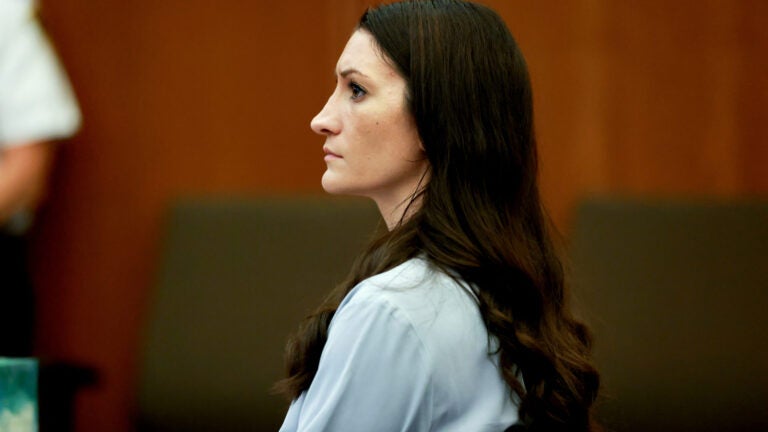
Lindsay Clancy’s murder trial still has a ways to go, but in the court of public opinion, internet sleuths have already reached their verdict.
Clancy has admitted to strangling her three children at home in Duxbury on Jan. 24, 2023 — those key facts aren’t in dispute. But as jurors work to determine whether Clancy was in her right mind at the time of the killings, some true crime aficionados have latched onto a more sordid theory.
Fixated on irrelevant minutiae and armed with baseless accusations, these armchair investigators have instead pointed blame at Clancy’s ex-husband, Patrick. His clothing that night, his body language, his subsequent remarriage — all of it has become fodder for an online true crime fandom of epic proportions.
But why?
“I think it’s a really uncomfortable case, and I think that is part of why people are drawn to it and are trying to understand it,” said Kathryn Coduto, an assistant professor of media science at Boston University who has studied the intersection of social media and true crime.
“It’s really uncomfortable for us to see someone who has clearly been in distress, who tried to get help and did not get what she needed,” Coduto continued. “And I think that when you look at true crime overall, people are looking for really clean narratives, and those often don’t exist.”
Margaret McLean, a true crime podcaster and former prosecutor who taught at Boston College, has another word for the conspiracy theories surrounding Clancy’s case: “Clickbait.”
“If people followed the case from day one — or even before, like I have — and you listen to the horrible 911 call in which Patrick Clancy was just agonized over finding his three children strangled like that, you would not buy into any of these conspiracy theories that he did it,” McLean said.
Lindsay Clancy, now 36, does not deny she strangled 5-year-old Cora, 3-year-old Dawson, and 8-month-old Callan. However, she’s raising what’s commonly known as an insanity defense as she argues she was in the throes of postpartum mental illness and heard a voice in her head instructing her to kill.
Jurors in her trial heard testimony last week from several mental health care providers who testified that Clancy was increasingly anxious and depressed in the months leading up to the killings, even as she repeatedly denied having thoughts of wanting to harm herself or the children.
Patrick Clancy, who has since divorced Lindsay and remarried, now lives in New York. But he’s described his ex-wife as a “very dedicated” mother and previously told The New Yorker, “I wasn’t married to a monster — I was married to someone who got sick.”
“I see a husband who loved his wife at the time, and he was trying to get her help,” McLean said, noting that Patrick Clancy attended some of his wife’s psychiatric appointments and even sent her a text calling her a “good mama” just hours before the killings.
“This is not painting a picture of a man who would kill his children and then set his wife up for it,” McLean added. She also dismissed the social media users who have sought to cast Patrick Clancy’s remarriage and move to New York in a suspicious light.
“There are many reasons why somebody who experienced a tragedy like seeing all your children strangled — I mean, I can’t imagine — might ultimately move away,” McLean said. “He might not want to be alone.”

To be clear, Patrick Clancy is not on trial; he has not been charged in connection with his children’s deaths, nor have prosecutors indicated he played any role in the killings. Meanwhile, it’s unclear just how many of the social media users posting Patrick Clancy conspiracy theories actually believe them.
“I think it’s a mix, right?” Coduto said. “I would say it’s the minority, honestly. I think there’s a minority who think, ‘No, this really is an elaborate cover-up.’ And these are people who get so sucked into the case.”
Like McLean, however, she noted the incentive for online creators to try to cash in on the popularity of true crime content.
“I do think for a lot of these people, perhaps very cynically, I think they know that they’re going to be able to get clicks, potentially monetize the content,” Coduto added. “So I think there’s definitely a monetary angle that I think is really uncomfortable and I think disingenuous.”
Both she and McLean suggested Karen Read’s high-profile murder trials — a case dominated by allegations of third-party culprits and mismanaged evidence — may have sharpened local interest in true crime conspiracy theories.
“I absolutely think that is having a trickle-over effect to this case,” Coduto said, adding, “Part of true crime overall is that there’s a whole true crime media environment, and so anything you’re consuming, you’re not consuming in a vacuum. And I think a lot of these people get influenced by what they learned from one case to the next.”
She was also careful to note that the online spread of misinformation — as in the unfounded conspiracy theories surrounding Clancy’s case — can erode trust in media across the board.
“One of the things that I worry about a lot, and part of what got me interested in studying this angle, is I do feel like people forget that these are real people involved in the crimes,” Coduto added. “I think it’s easy to want to make a spectacle of someone that you don’t know.”
McLean likewise urged true crime content creators to act more responsibly online.
“They need to back their arguments up with fact instead of just spouting out these nonsensical conspiracy theories, because they are hurtful to people,” she said.
Coduto concurred.
“To me, it becomes a big question of ethics, right? So, how are you treating these real people who have had some of the worst things ever happen to them?” she asked. “And I always think, with some of these people who are making these videos, how would they feel if, you know, the positions were flipped?”

Sign up for the Today newsletter
Get everything you need to know to start your day, delivered right to your inbox every morning.
