At sunrise in Patna, the steps of the Ganga ghats glow briefly in soft gold. Priests prepare for morning rituals. A faint mist hangs above the river. And then, as the light grows sharper, so does the reality — thermacol plates float near the banks, plastic glasses lie crushed underfoot, and tourists quietly turn away.
For years, people have complained about the state of the ghats along the Ganga. The trash became routine — an eyesore everyone noticed, but no one owned.
Everyone except Shubham Kumar.
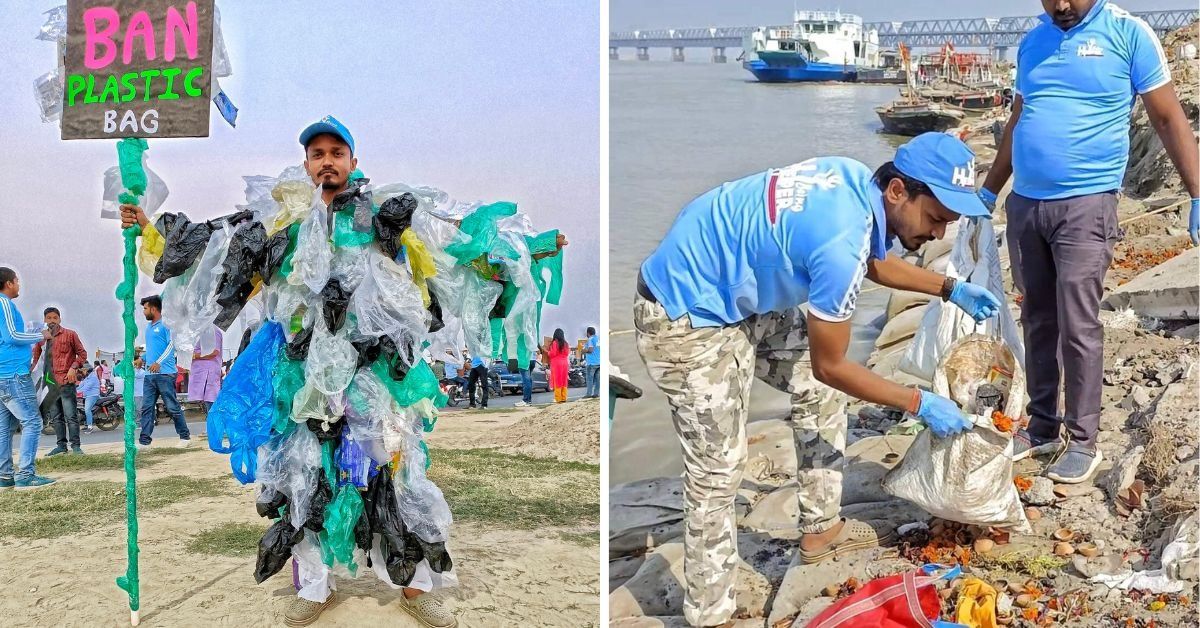
Every Sunday morning, he showed up at the ghats. Gloves on. Bags in hand.
An engineer by degree, Shubham worked four years outside Bihar. Like many others, he built a life away from home. But when he returned and saw his birthplace buried in garbage, he could not ignore it. Instead of joining the chorus of complaints, he made a decision — he came back to rebuild.
https://www.instagram.com/thebetterindia/reel/DVNMrMXCA0d/
Every Sunday morning, he showed up at the ghats. Gloves on. Bags in hand. He named the effort the Ganga Ghat Safai Abhiyaan. In the beginning, it was just a handful of volunteers. The first few Sundays, barely anyone turned up. A few shopkeepers laughed too.
“Yeh sab nautanki hai,” (all this is drama) they said.
They said the trash would be back by Monday.
But the next Sunday, Shubham returned. And the Sunday after that.
Instead of arguing, he started conversations. He distributed more that 5,000 dustbins. He explained how plastic would hurt businesses and how clean ghats would attract visitors. He explained to the shopkeepers how dignity and development go hand in hand.
Slowly, resistance turned into support.
The numbers began to shift. Today, there is a 98% drop in thermacol plates. A 65% drop in plastic glasses. 1,43,612 kgs of plastic are removed — the weight of 20 elephants. Over 2 lakh plastic bottles are recycled.
But as the ghats grow cleaner, Shubham noticed something else — women avoided the space due to fear of harassment. Cleanliness alone is not enough if safety is missing.
But as the ghats grow cleaner, Shubham noticed something else — women avoided the space due to fear of harassment. Cleanliness alone is not enough if safety is missing.
So he sets up changing rooms. Clean spaces became safer spaces, and safer spaces brought visitors back.
Today, more than 16,000 people earn from the restored areas. What begins with one man and a few volunteers now grew into a movement of over 1,100 volunteers. The work expands beyond Patna — reaching Ranchi and Varanasi.
At the ghats now, mornings look different. The river still flows as it always has. But the steps are clearer. The crowds return. Livelihoods revive.
Civic sense, Shubham proves, is not a viral moment. It is repetition. It is responsibility. It is showing up when no one else does.
Some wait for cities to improve. Others pick up the first bag themselves.