Home Improvement
Here’s the latest in swimming pool trends — and how much it could cost you to install one.
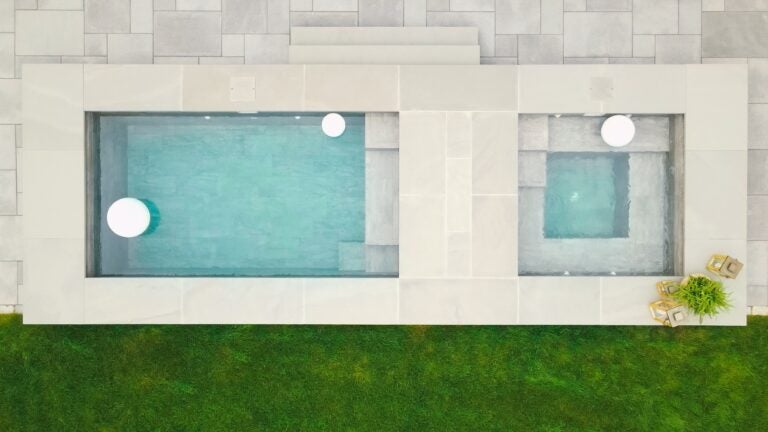
Plunge pools are becoming more popular as they are smaller and require less water. Jon Caron
One lazy summer Sunday, Neddy Merrill set out to swim across the county, envisioning a river made of his neighbor’s contiguous swimming pools. So went the beginning of John Cheever’s 1964 short story “The Swimmer.”
“He seemed to see, with a cartographer’s eye, that string of swimming pools, that quasi-subterranean stream that curved across the county,” wrote Cheever. Merrill’s plunge was as symbolic as it was chlorinated, and at least at first, pools represented promise and prosperity, nostalgia and romance. (The 1968 movie version was filmed in neighboring Connecticut.)
And in 2026, Massachusetts residents can add one more point of inspiration: it’s getting hotter. As temperatures warm and summer stretches further than ever, Massachusetts ranks in the top 10 for residential swimming pool installation, not far behind the scorching climates of Florida and Arizona, according to a 2025 industry report by RenoSys.
And Massachusetts ranks No. 6 nationally in installed inground pools per 100,000 residents with 1,847 per 100,000, said Sabeena Hickman, president & CEO of the Pool & Hot Tub Alliance, a Virginia-based nonprofit industry group, citing PKData’s 2025 figures.
Plunge pools and “natural” pools
A plunge pool in Milton. – Jon Caron
“We do find now that people are just desperate for a body of water in their backyard because it is hotter,” said Karen Larson, cofounder of Soake Pools, a New Hampshire-based company that manufactures plunge pools for year-round use. Smaller plunge pools are an emerging market. They can fit in tight backyards, use much less water, and require less energy to heat.
While warming temperatures may drive some into the water, the question of a pool’s ecological consequence emerges. Pool construction and operation can have plenty of ecological impact: transportation fuel and emissions, materials, water supply, and maintenance chemicals all add up.
Nantucket-based landscape designer Jesse Dutra designs “natural pools” around the country. A “natural pool” is simply a pool that doesn’t use chlorine, he said, instead relying on a biological process to clarify the water using what he calls a “regeneration zone.” The chlorine-free approach has helped clients add pools in areas where local code may prohibit pool chemicals, or where nearby wetlands may be vulnerable.
The pools follow all standard code expected of any conventional pool, including step design and electrical requirements.
“It’s been very popular because people love the idea of no chlorine, but they want to have a pool that feels like a regular pool, and this can accomplish that,” said Dutra.
While some pools are designed to blend into the landscape, some may look just like a conventional pool.
“We’ve done one in a tiny little backyard in Cambridge,” he said. “… You could do a very small natural pool, and the way you can do your regeneration zones is you can incorporate them into the decks, so they actually don’t take up any more additional space.”
A plunge pool in a Cape Cod yard. – Jon Caron
“The catch there is that in some parts of the country where it’s getting hotter, they also have water conservation or rules around water and the size of a pool, so we kind of satisfy both now,” said Larson.
The largest Soake pool is 7 feet by 13 feet. The pools, which start at $40,000, take about six weeks to manufacture, said Larson. Orders often tick up during heat waves, but unlike traditional inground pools, they can be installed by summer’s end if ordered in July. Based on their size, Larson estimates the company’s models use about 90 percent less water, a conservation bonus both for water and for heat resources.
“Whether or not you’re a champion for the environment, most people are a champion for their checkbooks,” she said.
Investing in a pool
But the reason pools have proliferated in Massachusetts historically is probably not climate as much as affluence, said David Hobaica, executive chairman of Easton Select Group, a collaborative of pool industry service providers.
“If you’re in a million-dollar-plus home, adding a pool is something that’s achievable for a lot of people,” he said.
Inground pools with vinyl inserts start at around $75,000, and custom gunite pools run $150,000 and up, said Hobaica. (Gunite is a high-pressure cement mixture used to create a durable pool surround.)
A modern suburban backyard and living room with table setting and swimming pool. – Zstockphotos
Hickman said the alliance is tracking a shift in how homeowners are financing pools, increasingly seeing buyers leveraging stocks, bonds, and retirement accounts as opposed to the traditional method of using home equity. (Homeowners should also factor in the cost of fencing, and check state and municipal requirements around the construction.)
“When you factor in the rising cost of travel, we believe even more families will choose to invest in their own backyard this year and next,” she said. “The pool is becoming the destination.”
However, don’t install a pool if increasing home value is a prime motivator, industry experts say. The increase will be marginal at best. (If that’s the goal, try a primary bedroom renovation instead, according to one recent study by the National Association of Realtors.)
“Swimming pools do not add value in my opinion,” said Bea Murphy, a Realtor with Lamacchia Realty in Braintree. “You either want one or you don’t.”
Murphy does not adjust pricing if a home has a basic pool, but for more luxurious, “outdoor oasis” setups, she said that can add value as an outdoor living space. That would include features such as a pool house and grilling area.
“To some, pools are a money pit … the cost to upkeep, maintain… plus the liability risk,” she said. Murphy said she opted out of a pool when buying her own home, because of safety concerns with young children.
“Personally, I would rather go to a friend’s house with a pool,” she said. “We live close to the ocean; we can go to the beach.”
Nationally, the premium for adding a pool is “essentially zero,” said Zillow Communications Director Matt Kreamer.
However, in Massachusetts, they might make a small difference; homes with pools add 0.8 percent to a sale price and sell 0.7 days faster (fastest in Worcester, Springfield and on the Cape). Just short of 12 percent of listings include a pool in the state, compared to 19 percent nationally, and Kreamer said that scarcity likely explains the premium here, compared to elsewhere in the country.
A plunge pool by New Hampshire-based Soake Pools at a house in Milton. – Jon Caron
“Pools signal a lifestyle upgrade in a climate where they’re not standard,” he said.
Pool owners are taking advantage of new features to enhance that lifestyle, said David Hobaica, executive chairman of Easton Select Group, a collaborative of pool industry service providers.
That includes automatic pool covers that help support child safety; more efficient variable speed pumps; and sun shelves, a design feature that creates a shallow ledge area, popular with families.
Like Airbnb, but for pools
Pools make the backdrop for childhood memories, but what happens when the kids grow up? Hobaica said that often coincides with other considerations about the home.
“There is a point where it may become too much work for somebody, but that usually coincides with the whole, “everything’s too much” — the house is too big, and it’s time to downsize.”
But when Marc Donato’s wife and kids stopped using his Billerica backyard pool, a friend mentioned she’d been renting time in her pool on Swimply, a platform that allows visitors to book time in private residential pools. Donato signed up, too, and the pool — complete with diving board — was back in business.
“Not to toot my own horn, but people love us,” he said. “They think we’re really nice, nice people, and [that] we’re so accommodating.”
Donato said in the two previous years, the couple hosted about eight bookings a week, from someone who comes weekly to read a book, to entire kids’ birthday parties. And they dove into the opportunity to offer hospitality to guests, dressing up their backyard lounge area and adding outdoor bathroom facilities. There’s a grill and cornhole. Donato heats the 20,000-gallon pool to 82 degrees and said he runs a tight ship cleaning and filtering.
“I think it’s the little things, it’s the having floats and having the noodles and having a Bluetooth speaker that they can use,” he said.
Swimply reported that demand for Boston-area pool bookings increased 550 percent in the past five years, following its area launch in 2020. Milton, Westwood, and Concord offered the highest grossing host fees ($25,000, $24,000, and $22,000 annually, respectively). For pool bookings, Boston ranks No. 17 among cities on the platform nationally. (Swimply provides up to $1 million in liability protection for guests.)
A pool area by New Hampshire-based Soake Pools at a house on Cape Cod. – Jon Caron
Out on the Cape, what’s lurking in the ocean brings up another reason to save the swimming for inland. Warming climate means warmer oceans, which has affected shark migration patterns. Dusky sharks, similar to great whites, are expected to be active off Cape Cod this summer, experts said.
“I’ve had customers that have told me over the years specifically that they don’t want to deal with the beaches and the sharks,” said Hobaica.
Address Newsletter
Our weekly digest on buying, selling, and design, with expert advice and insider neighborhood knowledge.