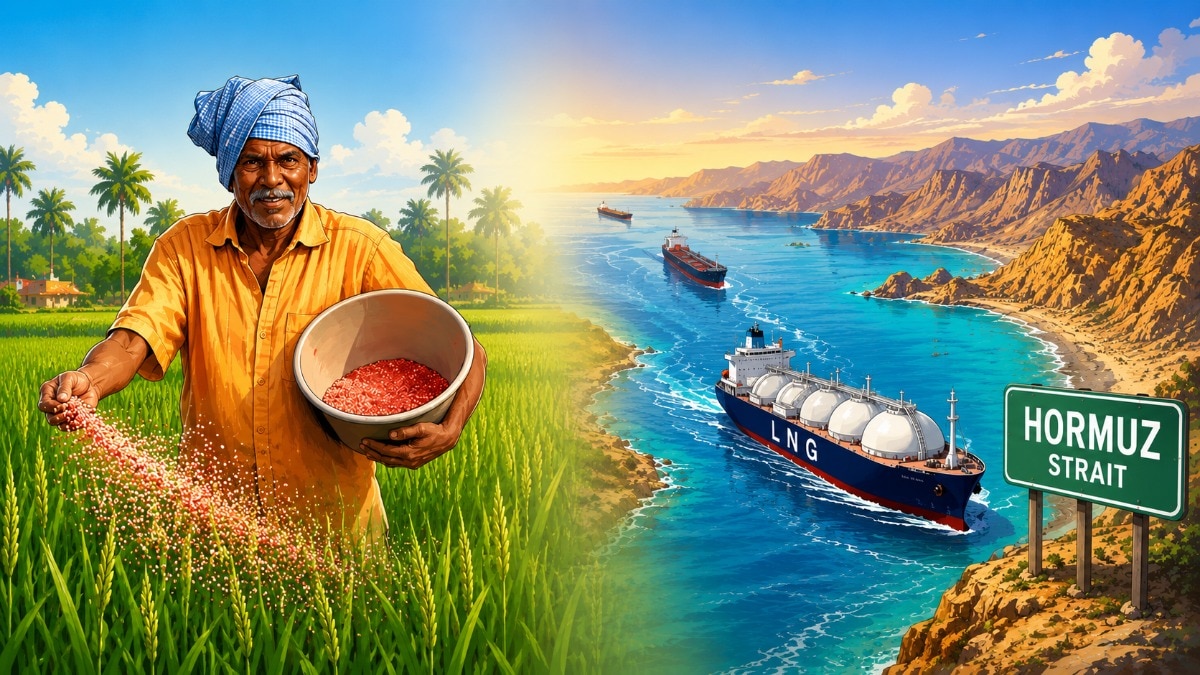
India is the world’s second-largest producer of rice and wheat. Yet the wheat grown in Punjab may still depend on nitrogen that originates in the gas fields of the Gulf.
We often speak of food self-sufficiency in India because it produces enough grain domestically. But this sovereignty built on imported nutrients remains structurally incomplete.
India relies on West Asia not just for finished fertilisers, but also for LNG used in domestic production
In 2024, India spent $7.68 billion on imported fertilisers, making it the world’s third-largest buyer after China and Brazil. Russia was the single biggest supplier, with a 21 per cent share. But the Gulf was the larger corridor. Saudi Arabia, Oman, the UAE, Qatar and Bahrain together accounted for nearly 37 per cent of India’s fertiliser imports, according to the Observatory of Economic Complexity.
And not just ready-made nitrogen fertilisers, even the raw materials India needs to make fertilisers at home, from sulphur to LNG, come heavily from West Asia.
With Iran threatening Hormuz, is a new fertiliser route opening up for India?
On March 14, the Indian Embassy in Saudi Arabia had already put Yanbu in plain sight. In a post on X, it described the Red Sea port as playing an “increasingly important” role in regional maritime trade and emerging as a key hub for Saudi fertiliser exports.
Indian officials inspected the port’s operations, road connectivity and trade capacity for the infrastructure India may now need to move fertiliser cargo without relying entirely on Hormuz. Earlier in 2025, India and Saudi Arabia had also agreed to deepen maritime cooperation through a Joint Working Group on shipping and logistics.
India Today has mapped the likely alternate route, drawing on clues from statements and media reports, to show how India may move critical fertiliser supplies if the Hormuz route continues to remain under strain.
The alternate route being explored would move stranded fertilizer cargo and future Gulf imports to ports inside the Persian Gulf. From there, the cargo could travel nearly 1,200 km by road across Saudi Arabia to Yanbu port on the Red Sea coast. It would then be loaded back onto ships and sent through the Red Sea and Arabian Sea to Indian ports, bypassing the Strait of Hormuz.
As the shipping crisis deepens amid the US-Iran conflict, one question now shadows Indian agriculture: can India secure its food supply when the fertility of its soil depends on the world’s most volatile maritime corridors?
However, public discussion of the Hormuz revolved only around oil. The Gulf’s cheap natural gas is not just burned for energy, it is also converted into ammonia and urea, in countries such as Qatar, Saudi Arabia and Oman, the nitrogen fertilisers that help feed Indian fields. West Asia also supplies a large share of the sulphur needed to produce other fertilisers.
With the kharif season at the doorstep, and the government repeatedly urging balanced fertiliser use and lower chemical dependence, the larger direction is clear. But, the crisis in Hormuz shows why that shift cannot remain only an agronomic slogan. If fertiliser ships are delayed, costs rise just when farmers need nutrients the most. Hence, India does not only need to use fertilisers more carefully, it needs to rethink where they come from, and how they move.
Geological Disadvantage
Political narratives often frame fertiliser imports as a policy failure. The reality is more complicated. India does not have large reserves of phosphate rock or potash, and it lacks the abundant cheap natural gas needed to produce ammonia and urea at scale.
Qatar, Saudi Arabia and Oman use their enormous natural gas reserves to produce cheap ammonia and urea. Morocco dominates phosphates, while Canada and Russia dominate potash.
India has none of these geological advantages. The Hormuz disruption exposed that dependence with unusual clarity. As tensions involving the United States, Israel and Iran escalated, traffic through the Strait slowed, fertiliser cargoes were delayed, LNG supplies tightened, and insurance costs jumped. Only a trickle of vessels of ammonia, nitrogen and sulphur continued to move through the corridor.
The consequences have spread through global agriculture. The world’s largest single-site urea export complex, Qatar’s QAFCO facility, reportedly went largely offline during the crisis. Urea prices surged by more than 60% within weeks.
For India, absorbing the rising global fertiliser costs through the subsidy system is a well-established instrument of maintaining price stability. In 2024-25, India’s fertiliser subsidy allocation rose from 1.68 lakh crore in the budget estimate to 1.92 lakh crore after additional spending was approved. For Kharif 2026 alone, the subsidy bill for phosphatic and potassic fertilisers is estimated at 41,534 crore, about 4,317 crore more than the Kharif 2025 requirement.
India’s fertiliser requirement for the Kharif season this year has been pegged at over 390 lakh metric tonnes. The danger, therefore, is not an immediate collapse in supply. The government has announced adequate reserve stocks of urea, DAP, MOP and complex fertilisers to cushion the system.
The more pressing question is : how long can that absorption continue if the Gulf conflict persists?
A third of the world’s fertilisers normally transit the Strait, and unlike oil, there is no strategic reserve architecture or mature alternative routing. The subsidy system turns a supply shock into a spending shock. The real question remains whether that shock has a ceiling. For now, the answer depends largely on how long the Strait remains under strain.
– Ends
Published By:
bidisha saha
Published On:
Jun 2, 2026 11:03 IST