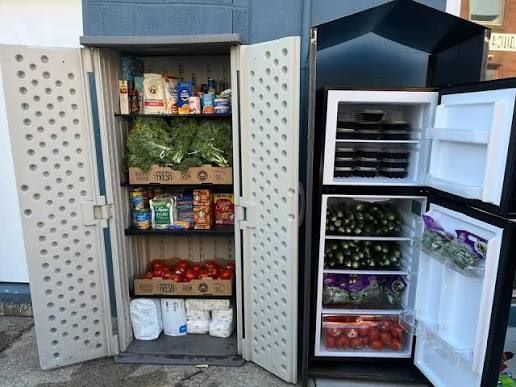
Source: https://hi-in.facebook.com/southphlcommunityfridge
Philly does not do subtle. It is a city where somebody will argue with you for ten minutes about whether Whiz belongs on a cheesesteak, then hand you the last bite off their own plate without thinking twice. That is the personality of the place. And it shows up hardest on the blocks the city has spent decades ignoring.
Walk through parts of West Philly, North Philly, or Kingsessing and you can go fifteen or twenty minutes without passing a real grocery store. There is a corner store on every other block. But actual fresh food, sold at a fair price, close enough to get to without a car? Good luck.
People call this a “food desert.” Drop that phrase. Deserts happen naturally. This did not. This got built, block by block, through redlining maps drawn seventy years ago, through supermarket chains that packed up and left and never came back, through a long list of decisions that all somehow landed on the same zip codes. That is food apartheid. It has a cause, and the cause has a name, and pretending otherwise lets everybody off the hook.
So people stopped waiting for somebody to fix it and started fixing it themselves.
Charity usually comes with a gatekeeper attached. You fill out a form. You explain your situation to a stranger. You wait to hear whether you qualify to be fed this month. Even when the people running these programs mean well, there is a quiet humiliation built into that process, and a lot of folks would rather go without than sit through it.
Community fridges do not work that way. Walk up to one anywhere in Philly, and you will usually find the same handwritten line taped near the door: take what you need, leave what you don’t. No ID check. No explaining yourself. Nobody’s deciding whether your reason for being hungry is a good enough reason.
One organizer running a Philly fridge put it about as plainly as it gets: “It’s not a homeless thing, it’s a people thing.”
That line does a lot of work. It means the fridge is not a program built for a category of persons to feel sorry for. It is just sitting there on the sidewalk for whoever needs it, and on any given week, that ends up being a lot of different kinds of people. The mom working three jobs. The retired guy on a fixed income. The college kid who is broke this month. Nobody’s ranking whose hunger counts more.
If you want to see how this actually plays out day to day, look at two projects running right now.
Dr. Michelle Nelson started the Mama-Tee Community Fridge Project in the summer of 2020, setting up a single fridge outside a restaurant on Girard Avenue in North Philly’s Ludlow neighborhood. She painted it bright yellow, which turned out to be a smart move, because now people all over the city recognize a Mama-Tee fridge the second they see one.
That first fridge turned into a whole network. Mama-Tee locations now sit outside senior living facilities and more recently, a children’s hospital in North Philly. Dr. Nelson has said her whole approach comes down to one belief: food is a right, not something you have to prove you deserve. Over the years the project says it has fed well over a hundred thousand people, restocked one bag of apples and one crate of squash at a time by volunteers who show up because they live nearby and they can.
Source: https://www.instagram.com/mamateefridge/
Ask Dr. Nelson what the hardest part is, and it is usually not finding people who need the food. It is finding enough hands to keep every fridge stocked and clean across a city this size.
On the other side of town, sisters Sonia and Sonam Parikh started The People’s Fridge on 52nd Street in West Philly that same year, for a completely different reason. Their father had just died, and afterwards they started getting calls from strangers, people who would tell them things like “your dad used to buy me groceries” or “he left diapers on my porch when I couldn’t afford them.” Nobody had asked him to do any of it. He just did it quietly, for years, and nobody in the family fully knew the extent of it until he was gone.
Setting up the fridge was their way of keeping that going. It sat outside Sonam’s coffee shop for a few years and became a fixture on the block, then moved into a partnership with a local library branch, the first time a city agency in Philadelphia agreed to host a community fridge on its own property. Demand kept growing beyond what one refrigerator could hold, so The People’s Fridge eventually expanded into a bigger operation, now running food giveaways from a warehouse in West Philly a couple of times a month.
Same city, same decade, two completely different reasons for getting started. But underneath it, the same basic math: if nobody is going to feed your neighbors, you feed your neighbors.
Read also: Gumball Machine Poetry and a Philly Soul: LindoYes’s Sweet Treats for the Mind
None of This Is New
If you grew up around Black family or church culture, none of this should feel unfamiliar. Somebody’s grandmother always had a pot big enough to stretch if extra people showed up. Somebody’s aunt kept a little extra in the freezer for the family down the block going through a hard stretch. The church basement always set a plate aside for whoever needed it, no questions, no forms.
Community fridges are that same instinct with a street address and a coat of paint. It did not start in 2020. It just found a new shape that year, when the pandemic made the cracks in the food system impossible to look past, and a lot of people decided they were not going to sit around waiting for somebody else to close them.
None of this needs a nonprofit filing or a grant application behind it.
Drop off produce or shelf-stable groceries at a fridge near you. Fruit, vegetables, canned goods, whatever you would want to find if you opened that door hungry yourself.
Send money straight to Mama-Tee or The People’s Fridge. Fridges need power, repairs, and replacement parts, and that side of things runs almost entirely on donations most people never think about.
Volunteer if you have got a couple of hours. Both projects need people willing to restock and check on a fridge on some kind of regular schedule, which is less exciting than it sounds but is what actually keeps the whole system running.
And if there is no fridge anywhere near you, think about being the person who starts one. It does not take much. A donated fridge, an outdoor outlet, a business owner willing to let you plug in out front, and a handwritten sign with that same line on it.
Philly did not wait around for anybody’s permission. People just started plugging in refrigerators. That is the whole blueprint, and there is nothing stopping it from working anywhere else.
Anand Subramanian is a freelance photographer and content writer based out of Tamil Nadu, India. Having a background in Engineering always made him curious about life on the other side of the spectrum. He leapt forward towards the Photography life and never looked back. Specializing in Documentary and Portrait photography gave him an up-close and personal view into the complexities of human beings and those experiences helped him branch out from visual to words. Today he is mentoring passionate photographers and writing about the different dimensions of the art world.