Local News
State officials are temporarily designating all forms of kratom as Schedule I substances, which have a “high potential for abuse.”
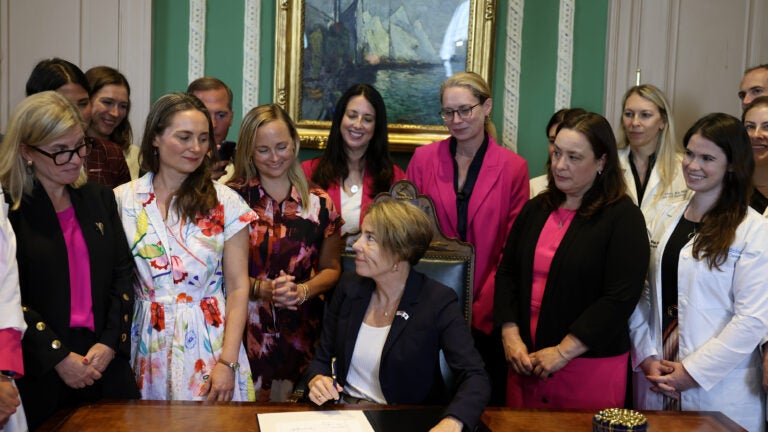
Gov. Maura Healey. Jessica Rinaldi/Boston Globe
The Healey administration is moving to crack down on kratom, a widely available and largely unregulated substance that can produce effects similar to opioids and stimulants.
The sale of all kratom products will soon be restricted statewide. Department of Public Health Commissioner Robbie Goldstein issued an emergency order temporarily designating all forms of kratom as Schedule I substances under state law.
Schedule I substances are ones that have been found to have a “high potential for abuse.” They lack any accepted medical use for treatment and cannot be safely used under medical supervision, according to state law.
The state can temporarily place a substance in Schedule I if the DPH finds that doing so is necessary to avoid an “imminent” public safety hazard and if the substance is not listed under any other schedule designations.
Goldstein’s order will take effect after a 14-day notice and remain in effect for up to a year. Local boards of health and municipal officials now have “additional authority to take enforcement action against retailers selling kratom products,” officials said in a release.
Kratom refers to both a tree native to Southeast Asia and products derived from its leaves. Many public health experts are concerned about a specific compound found in kratom, known as 7-hydroxymitragynine, or 7-OH. Products like tablets and gummies that contain synthetically-enhanced levels of 7-OH have become more widely available at convenience stores and smoke shops, causing officials to take new actions to restrict them.
Last month, the DEA began the process of temporarily placing 7-OH under Schedule I of the federal law governing controlled substances, as officials warned about its growing threat to public safety. The federal action does not apply to “botanical” kratom products that have naturally occurring 7-OH below a specific threshold.
But the Healey administration’s action applies to all kratom products. The potency and ingredients of kratom products can vary drastically, making it difficult for members of the public to understand what exactly they are taking, officials said.
“Dangerous kratom products are being sold in stores across Massachusetts with little oversight, and people – including children – often have no way of knowing what they’re buying or how potent it is,” Gov. Maura Healey said in a statement.
Kratom has been used as a traditional medicine around the world. Some users rely on it to help with pain, anxiety, and depression. Others say that it helps reduce opioid or other substance use and manage withdrawal symptoms, according to the National Institutes of Health.
But some experts are worried about users becoming addicted to kratom itself, which could lead to other withdrawal symptoms. In addition to mild side effects like nausea, kratom can cause serious neurological, respiratory, and cardiovascular issues.
Kratom poses an overdose risk, especially when paired with opioids, alcohol, or sedatives. Kratom use can be fatal in extremely rare cases, according to the NIH.
As part of the state’s new initiative, the DPH is sending guidance to local health care facilities, boards of health, and substance use treatment programs about the new restrictions. This information will include details on the risks associated with kratom and available treatment services. DPH officials are planning an informational webinar for local public health leaders.
“In public health, we need to be nimble, responding to new and emerging threats with evidence-based actions,” Goldstein said in a statement. “Kratom is increasingly being used by youth and adults, and many are unaware of the risks, including overdose, dependence, and serious health consequences. Our goal is to protect the public while getting those who need treatment or support the care they deserve.”
With the action announced Thursday, Massachusetts joins a growing number of states that are restricting kratom. Fourteen other states have banned or scheduled kratom in some way, while 23 have introduced age restrictions on the sale of kratom products, according to the Rockefeller Institute of Government.
The kratom landscape varies state-to-state in New England. Maine and New Hampshire do not restrict the substance on a statewide level. Vermont has had a kratom ban on the books, while Connecticut implemented a ban of its own earlier this year. Rhode Island recently became the first state in the nation to overturn a kratom ban.
Some individual municipalities in Massachusetts have enacted kratom bans, and the Boston City Council is currently exploring a city-wide ban on synthetic 7-OH products.
Ross Cristantiello
Ross Cristantiello, a general assignment news reporter for Boston.com since 2022, covers local politics, crime, the environment, and more.
Sign up for the Today newsletter
Get everything you need to know to start your day, delivered right to your inbox every morning.