Local News
“Our grading is too compressed and too inflated, as nearly all faculty recognize; it is also too inconsistent, as students have observed.”
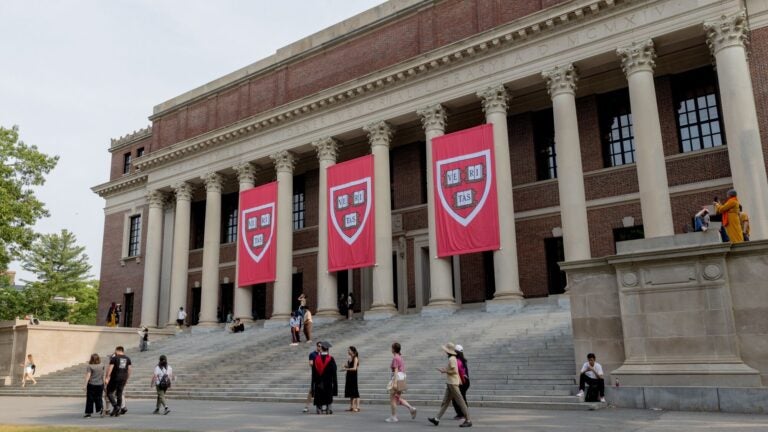
The Widener Library on the Harvard Campus in Cambridge, Mass., in June 2025. Cassandra Klos/Bloomberg
Harvard faculty are voting this week on whether to cap the number of As earned in each undergraduate class in an effort to combat grade inflation at the Ivy League university.
Online voting on the proposal, which closes May 19, opened Tuesday. Faculty will decide whether to implement a 20 percent cap of A grades plus four in courses across Harvard College. The cap only affects As, not A- grades or other grades.
“Our grading is too compressed and too inflated, as nearly all faculty recognize;
it is also too inconsistent, as students have observed,” Dean of Undergraduate Education Amanda Claybaugh wrote in a 2025 report. “More importantly, our grading no longer performs its primary functions and is undermining our academic mission.”
A proposal from February outlines a plan to cap the number of potential As awarded at 20 percent of a given class, with room to award four additional As beyond 20 percent. In a class of 10, up to 60 percent of the class could earn As, or 6 students. In a class of 100 students, 24 students could earn As, the highest grade possible at Harvard.
A report on grading was first commissioned in 2022 amid concerns over rising grades, according to the college’s Office of Undergraduate Education. Faculty and students discussed the Grading Policy Proposal at two February town halls, which prompted revisions regarding non-letter grade courses.
The vote was initially supposed to take place last month, but was delayed.
In her report, Claybaugh wrote that “many” faculty feel “powerless to grade otherwise,” citing tenure concerns, pressure from other faculty, and the need to maintain good enrollment in their classes.
“No one wants to be an outlier,” she wrote. “With good enrollments come guaranteed teaching for graduate students, the possibility of more faculty lines for departments, and the opportunity to introduce students to the subjects we’ve devoted our lives to studying.”
Report: More than 60 percent of all grades awarded at Harvard are As
In 2005, As accounted for 24 percent of all grades awarded in Harvard College. Two decades later, more than 60 percent of all grades awarded are As.
“Faculty newly arrived at Harvard are surprised at how leniently our courses are graded, and those who have taught here for a long time are struck by the difference from the recent past,” Claybaugh wrote in the report. “Students, for their part, were more sanguine.”
As should only be awarded for “exceptional quality,” according to the school’s grading guidelines, Claybaugh wrote.
If approved, As would make up 34 percent of all grades, closer to the distribution in 2011, “given the many small courses at the college,” she wrote.
Students will also be ranked by average percentile rank, the proposed grading policy says. Instructors will submit raw scores along with letter grades to calculate internal honors, like summa cum laude and other prizes.
Grade inflation at Harvard has shifted the summa cum laude cutoff “so close to 4.0 that summa eligibility now depends on GPAs carried out to five decimal places,” the proposal said. In 2010, one student was awarded a prize for the highest GPA. In 2025, 55 students won the prize.
“Percentile rank is especially attractive because it compares students directly to their peers rather than relying on fixed point scales or cutoffs,” the February proposal said. “It remains stable even when assignments or courses differ in difficulty, and it is less sensitive to unusually high or low scores.”
Externally, the 20 percent cap on As “should be broadly advertised and accurately described on transcripts” for potential employers, graduate admissions officers, and others.
Critics, however, say the proposal pits students against each other and creates ethical issues in grading, where there’s inevitably subjectivity, professors told The Boston Globe.
“I didn’t get into this line of work because I wanted to rank students against one another, but because I wanted to teach them,” said Harvard history professor Frank Johnson. He told the Globe the proposal would be “too blunt an instrument” to curb grade inflation.
Students, in a Harvard Crimson editorial, seem to begrudgingly agree with the concerns raised in Claybaugh’s report.
“We may have to choose between a squeaky-clean transcript and being, say, an editor at The Crimson,” the editorial said. “But such tradeoffs are worth a world where a grade means what it should — a level of mastery of material.”
Molly Farrar is a general assignment reporter for Boston.com, focusing on education, politics, crime, and more.
Sign up for the Today newsletter
Get everything you need to know to start your day, delivered right to your inbox every morning.