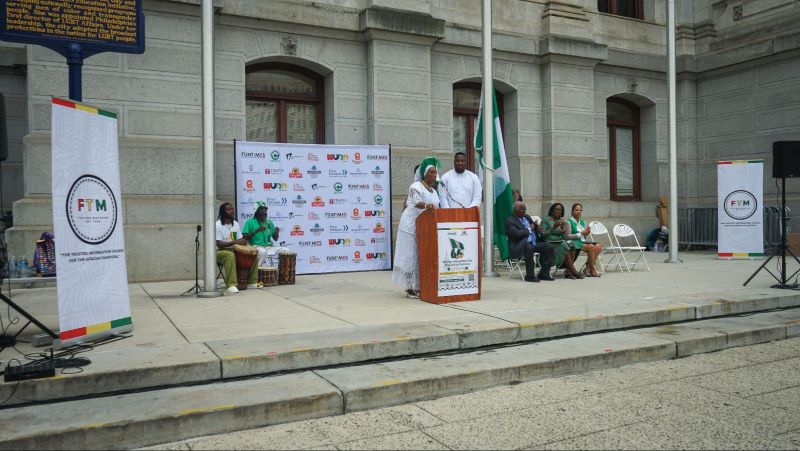
On Thursday, October 1, 2026, under a clear, light-blue sky, a large crowd gathered outside Philadelphia’s City Hall for an occasion that means a great deal to Nigerians far from home. As the clock moved toward noon, the green and white of the Nigerian flag rose once again. FunTimes Magazine, in partnership with Pennsylvania State Rep. Carol Kazeem, hosted the 66th Nigerian Independence Day Flag-Raising Ceremony.
Nigerians, friends of the community, and others came together to mark the anniversary of Nigeria’s independence from British rule on October 1, 1960. This was the third year the celebration has come to one of the city’s most visible civic spaces, and it felt less like a one-off event than a gathering the community had been waiting for.
Hosted by Leah Uko and Nkwa Asonye, the ceremony drew African and Caribbean immigrants, city officials, local residents, and Nigerian Americans. They listened closely to formal remarks from guest speakers, and the attention across the crowd was plain.
Many in the crowd dressed for the day. Radiant shades of green and white were everywhere, with flowing gowns, elaborate headwraps, and sharply tailored agbadas, each worn with pride. Together they they transformed an ordinary afternoon in Center City into something unmistakably Nigerian, giving City Hall the look of a family reunion, with Nigeria’s national colors as the dress code. It was a reminder that culture can travel. It can cross oceans, settle in new cities, and still retain the colours, clothing, sounds, and traditions that make it recognizable.
One of the most memorable parts of the afternoon was the traditional ceremonial gowning. Clothing became more than adornment as each honoree was robed in a way that carried the weight of cultural recognition. In that moment, they became part of a royal heritage.
Then came the Nigerian national anthem. As it played, attendees raised the small flags handed out to them, and the green and white rippled across the crowd. For a few minutes, everyone present, whether born in Lagos or Philadelphia, or simply passing through, felt part of the story.
The Azikiwe Legacy Award presentation added another important dimension to the ceremony. The award recognizes leadership and achievement and continues FunTimes Magazine’s practice of using its Independence Day celebration to acknowledge people whose contributions have made a difference in their communities.
Dr. Eric Nzeribe, founder and publisher of FunTimes Magazine, echoed this in his speech:
“The Azikiwe Legacy Award serves a different purpose. It is an outward homage from the community to the greats among us. It allows us to say, while they are present, that their work has been seen, valued, and entered into our public memory.”
He added that the audience had a role in the moment as well:
“This ceremony therefore belongs to the audience as much as it belongs to the honorees. Your presence turns an award presentation into a public record. Your applause tells the recipients that the community understands the weight of their contribution. Bringing children, friends, and colleagues allows the meaning of the moment to travel beyond City Hall.”
By placing community recognition alongside the flag-raising and cultural performances, the ceremony connected Nigeria’s history with the work being done by Nigerians and members of the wider African diaspora today.
The drums rolled in. The rhythm announced another change in the atmosphere as masquerades, their faces veiled, appeared and commanded attention with energetic movements and a performance that brought another layer of Nigerian cultural expression to the celebration.
For those familiar with Nigerian masquerade traditions, the performance offered a connection to cultural practices that have existed long before today’s diaspora communities. For others watching, it was an opportunity to encounter an aspect of Nigerian heritage in the middle of Philadelphia.
Throughout the afternoon, speakers returned to one theme: the connection between Nigeria and the wider African Diaspora. Their words underlined what the ceremony has come to represent. It honors a country’s history, and it gives those who have built lives far from home a place to celebrate where they come from. For Nigerians living abroad, independence celebrations can be both a look backward and a look forward. They provide an opportunity to remember the country that existed before migration while also considering what Nigerian identity looks like in a new environment.
Of course, no Nigerian celebration would feel quite complete without food. Guests were able to take a little taste of Nigeria home with them. Puff-puff and beef patties were among the treats provided, giving guests something familiar to enjoy after the formal proceedings had ended.
The Nigerian Independence Day Flag-Raising Ceremony at Philadelphia City Hall has now become part of a three-year story.
In 2024, the City of Philadelphia marked Nigeria’s 64th anniversary at City Hall with a mayoral proclamation recognizing “Nigerian Independence Week in Philadelphia.” Another gathering followed in 2025. With this year’s ceremony, the Nigerian flag-raising is settling into place as a fixture on Philadelphia’s civic calendar.
What began as a ceremony has increasingly become a moment for the Nigerian community to see itself represented in one of Philadelphia’s most prominent public spaces.
The day would not have been complete without recognizing the people behind it. Dr. Nzeribe thanked the Lenfest Institute for Journalism, the Peoples Media Fund, Campaign for Working Families, Press Forward, The Pivot Fund, Lincoln University, Temple University, the Diaspora Advisory Council, student researchers, civic partners and volunteers, noting that the work was made possible by many people and institutions.
Then he looked ahead, saying:
“As Nigeria’s flag rises over Philadelphia, may everyone gathered claim a place in the significance of the moment. Years from now, the enduring words may be simple: We recognized our greats. We stood together. We were there.”