PWHL
Sparre set lofty goals for himself and his team.
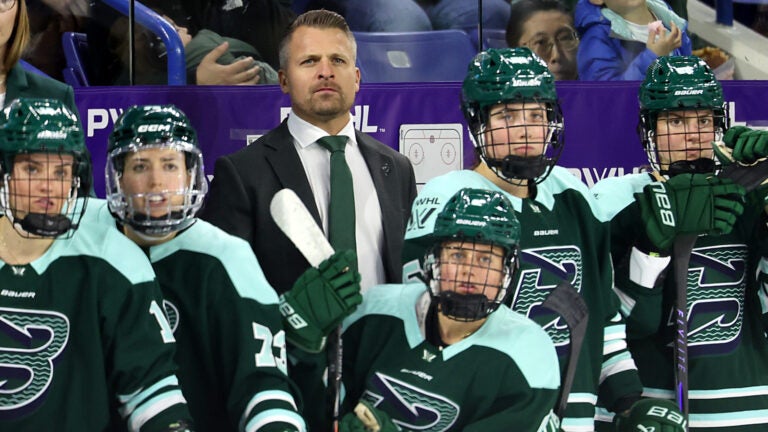
The Fleet’s Kris Sparre had never been a head coach prior to accepting his role, and he had never coached women. Ken McGagh for The Boston Globe
May 19, 2026 | 8:31 AM
4 minutes to read
Kris Sparre had never been a head coach prior to accepting his role with the Fleet last summer, and he had never coached women. He inherited a team that had lost its captain and endured a roster shakeup because of expansion.
Yet when he made his first media appearance last July, Sparre set lofty goals for himself and his team.
Did he live up to the expectations he set 10 months ago? Let’s grade how he performed on each of his major commitments:
“I want to make the Boston Fleet a championship-level program that we can all be proud of.”
Did the Fleet win a championship? No. But did Sparre build a culture and manufacture results to be proud of? Certainly.
He didn’t expressly state in his first media appearance that the goal in Year 1 was to win the Walter Cup — his exact words were “we’re going to work and push into that each and every day to make sure that that’s our group one day” — but winning it all was a sentiment he and the players didn’t shy away from throughout the season.
That goal appeared more attainable as the season progressed. In what could easily have been a rebuilding year following a roster shakeup and the arrival of a new coach, the Fleet went 16-5-4-5 in the regular season and earned a record 62 points, tied for first in the league.
But as Sparre told the Globe in April, “You don’t get anything for finishing first” in the regular season.
Grade: B+
Boston Fleet goaltender Aerin Frankel (31) and captain Megan Keller (5) fist bump during the second period of Game 2 against the Ottawa Charge Saturday night at Tsongas Center. – Finn Gomez for the Boston Globe
“I can promise you that moving forward, the Boston Fleet are going to be a very, very difficult team to play against.”
From the outset, Sparre preached a “suffocating,” “aggressive” style of hockey at both ends of the ice. The Fleet made their forecheck their signature and wore down opponents with relentless offensive-zone pressure.
Statistically, the Fleet were up there with the toughest teams to beat: Boston allowed the second-fewest goals in the league (45) behind Montreal (41), while scoring the third-most (74).
Opposing coaches took notice. After the Fleet’s season ended with a Game 4 playoff loss in Ottawa, Charge coach Carla McLeod commended Sparre on his first season and noted that he had accomplished his goal of making the Fleet one of the hardest teams to play against.
“They’re so relentless, so we knew we were in for a good, hard-fought battle,” McLeod said.
Despite the near-constant offensive-zone pressure, the Fleet had to grind through a stretch of 12 consecutive one-goal games during the regular season, and they often struggled to score when it mattered — including in their playoff series.
The Fleet made life hard for the Charge and goaltender Gwyneth Philips in the postseason, outshooting, Ottawa, 142-94, in the four-game series, but the Fleet couldn’t convert their aggression into goals.
Grade: A-
“If we want to win, we’re going to have to get our youth up to speed immediately.”
The Fleet signed all six of their draft picks, something general manager Danielle Marmer said was a pleasant surprise. But that meant Sparre and his staff had extra work to do on this promise.
Sparre came from a developmental background, having worked for the Anaheim Ducks’ AHL affiliate, and prides himself on his ability to turn young athletes into franchise players.
“We’re going to help them see their way through it and give them tools and skill sets to work on, but it’s up to them on the daily to work on it,” Sparre said at the team’s breakup day. “And credit to them, they took charge of that every day.”
All six of the Fleet’s first-year players — Sparre doesn’t use the word “rookie” because he feels it minimizes their importance to the team — played meaningful minutes and were consistent performers, but none outperformed their draft position more than fifth-round selection Abby Newhook.
Fleet fifth-round draft pick Abby Newhook had seven goals and seven assists in 29 games during the regular season and added an assist during the playoffs. – Matthew J. Lee/Globe Staff
The Boston College product had seven goals and seven assists in 29 regular-season games, appeared regularly on the top power-play unit, and earned praise from the coaches for her physicality and hockey IQ.
She played herself into a position to be poached in the expansion process, which Marmer said feels like “serving some players up on a silver platter.”
Grade: A
“We’re going to have everybody coming in every single day excited about putting in the work.”
In hearing from players on breakup day, it’s clear that if nothing else, Sparre was successful in accomplishing this goal. His coaching philosophy is rooted in forming strong relationships with his players, many of whom said that this year was their favorite hockey season, at any level.
They attributed their chemistry to the culture Sparre built and his insistence that everyone — from the top-line forwards to the third-string goaltender — had an equal hand in the team’s success.
“It was a very special group where everybody had a really important puzzle piece,” said veteran forward Jill Saulnier. “That’s rare in sports. . . . It’s hard to get yourself in a place where everybody feels valued.”
Grade: A
⚽ Get the latest World Cup news
Receive updates on the 2026 FIFA World Cup