World Cup
Things could not have gone much better for the city of Boston during its one month hosting the 2026 World Cup.
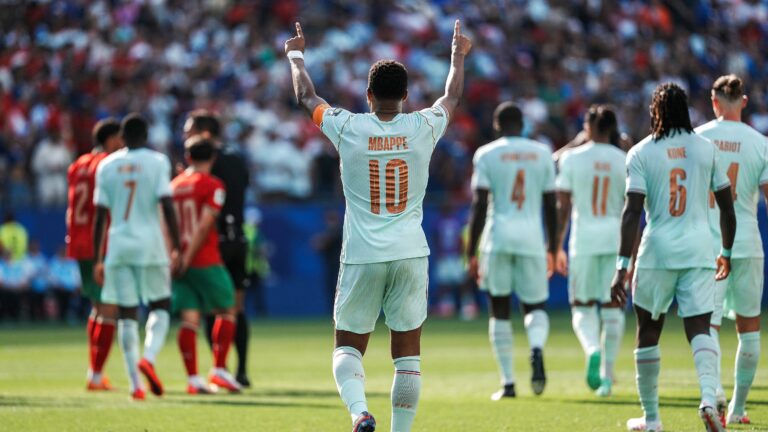
France forward Kylian Mbappé celebrates after scoring against Morocco. Barry Chin/Globe Staff
July 10, 2026 | 5:06 PM
3 minutes to read
FOXBOROUGH – After 27 days, seven scintillating matches, and too many gallons of beer to count, the World Cup experience in Boston is over.
While the absence of global football will leave a traffic cone-sized hole in our hearts, the final act in Foxborough — France’s 2-0 triumph over Morocco on Thursday – was a worthy capstone to an unforgettable month.
A crowd of 63,811 saw literal fireworks before kickoff, as pyrotechnics shaped like the flags of the two countries launched from the field following the conclusion of the Moroccan national anthem.
Then came the metaphorical firecrackers, in the form of goals from French superstars Kylian Mbappé and Ousmane Dembélé – the same pair who filled the scoresheet at “Boston Stadium” for Les Bleus in the team’s 4-1 victory over Norway in June.
Mbappé, who exited early due to a knock on his ankle, said after the game that France was rounding into form.
“I feel that we understand the potential of the team,” Mbappé said. “It’s not potential anymore, it’s what we’re actually doing.”
Kylian Mbappé put on a show for the Foxborough crowd with his eighth goal of the tournament. (Barry Chin/Globe Staff) – Barry Chin/Globe Staff
Morocco, who lacked firepower in the front line thanks to an injury to Ismael Saibari, hung around as long as they could.
After Mbappé had a first-half penalty saved and the teams went into the locker rooms at 0-0, the Atlas Lions seemed to believe they had a chance – or at the very least, might be able to sneak through to extra time and penalty kicks.
But after Mbappe’s breakthrough in the 60th minute, quickly followed by Dembélé’s goal in the 66th, Morocco was deflated.
“We have to recognize that it’s a great team,” Moroccan coach Mohamed Ouahbi said after the final whistle. “We have to accept this defeat.”
Only one team could win at Thursday’s quarterfinal. But before a single ball was kicked, there was already another winner already running a victory lap: the city of Boston.
Members of the Tartan Army run to embrace Morocco fan Ali Jellal (right) as the two cross paths on Thursday. – Jessica Rinaldi/Globe Staff
Despite all of the logistical hurdles, Boston’s World Cup was a dream come true – for traveling fans, for residents, and for government officials who hoped the event would give Boston the kind of publicity money can’t buy.
No one could have predicted that Scotland’s love affair with the city of Boston would be one of the defining stories of the tournament. Headlines from around the world shared tales of the Tartan Army drinking the city’s bars dry, of single Bostonians looking for (and sometimes finding) their own Scottish prince, or of newfound friendships that spanned language barriers and continents.
And while Norway and striker Erling Haaland were certainly on people’s radar pre-tournament, the Viking Army and their viral rowing celebrations — both in Boston Stadium for its games against France and Iraq and on the escalator at South Station — were another free advertisement for the city.
Add in the fact that Boston is the home base for a French team that is now favored to win the whole World Cup, and that the city’s fans got to see arguably four of the ten best teams in the world (France, England, Morocco, and Germany) play in Foxborough, things could not have gone much better.
In short order, Boston will say goodbye to kilts, to extended bar hours, and to calling Gillette Stadium by the FIFA-sanctioned name of Boston Stadium. But with any luck, Boston’s World Cup experience will resonate for years to come.
Sign up for the Today newsletter
Get everything you need to know to start your day, delivered right to your inbox every morning.