The Boston Globe
Midwood has planned a development at Bromfield and Washington since 2008.
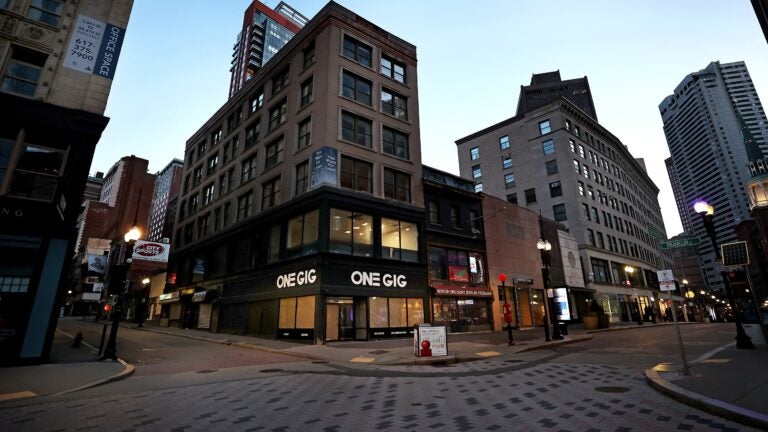
Midwood Investment & Development has long planned to build a tower at the corner of Washington and Bromfield streets in Boston’s Downtown Crossing. David L. Ryan/Globe Staff
updated on July 10, 2026 | 1:29 PM
3 minutes to read
A New York developer is back in front of Boston city planners with plans for two towers on Bromfield Street, a high-traffic stretch of Downtown Crossing that has seen better days.
Midwood Investment & Development has told the city it plans to develop 918 apartments on two Bromfield Street sites. One tower, at the corner of Washington and Bromfield streets, could reach 500 feet and house 760 apartments, while a second property up the block at 45 Bromfield St. could include 158 apartments in a 17-story building. Together, the two buildings would have about 180 units set aside at affordable rents.
“We are responding to the city’s goal of creating more housing units,” Midwood chief executive John Usdan wrote in a June 17 letter to the Boston Planning Department. “At this central location, residents will have ready access to public transit, parks and open spaces, retail stores and restaurants.”
A rendering of one of Midwood’s proposed skyscrapers at the corner of Washington and Bromfield streets in Boston’s Downtown Crossing. – Midwood/Adrian Smith + Gordon Gill
Midwood first pitched a tower at the corner of Washington and Bromfield streets in 2008, and has pursued several projects there since then. The 45 Bromfield St. proposal, however, is a new addition to the firm’s downtown plans.
The mid-block lot is located at the corner of Bromfield and Province streets and is “now occupied by four largely vacant and obsolete commercial buildings,” Usdan wrote in a separate June 17 letter to the city.
Midwood representatives did not respond to a request for comment.
Their new proposals follow the city’s changing its downtown zoning code to allow for taller housing developments. The zoning updates were intended to maximize developers’ options for reinvesting in downtown, said Brittany Comak, a spokesperson for the Planning Department.
“These proposals, in addition to the numerous buildings slated for office conversions, are proof that the zoning is working as envisioned to create a thriving and reimagined Downtown,” Comak said in a statement.
Still, there’s a long way to go from proposing housing to breaking ground. Developers cheered the news that Massachusetts voters would not have a rent control question on ballots this fall, but routinely report that financing large projects amid macroeconomic uncertainty is difficult at best.
Midwood has crafted proposals that meet downtown’s new zoning standards, which should — in theory — streamline the city’s development review process. Still, the corner of Washington and Bromfield will likely be hotly debated in the coming years: beyond Midwood’s proposals on one side, Boston developer Ron Druker has long held property across the street where he could propose a separate skyscraper.
Midwood’s properties are located in what has historically been considered part of the city’s Ladder Blocks, a series of one-block streets including Temple Place and Bromfield, Winter, and West streets that connect Downtown Crossing to the Boston Common. The city considers the Ladder Blocks “architecturally and historically significant,” given the proliferation of “notable 18th- and 19th-century buildings” in the area.
“While famous for the grandeur of the commercial hub, the Ladder Blocks are also known for the rich history they emulate through its buildings and streets,” a 2018 publication from the Boston Preservation Alliance states. “Bromfield Street is often thought to be the epitome of Old Boston.”
Though it was once bustling, Bromfield Street struggled with vacancy following the pandemic. Many of the retail storefronts Midwood owns have lain empty for years. Still, the street is “an amazing site for residential” development given its proximity to multiple MBTA lines and the Financial District, said Michael Nichols, president of the Downtown Boston Alliance.
“We have to bring workers to the doorstep of their downtown offices,” Nichols said. “This is what downtown needs. … There is a real desire to be in the heart of our city. We just need to give people reasons to be.”
Nichols said any perception that Midwood had “hollowed out their holdings” by deliberately leaving ground-level storefronts vacant to pave way for future development isn’t accurate.
“For basically the last ten years, they thought they were three years away from starting construction,” Nichols said. “When leases came due, they weren’t in a position to extend for five or ten years.”
Beyond its Bromfield proposal, Midwood in 2020 spearheaded a renovation of three downtown buildings — two dating back to the 1870s and a third from the 1930s. The 45,000-square-foot One Milk Street complex now includes a ground-level Shake Shack with office space above.
“It’s smaller, but it showed their commitment to the area,” Nichols said.
Social justice organization Embrace Boston is also planning a project in the Ladder Blocks. Earlier this month, Embrace said it acquired two West Street buildings and plans to redevelop them into a civic and cultural center.