

Every groundbreaking achievement begins with someone willing to go first.
On Emirati Women’s Day, observed annually on August 28, attention turns to the women whose determination has expanded opportunities, challenged expectations and created new possibilities throughout the UAE.
Celebrated in 2026 under the theme “We Emerge Stronger and Better,” Emirati Women’s Day recognises the achievements and influence of Emirati women in every part of society. This year, five trailblazers deserve particular recognition for becoming pioneers in their respective fields.
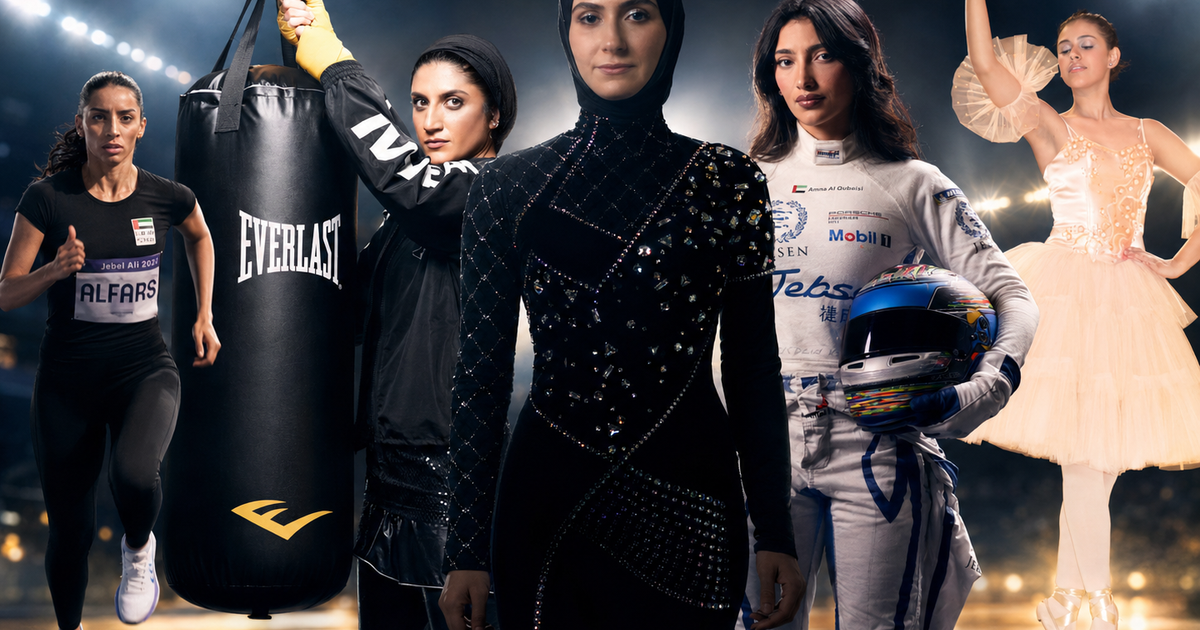
Zahra Lari, Alia Al Neyadi, Fahima Falaknaz, Maryam Al Farsi and Amna Al Qubaisi come from very different disciplines. Their achievements span figure skating, ballet, boxing, athletics and motorsport. What connects them is the courage to enter spaces where few, if any, Emirati women had been represented before.
Their stories are more than a collection of impressive titles. Each woman helped make an unfamiliar path visible to the next generation.
Zahra Lari Put Emirati Figure Skating on the World Stage
Zahra Lari became the first figure skater from the UAE and the Middle East to compete internationally, introducing an entirely new chapter in the country’s sporting history.
Lari began learning to skate at the age of 12, an unusually late start in a sport where many elite competitors begin training as young children. Her determination eventually took her from an ice rink in Abu Dhabi to competitions around the world.
Her career also attracted international attention because she competed while wearing a hijab. During an early competition, she received a deduction connected to her head covering. Lari later raised the matter with the International Skating Union, contributing to greater understanding and acceptance of the hijab in competitive skating.
Beyond her appearances on the ice, Lari has continued supporting the development of figure skating in the UAE. She is a co-founder and chief executive of Emirates Skating Club, helping young athletes access training and opportunities that were far less established when she began.
Her legacy is therefore not limited to becoming the first. She has also worked to ensure that she will not be the last.
Alia Al Neyadi Brought Emirati Representation to Ballet
Alia Al Neyadi became widely recognised as the UAE’s first professional Emirati ballerina, building a career in a discipline that requires years of technical training, strength and artistic control.
Her relationship with ballet began in childhood. Supported and trained by her mother, a former professional dancer, Al Neyadi developed her skills through intensive practice and stage experience. She went on to complete more than 70 performances, establishing herself as a visible Emirati presence in the performing arts.
Ballet may appear effortless from the audience, but reaching a professional level requires exceptional physical discipline. Dancers spend years developing balance, flexibility, musicality and precise control over every movement.
By pursuing that path professionally, Al Neyadi challenged narrow assumptions about which careers were open to Emirati women. She demonstrated that cultural identity and classical performance could exist together without either being diminished.
Her career also gave young Emirati performers something essential: a person with whom they could identify. Seeing an Emirati ballerina on stage transformed ballet from a distant possibility into an attainable ambition.
Fahima Falaknaz Entered the Boxing Ring
Fahima Falaknaz is recognised as one of the UAE’s first female Emirati boxers and has frequently been described as the country’s first Emirati woman to compete in the sport.
Falaknaz did not begin boxing during childhood. She entered the discipline as an adult, proving that personal reinvention and athletic ambition do not have an expiration date.
Her journey eventually led her to represent the UAE internationally, including at the Asian Women’s Boxing Championships. Entering a traditionally male-dominated sport required more than physical strength. It demanded the confidence to confront social expectations surrounding women in combat sports.
Boxing is built on endurance, speed, discipline and strategy. Falaknaz’s participation helped shift the conversation away from whether Emirati women belonged in the ring and towards what they could achieve once given the opportunity.
She later extended her influence by helping other women access the sport through women-focused boxing classes. Her story shows how one personal breakthrough can create a wider community of participation.
Maryam Al Farsi Raced Into Olympic History
Sprinter Maryam Al Farsi made history at just 16 years old when she represented the UAE in the women’s 100 metres at the Paris 2024 Olympic Games.
Al Farsi became the first Emirati female sprinter to compete on the Olympic stage. She lined up at the Stade de France against athletes with considerably more international experience and completed her preliminary-round race in a personal-best time of 13.26 seconds.
The result represented far more than a number on a timing board. Reaching the Olympic Games is one of the most demanding accomplishments in competitive sport. Doing so as a teenager and becoming a national first placed Al Farsi among the UAE’s most promising young athletes.
Her Olympic appearance also expanded the visibility of Emirati women in track and field. Young runners across the country can now point to a clear precedent: an Emirati sprinter has competed in the world’s most recognised sporting event.
Al Farsi has continued training with ambitions of returning to the Olympics, turning her historic debut into the beginning of a longer journey rather than its conclusion.
Amna Al Qubaisi Changed the Face of UAE Motorsport
Amna Al Qubaisi became the first Emirati female racing driver and has since established an international career across karting and single-seater competition.
She began karting at 14 and quickly progressed into increasingly competitive championships. In 2017, she became the first Emirati woman to win the UAE Rotax Max Challenge Championship. She later competed in Italian Formula 4, Formula Regional and the all-female F1 Academy series.
In 2018, Al Qubaisi became the first woman from the Middle East to participate in a Formula E test programme. She achieved another significant result in 2019 when she became the first woman to win a Formula 4 race in the UAE.
Motorsport remains one of the most technically and financially demanding sporting environments. Drivers must combine physical conditioning with rapid decision-making, engineering knowledge and the ability to perform under intense pressure.
Al Qubaisi’s international career has made Emirati women more visible within that world. Her younger sister, Hamda Al Qubaisi, has also built a successful racing career, reinforcing the family’s growing contribution to UAE motorsport.
Five Different Fields Connected by One Powerful Idea
These five women did not follow the same route. Some began their disciplines in childhood, while others discovered their calling later. Some performed under stage lights, while others competed on ice, inside a boxing ring, on an athletics track or behind the wheel of a racing car.
What connects them is their willingness to enter spaces where there was little existing representation.
Becoming the first carries a particular weight. There is no established route to follow, no familiar example to copy and often no guarantee that institutions or audiences will immediately understand the ambition.
That is why these achievements matter beyond sport and performance. They show how representation changes expectations. Once a path has been taken, it becomes easier for others to imagine themselves following it.
Emirati Women’s Day Looks Towards the Next Generation
Emirati Women’s Day is not only an occasion to celebrate completed achievements. It is also an opportunity to consider what those accomplishments make possible next.
A young Emirati girl watching Zahra Lari can imagine competing on ice. Alia Al Neyadi’s story shows that she can build a life in the performing arts. Fahima Falaknaz proves that strength and courage belong in the boxing ring. Maryam Al Farsi demonstrates that an Olympic starting line is within reach. Amna Al Qubaisi shows that motorsport can also have an Emirati woman at the front of the grid.
Their careers have changed the meaning of “first” from an exception into an invitation.
On Emirati Women’s Day, their stories offer a reminder that progress begins with individual courage but becomes truly powerful when it creates opportunities for others. These five women made history in their fields. The next generation will decide how much further those paths can go.
