Boston Bruins
“It just might be this is what his new level is, and you have to accept that.”
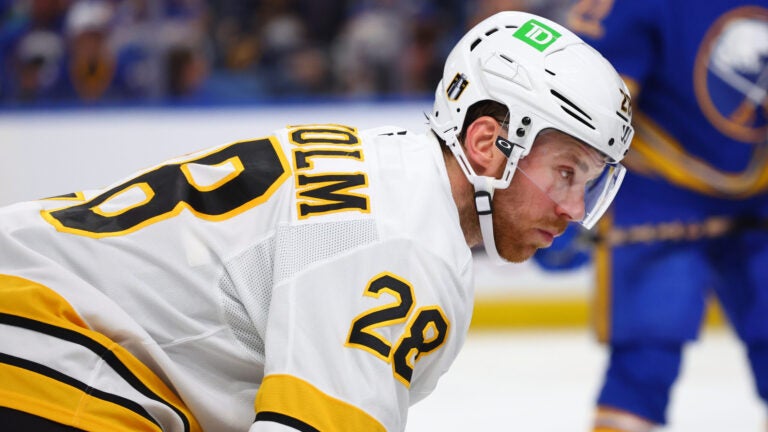
Elias Lindholm and the Bruins are stuck in limbo after another injury-marred season. AP Photo/Jeffrey T. Barnes
The Boston Bruins and GM Don Sweeney still have plenty of work to do this offseason.
But, as Boston tries to clear several logjams across the depth chart, there should be some optimism around several key cogs of the lineup.
Beyond the expected production generated by franchise stalwarts David Pastrnak, Charlie McAvoy, and Jeremy Swayman, ancillary pieces like JJ Peterka, Morgan Geekie, and Pavel Zacha look like solid contributors.
Boston should also receive a boost from a burgeoning youth movement, with players like Fraser Minten, James Hagens, Michael DiPietro, Marat Khusnutdinov, and Frederic Brunet all due for larger roles in 2026-27.
But, as the Bruins try to stave off regression and build off their brief playoff appearance this past spring, Boston’s depth chart is still anchored by one looming question mark: veteran center Elias Lindholm.
Initially signed as Boston’s high-priced solution for the vacancy created by Patrice Bergeron’s retirement, Lindholm was brought in by the Bruins in July 2024 with the expectation of being a stout, two-way 1C.
Through two seasons, the results have been underwhelming, to say the least.
And, given Boston’s incoming influx of young pivots, coupled with both Lindholm’s pricy contract and worrisome injuries, the 31-year-old forward is seemingly in a state of limbo for a Bruins team that could desperately use his production somewhere in its middle-six corps.
As Sweeney alluded to last month, the expectations for Lindholm in Boston have shifted since the Bruins first signed him to a seven-year, $54.25 million contract.
“I think Elias is a valuable player. He can play with different players,” Sweeney said. “He can play in a shutdown role. He’s done a pretty good job in the power play when we used it there. Just hasn’t produced at the level he used to. Is that team-related or adjustment-related, two different coaches? There’s all kinds of variables in that sense.
“Health is one of them. That’s not his fault. I know he’s working hard. He’s looking at some alternative stuff to get over the hump and come back like he wants to produce to the level we would all like to see. But it just might be this is what his new level is, and you have to accept that. But it’s not for lack of trying.”
It might have been asking a lot for the Bruins to expect Lindholm to replicate the 42-goal, 82-point campaign he generated while on a line with Calgary’s Matthew Tkachuk and Johnny Gaudreau in 2021-22.
But, the Bruins had hoped Lindholm would complement his 200-foot game and faceoff acumen with 60-plus points, year in and year out, especially if on a line next to Pastrnak.
Instead, Lindholm has averaged 47.5 points per season over his two years in Boston, scoring 34 goals and 61 points over 151 total games.
During the 2025-26 campaign, just 21 of Lindholm’s 48 points came at 5-on-5 play. That ranked ninth on the Bruins, below younger players like Khusnutdinov (26 5-on-5 points) and Minten (27 5-on-5 points).
After a promising stretch of play alongside Pastrnak at the tail end of the 2024-25 season, Lindholm labored next to Boston’s top forward this past year.
In their 587 minutes of 5-on-5 reps together, a line featuring Pastrnak and Lindholm was outscored 29-26.
Even with Lindholm being as advertised at faceoffs (56.1 percent) and chipping on at the “bumper” spot on the power play, his inability to drive play at 5-on-5 play remains a top concern, especially when factoring in the fact that he holds the fourth-highest cap hit on the club at $7.75 million.
Perhaps more concerning is the remaining five years of Lindholm’s contract.
Beyond the fact that he’s set to turn 32 years old in December, Lindholm’s tenure in Boston has been marred by nagging back injuries — not the exactly the type of ailment that improves as one gets older.
An initial back issue in August 2024 had Lindholm playing catch-up for most of the 2024-25 season, with the veteran missing most of training camp and generating just 47 points over 82 games.
Those same back injuries flared up again this past year — eventually necessitating pain-reducing injections to treat the nagging ailment.
“I mean, I felt good until the injury and then pushed myself real hard to be able to go to the Olympics. Kind of a long shot, but after the injection and obviously I ended up going,” Lindholm said at the team’s break-up day in May. “After that, it was tough to kind of recover, I think going over there and my body was not great, but battled through and then came back and kind of kept grinding and couldn’t find the confidence or stuff like that to play my game. So it was tough.”
After he tallied 37 points in his first 44 games of the 2025-26 campaign, Lindholm’s play cratered after the Olympics, as he scored just six goals and 11 points in 25 games.
While Sweeney acknowledged earlier this offseason that Lindholm might have to “train a little differently” moving forward to counter those back woes, it’s still a troubling sight for a Bruins team that was banking on Lindholm to drive a line for at least the first three to five years of his contract.
Instead, the Bruins are seemingly stuck with a player who might be more of a middle-six contributor and whose production is not exactly guaranteed moving forward, given concerns about that back injury resurfacing.
Once deemed as a top-line fixture, Lindholm is now more of a square peg in a round hole on Boston’s depth chart. Zacha and Minten both stand as more appealing top-six options down the middle for Boston in 2026-27.
Add in the continued growth of Hagens (ahead of an expected shift back to center) and the eventual arrival of 6-foot-7 pivot Dean Letourneau next spring, and Lindholm — even if healthy — could be reduced to more of a third-line role, potentially on the wing, far sooner than the Bruins expected.
At this point, the best bet for both the Bruins and Lindholm moving forward is simply staying the course — given that both a buyout (keeping his contract on the books until 2036) and a trade seem unlikely at this point.
Even if Lindholm’s annual cap hit is at least getting a bit more palatable amid a surging salary cap, the optics are still tough to ignore for a Bruins team that could have harnessed that nearly $8 million in annual cap space to shore up other areas of this retooling roster.
The future of Boston’s center pipeline is looking pretty promising. But in the present, both the Bruins and Lindholm are seemingly mired in an uncomfortable and unfortunate partnership.
Conor Ryan is a staff writer covering the Bruins, Celtics, Patriots, and Red Sox for Boston.com, a role he has held since 2023.
Sign up for the Today newsletter
Get everything you need to know to start your day, delivered right to your inbox every morning.