The Boston Globe
Karina Holmer was a 20-year-old au pair from Sweden who ventured out into Boston on a Friday night and became the victim of a grisly murder that has haunted the city ever since.
It was June 21, 1996, and that Friday night Holmer went out dancing at Zanzibar, a popular nightclub at Boylston Place, also known as “The Alley,” next to Boston Common.
The Globe reported that Holmer was last seen alone around 3 a.m. Saturday near Boylston and Tremont Street, not far from the club.
On Sunday afternoon, June 23, someone made a horrific discovery: the top half of Holmer’s body was found in a dumpster behind a building at 1091 Boylston St., in an alley that faced Ipswich Street.
Police believed that Holmer had been strangled and then cut in half at the waist, possibly with a saw, the Globe reported at the time.
The lower half of her body was never found.
Boston Police Superintendent Paul McLaughlin said that Holmer’s murder is “every parent’s worst nightmare,” and that investigators are still trying to answer questions about the case.
“Like where was the crime scene? It’s never been located,” McLaughlin said in a phone interview. “Was it 50 feet away or was it 5 miles away? … You don’t really know. There’s a lot of buildings there, there’s a lot of apartments, there’s a lot of businesses, there’s a lot of places where theoretically it could have happened.”
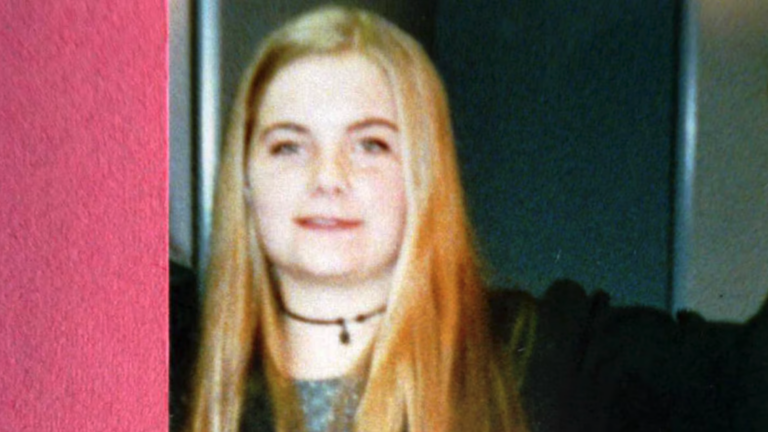
An undated passport picture of Karina E. Holmer. – AP
Police are asking anyone with information to come forward.
“I assume there’s somebody out there, or maybe more than one person, that in some way, shape, or form knows something about this,” McLaughlin said. “Somebody sitting out there that, 30 years later, might be in a whole different walk of life … in another stage of their life where what they might not have wanted to say back then, they now realize for one reason or another, conscience, or just just having thought it through … they now look at it and say, you know, maybe it’s time I share this information. We’d like to think that could happen.”
Holmer arrived in the United States in March 1996 and had been working as a nanny for Frank Rapp, a photographer, and his wife, Susan Nichter, the Globe reported at the time. When she wasn’t watching their children at their home in Dover, Holmer on some weekends would sleep at Rapp’s studio at 327 A St. in South Boston. That’s where she was that Friday night before heading out to the nightclub, the Globe reported.
On June 25, 1996, this Boston police Crime Scene Investigation truck was parked outside of Frank Rapp’s photo studio at 327 A St. in South Boston. – Bill Brett / The Boston Globe
When reached by phone this month, Rapp and Nichter both declined to comment.
“We have nothing to say,” Rapp said. “Our family has been impacted by this. … We don’t have anything to say.”
The day after Holmer’s remains were found, a fire was discovered in a dumpster outside of the couple‘s Dover condominium, the Globe reported at the time.
Nichter told the Globe at the time that the fire was a “weird coincidence” and maintained that Rapp had an “airtight” alibi: He had taken the children out to McDonald’s and to see the movie “The Hunchback of Notre Dame” at the Mendon Drive-In, and slept at home and spent Saturday there with his parents and family, the Globe reported.
Police looked through the dumpster at the Dover condominium and used cadaver-sniffing dogs to search the town’s transfer station.
The Globe reported that much of the police investigation focused on patrons of the nightclub where Holmer was last seen. But investigators were stymied, and they had no crime scene.
“There’s no ability to determine with any definite basis how she was killed, why she was killed, where she was killed,” David Meier, a former Suffolk County prosecutor, told the Globe in 2016. “Nevermind who killed her.”
In July 1996 flowers and an anonymous letter marked the area near the dumpster where Karina Holmer’s body was found. – Evan Richman / The Boston Globe
Holmer had told her friends that she wanted to return home to Sweden that August because she was unhappy here, according to media reports.
The Globe reported that Holmer had written an ominous letter to her friend Ulrika Svensson. “She wrote to me and said: ‘Something terrible has happened. I cannot tell you right now what it is. But I will tell you when I get home,’ ” Svensson said in an interview with a Swedish newspaper that was picked up by the Globe and the Associated Press.
The Associated Press also reported that Holmer expressed discontentment to another friend, Charlotte Sandberg. “There is always so much cleaning and I think I am stressed all the time,” Holmer wrote. “So this is not exactly what I thought it would be.”
On June 23, 1997, a letter and flowers were placed on this fence on Ipswich Street near Boylston Street, close to where Karina Holmer was found murdered the year before. – Bill Brett / The Boston Globe
One year after the murder, the Globe interviewed her father, Ola Holmer. He said he carried Karina’s memory with him every day.
“You call it an anniversary,” he said in the June 1997 interview. “That’s a very odd word for me. Anniversary for me is some kind of celebration.”
Ola Holmer recalled how much Karina was smiling on that day in March 1996 when they drove her to the airport.
“She was happy going to America,” he recalled. “She was a bit leaning on her friends all the time. She wanted to show us, her parents, that she could manage this all on her own.”
A week before she left Sweden, Holmer won 10,000 Swedish crowns on a lottery ticket (the equivalent of $1,500 back in 1996) and Holmer looked forward to using that money while she was abroad, the Globe reported.
At the airport, her last words to her family were: “I hope I’m doing the right thing,” the Globe reported.
At her funeral service in Sweden, two poems that Holmer had written as a teenager were read. The Globe reported that in one of them, a 1992 poem titled “Life,” Holmer wrote:
The richest gift you ever got is LIFE.
Don’t throw that away or ever step on it.
But hold it high in your hands.
Inside the white stone church, white roses adorned top of Holmer’s coffin and wildflowers picked from nearby forests decorated the aisles, the Globe reported.
The Rev. Ebbe Appelros, the Lutheran pastor who led Holmer’s funeral service, told the Globe at the time that Holmer’s loved ones were still too shocked to speculate on what had happened on that fateful night when Holmer vanished.
“At this stage, I don’t think it matters, but it will matter in time to come,” Appelros said in the 1996 phone interview. “What happened to Karina? Did she suffer, and how? And why?”
Thirty years later, those questions remain unanswered.
On the anniversary of her death, the search for Holmer’s killer continues, according to James Borghesani, a spokesperson for the Suffolk County district attorney’s office.
“I can tell you that the Karina Holmer case has always been considered active and ongoing by our prosecutors and investigators and always will be until her killer is identified and brought to justice,” Borghesani said in an email. “Every year we see new information arise in unsolved cases of every length so there’s always hope.”
Anyone with information is urged to contact the homicide unit at 617-343-4470. Tips can also be submitted anonymously by calling the Crime Stoppers Hotline at 1-800-494-TIPS or texting “TIP” to “CRIME” (27463) on your phone.
Sign up for the Cold Case Files newsletter.
Jeremiah Manion of the Globe staff contributed to this report.
Emily Sweeney can be reached at [email protected]. Follow her @emilysweeney and on Instagram @emilysweeney22.
Sign up for the Today newsletter
Get everything you need to know to start your day, delivered right to your inbox every morning.