Local News
Supporters say students will save time and money, while critics argue shorter programs could come at the expense of a well-rounded education.
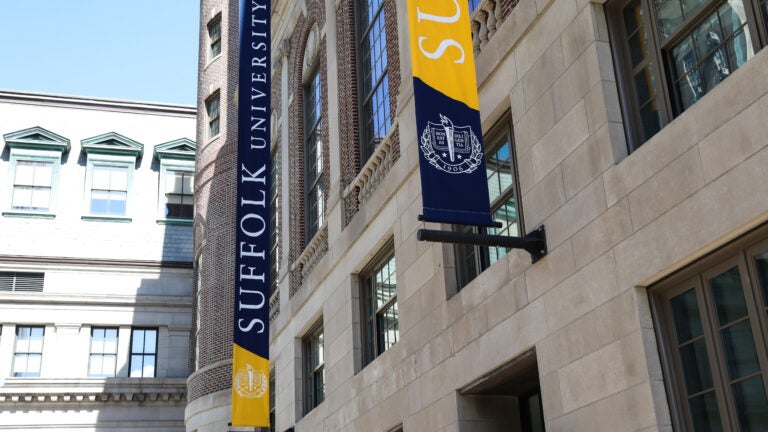
New banners on Suffolk Universities Sawyer Building. Michael J. Clarke, Associated Press
A bachelor’s degree in three years instead of four could soon become a reality for some Massachusetts students.
Merrimack College and Suffolk University plan to launch a three-year pilot applied bachelor’s degree program in fall 2027, following approval from the Massachusetts Board of Higher Education last week.
Supporters say the accelerated programs could reduce the cost of earning a degree, but critics argue students may sacrifice the breadth of education needed for graduate school and the workforce.
“Many students need to launch their careers sooner to support themselves and their families, and these pilots explore how we can grow options for being career-ready in a way that reduces costs and time to degree,” said Commissioner of Higher Education Noe Ortega, in a statement.
Merrimack will pilot a 96-credit version of its bachelor’s degree in business administration, communications, criminal justice, and psychology programs.
Suffolk, meanwhile, will pilot a 94-credit applied bachelor’s degree in healthcare administration and innovation.
The standard number of credits for a bachelor’s degree is 120.
The program will expand upon the state’s growing slate of affordable college options, including free community college, free and more affordable public four-year degrees, and expanded Early College programs that allow students to earn college credits at no cost in high school.
The concerns
The Massachusetts Teachers Association warned before the vote approving the pilot program that the most financially vulnerable students would opt for shorter degrees, potentially creating deeper inequities.
“It’s distressing to me that this proposal is in some sense aimed at low-income or working-class students,” said Heike Schotten, a faculty member at UMass Boston, in a statement.
She continued, “My students are already disadvantaged by having to work full-time while taking classes. To offer them less of an education, as if it were an accommodation of that disadvantage rather than a kind of enhancement of it, is at best dishonest and at worst cruel.”
The Massachusetts Teachers’ Association said that faculty and staff expressed concerns that shortened degrees will create a “two-tiered higher education” system that will “erode the state’s reputation for academic excellence.”
The teacher’s association said that 30 fewer credits may not seem like much, but it means fewer electives and general education courses that make a well-rounded student.
The Massachusetts Teachers’ Association did not respond to a request for further comment following the vote.
The union represents over 100,000 teachers, faculty, and professional staff at public schools, colleges and universities across the state.
Kevin Young, an associate professor of history at UMass Amherst, said the program will “degrade the quality of higher education in our state.”
“The solution to financial difficulty is not to lower our standards or further reduce the place of liberal arts in our curricula,” Young continued. “The solution is stronger public funding, administered democratically at the campus level.”
Do you agree with colleges offering 3-year bachelor degrees?
Beth Treffeisen is a general assignment reporter for Boston.com, focusing on local news, crime, and business in the New England region.
Sign up for the Today newsletter
Get everything you need to know to start your day, delivered right to your inbox every morning.