Local News
Several of the board’s recommendations echo earlier concerns regarding police bodycam footage and immigration tensions.
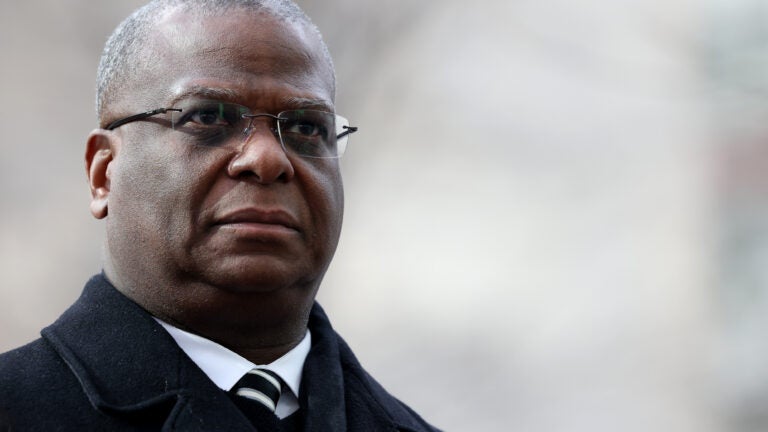
The memo, which calls for several reforms, is addressed to Boston Police Commissioner Michael Cox. Jessica Rinaldi/The Boston Globe
A citywide police watchdog organization is calling for reforms to the Boston Police Department’s bodycam footage policies in the wake of two fatal police shootings.
The Office of Police Accountability and Transparency (OPAT) issued a memo June 8 addressed to Boston Police Commissioner Michael Cox from the department’s civilian review board. The board is responsible for looking into civilian complaints of alleged police misconduct.
OPAT’s memo targets Boston police policies in two different areas: the release of bodycam footage and involvement with federal law enforcement agencies. The memo’s recommendations include a formal update to Rule 405, which details the police department’s body worn camera policy.
“In light of the recent killings of two Boston community members by on duty BPD officers, we are in the midst of an intense public dialogue around the BPD’s policies for using force on civilians and around if and when to release bodycam footage of these killings,” the memo reads.
The board recommended releasing bodycam footage of “critical incidents” to OPAT within seven days of their occurrence and to the public within 30 days “after consulting family members of the alleged victims and survivors.” These situations are defined by OPAT as “incidents involving the on-duty discharge of a firearm by a BPD officer or employee, as well as police use of force that results in serious injury or death,” according to the memo.
Memo’s bodycam recommendations echo calls from city councilors
Though OPAT did not explicitly reference specific instances of lethal force by Boston police officers, the memo’s recommendations echo similar calls from city councilors after Stephenson King, 39, was shot and killed by police March 11.
The fatal shooting occurred when officers responded to a reported carjacking in Roxbury. When they found King behind the wheel of the involved vehicle, he disobeyed their commands, attempted to flee, and struck a police cruiser, police have said.
Officers fired their weapons and struck an unarmed King, who was brought to a local hospital and pronounced dead. The following week, prosecutors charged Nicholas O’Malley, the officer who allegedly killed King, with manslaughter.
Prosecutors say the bodycam footage refutes O’Malley’s alleged claim that he fired his weapon because he believed his partner was in danger. However, Suffolk County District Attorney Kevin Hayden has declined to share additional evidence “for the integrity of this investigation.”
Following several councilors’ push for the video’s release, they voted April 15 to request bodycam footage for all incidents from the start of 2025 through April 2026 that did not result in a criminal investigation. This includes footage from officer-related incidents that resulted in a settlement or civil proceedings and incidents involving alleged misconduct that did not lead to criminal charges.
Department calls for ‘de-coupling’ from federal agencies
Though the memo leads with bodycam recommendations, the bulk of the four-page document addresses the Boston Police Department’s relationship with federal law enforcement activities. The named federal agencies include the FBI, the Department of Homeland Security (DHS), and Immigration and Customs Enforcement (ICE).
“In light of aggressive and violent federal policies targeting our immigrant neighbors, as well as the deaths of civilians in Minneapolis in January 2026, the Civilian Review Board writes to express concern regarding ongoing collaboration between [Boston police] and federal law-enforcement agencies…” the memo reads. “Boston’s commitment to civil rights and community trust requires that the BPD decouple its local policing activities from federal enforcement practices that undermine the Boston Trust Act and the principle of community-based public safety.”
OPAT’s chief concern regards the practice of collecting and sharing surveillance data with agencies like the Boston Regional Intelligence Center (BRIC). This data is often collected through field interrogation, license plate readers, and observation reports. At times, the information is “gathered from individuals who are not suspected of any crime,” according to the memo.
Due to the presence of DHS officials within Boston police headquarters, this distribution of information “risks converting ordinary residents into data points within federal systems.” However, OPAT asserts that these risks extend beyond undocumented immigrants in Massachusetts.
“Federal authorities have in recent years targeted lawyers, humanitarian workers, political dissidents, and individuals seeking reproductive or gender-affirming healthcare,” the memo states. “Information-sharing that enables such actions — even if technically permitted — exposes vulnerable people to unjust consequences and contradicts Boston’s stated commitment to human rights and equitable policing.”
To address these concerns, OPAT recommended that Boston police prohibit collecting or sharing the fingerprints of non-felony arrestees. Under the recommendations, fingerprinting for misdemeanors which do not involve violence, domestic violence, or weapons charges and are not required for adequate identification will require “supervisory authorization,” according to the memo.
OPAT also proposed that the biometric data of non-felony arrestees will not be transmitted outside the Boston Police Department. Further recommendations include tightening of BRIC’s information collection policies and required submission of quarterly reports to OPAT and the City Council with “statistical breakdowns regarding civil immigration detainer requests and responses by law enforcement officials.”
OPAT urges police to separate from task forces, decline grants
The watchdog’s concerns about Boston police involvement in federal agencies extends to groups like the FBI’s Joint Terrorism Task Force. The memo criticizes cooperation with these task forces and condemns a lack of “timely responses to public records requests regarding these federal partnerships.”
“While combating violent crime and terrorism is essential, continued cooperation with federal agencies whose civil-immigration activities target immigrant communities places Boston residents at risk and undermines local accountability,” OPAT’s memo reads.
The solution to these opaque collaborations is to withdraw from the named federal task forces, create a public list of “all formal and informal partnerships,” and release records of all related federal information requests, according to the board.
OPAT further recommended that both Boston police and the city itself decline DHS funds that “federal-local entanglement in immigration and intelligence programs and runs contrary to the City’s commitment to equity and transparency.” However, they warned that the city must take a “precautionary approach” to pulling out of these sources of funding.
A representative for OPAT was unavailable for a comment, and Boston police did not respond to a request for comment.
Sign up for the Today newsletter
Get everything you need to know to start your day, delivered right to your inbox every morning.