BOSTON CELTICS (2-1) at PHILADELPHIA 76ERS (1-2)
Location: Xfinity Mobile Arena, Philadelphia, PA
Radio: 98.5 The Sports Hub
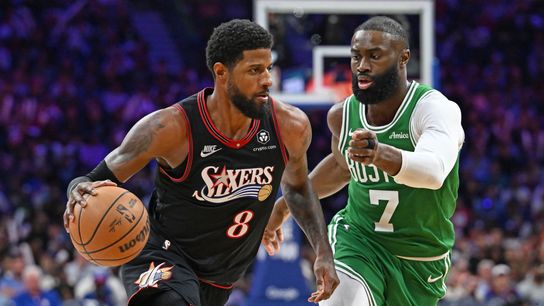
Preview: In Game 3, the Boston Celtics won a barnburner at Xfinity Mobile Arena. It all came down to the final few minutes of the game, both teams going back and forth.
But a steady stream of Jaylen Brown buckets followed by three clutch moments — Derrick White‘s offensive rebounds, Payton Pritchard‘s side-step three, and Jayson Tatum‘s deep pull-up — were enough to close the doors on the Philadelphia 76ers.
Now, the Celtics must focus on the present. Game 4 could conclude in two very different realities. One, the Celtics go back to Boston up 3-1, with a chance to close out the series in five games. Or two, they go back to Boston ready to fight for their playoff lives, with the series tied 2-2.
“The closer you are winning is really the closer you are losing,” Jordan Walsh said at Celtics shootaround on Sunday afternoon. “Because the closer you are winning, the more comfortable you get. And I feel like we need to fight that. I feel like in Game 1, after the win, we got pretty comfortable. And they came out in the second game, they kind of hit us in the mouth, and we didn’t respond. So, I feel like having that humility to come into the next game was the same intentionality, [hunger], passion, aggressiveness [is key to getting] a win.”
Tale of the tape: If Game 1 was an example of how to play and Game 2 was the opposite, Game 3 was a blend of both.
Boston was imperfect. There were mistakes. Turnovers in the lane, transition opportunities for the 76ers, and empty offensive possessions.
“Runs [are] the name of the game,” Neemias Queta said at practice on Saturday. “They’re really good when they get stops, and they get out in transition. They get to hit those layups, dunks, whatever. But I think it starts with us. Our shot selection, being able to crash, being able to get stops. And I think those things are what we need to rely on.”
With Tyrese Maxey and VJ Edgecombe in the fold, Philadelphia runs whenever it gets the chance. This makes them particularly good at going on little runs that can flip a game on its head.
For the Celtics, stopping those runs is crucial. But it’s not that simple.
“It’s not perfect. So, you take a look at a couple of plays last night. I think JB loses the ball, he sprints down in transition, gets a block, right? It’s just, move onto the next play as fast as you can. JB blocks a guy at the rim, Baylor [Scheierman] comes in, gets a steal. That’s a live-ball turnover that, because of our competitiveness and our next-play mentality, we were able to get that. But then you look at the rim read Luka [Garza] has on [Adem] Bona, [he] gets a block, they come down, and Edgecombe gets a dunk.
“Sam [Hauser] gets a back cut, Bona gets another block, they come down and get an extra possession. So, it’s just managing the transitions of the game, knowing that you’re not going to play perfect. How quickly can we move on to the next possession? But you want to take care of the ball, you want to have great rim reads, and then, when you do make a mistake, which is going to happen, you just sprint back and have a next-play mentality.”
Getting caught up in mistakes will only make the issue worse. Brown’s chasedown block was a perfect example of the next-play mentality Mazzulla preached.
Though there are ways for the Celtics to limit the issue.
“Not having bad turnovers,” Payton Pritchard said, chuckling as if it were obvious. “I would say that’s the main priority. Every time we’ve had bad turnovers, they got out and ran. And then, it’s just controlling the hustle plays, offensive rebounding, stuff like that.”
The Celtics committed 17 turnovers in Game 3. It was the most they’ve coughed up in the series so far, and the number has been steadily rising. That’s controllable No. 1 for stopping Philadelphia’s runs.
“It’s just managing them,” Mazzulla said. “You’re going to have — I mean, ideally, I’d like to have — in, Game 1, we had eight turnovers, in Game 2, we had 15, 17 last night, so you want to have less of those. But at the end of day, we just got to make plays. You just got to make a next play. And some of that you’ll control. Some that, they’re really good at that. So, I think our offensive rebounding, our ball security have to be able to do some of that. Our rim reads have to do that. But then we just got to sprint back and make plays, which I thought our guys did a good job of doing. “
Game 4 key: The Sixers’ runs were a big factor in Game 3, just as they were in the first two games of the series. But Maxey has been a problem, too.
Even when he’s not efficient — he shot just 12-of-31 in Game 4 — his ability to nail big shots in big moments makes him a constant threat.
“It’s kind of a give-and-take,” Walsh said of containing Maxey. “Some things, we have to live with, some things, we must take away. But kind of like finding that balance is what makes a difference. And then, JB talked about that. It’s finding a balance. Trying to make me a better defender against whoever [I’m] guarding. Everything’s about balance. When to be aggressive, when to back off, when to pick up high, when to pick up low, just stuff like that.”
Walsh did mention that some of the tendencies Brown mentioned to him before the series have come into play, and perhaps that’s part of the reason Boston has been able to stunt Maxey’s efficiency a little bit.
But Maxey also puts immense pressure on the Celtics’ center room, which has dealt with some foul trouble so far this series.
He’s not the only one, either. Edgecombe is great at getting downhill. Paul George thrived in the late-game pick-and-roll on Friday night. Oubre drives through contact well, and Andre Drummond‘s work on the offensive glass puts guys in tricky positions.
Yet much like the Sixers’ runs, there are small things that the Celtics’ bigs can control.
“I think the number one thing is trying to keep them off their tendencies,” Garza said. “Whether it’s Maxey, and he’s trying to get to his right hand, or whatever the case may be. I think it’s trying to put him in a position where he’s going to a spot that is not what he’s trying to do every single time that you see on film and that we talk about. And then obviously, just trying to stay disciplined as best you can, and not foul, go straight up. And obviously, there’s going to be calls that don’t go your way, but I think throughout the course of the game, there’s a lot of fouls that we can control as well.
“We’ve had some screening fouls, and different things like that. And they’re good at kind of drawing those as well. Oubre, a couple guys that are good at, when they feel the contact, getting those calls. But I think for us, it’s really being disciplined on those controllable fouls, and then obviously, there’s situations where you got to protect the rim and make sure they don’t get easy ones.”