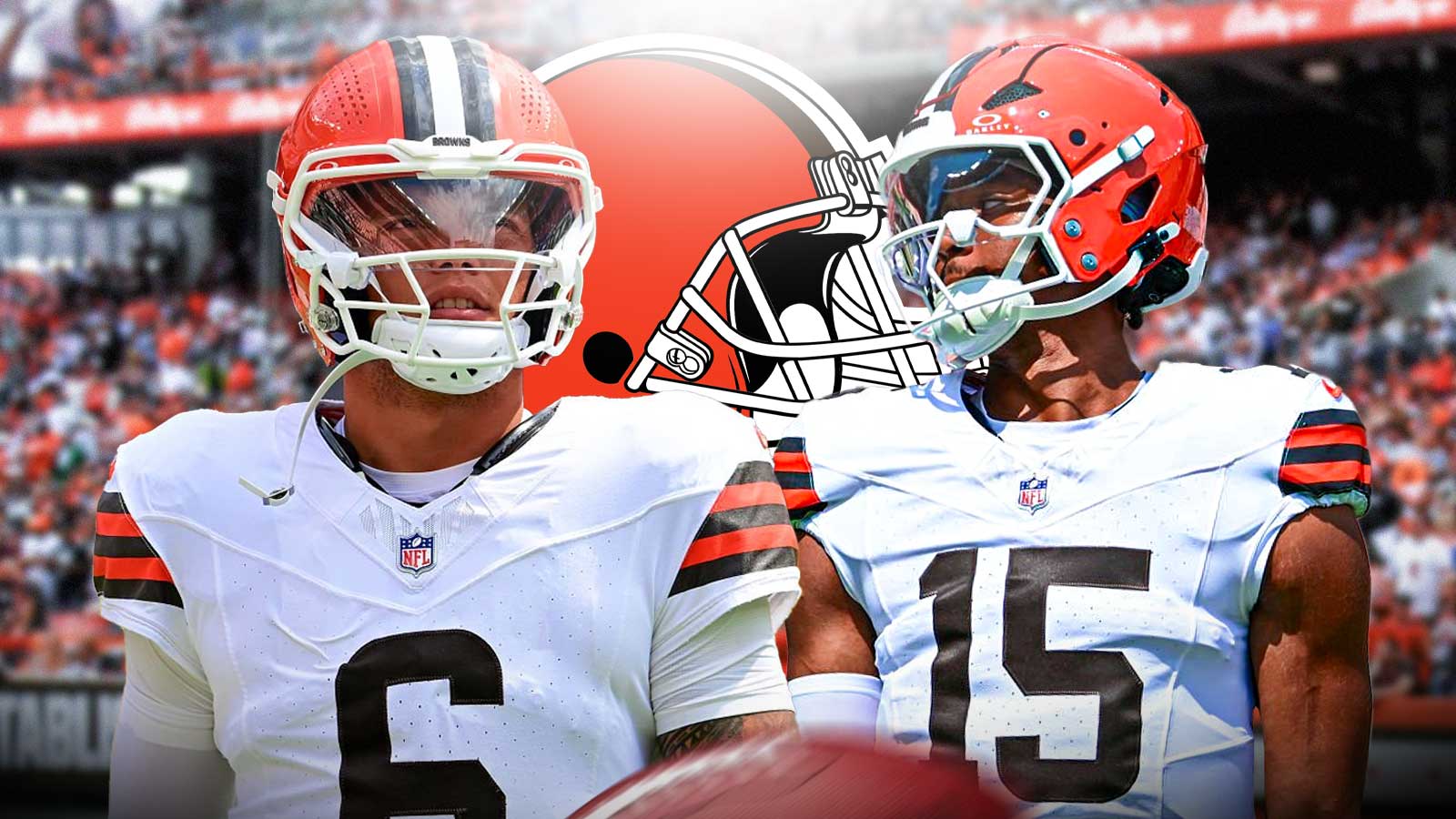
Browns face a brutal quarterback decision between Dillon Gabriel and Taylen Green before the 2026 NFL roster deadline.
For the Cleveland Browns’ 2026 roster, no roster decision will be more painful than what they must do at quarterback. The top of the room appears firmly defined with Deshaun Watson starting — at least for now. And yet, the battle for the final developmental spot has created a fascinating collision between certainty and upside.
Turbulence and transformation
Cleveland’s ongoing preseason campaign has delivered a turbulent glimpse into a franchise undergoing a fundamental identity shift. Todd Monken has installed an aggressive, tempo-driven offensive scheme. As such, live exhibition snaps have produced sharp contrasts and dramatic momentum swings across the depth chart. The summer slate reached a critical fever pitch during a weather-delayed matchup against the Buffalo Bills. Dynamic playmaking sparked scoring momentum while pocket indecision and turnovers led to visible frustration from the home faithful. Along the line of scrimmage, rebuilt trenches have endured baptism by fire. Those exhibitions have provided Cleveland’s coaching staff with the unfiltered evidence necessary to make increasingly difficult personnel decisions. And no position has produced a more consequential decision than quarterback.
Cleveland’s biggest headache
When examining the entirety of Cleveland’s depth chart, no dilemma is more agonizing or structurally consequential than the quarterback spots. Carrying four quarterbacks on an active 53-man roster is generally difficult to justify. They already did it before, and it basically went nowhere.
For Cleveland, the first two positions appear secure. Watson’s massive guaranteed contract makes him extremely difficult to move. Shedeur Sanders has asserted himself as an electric catalyst. That leaves Gabriel and Green fighting for what could be the lone developmental spot. The decision is therefore about what the Browns value more: immediate operational security or potentially transformational upside.
Gabriel offers safer path
Gabrielis straightforward: he looks like the quarterback who can be trusted to execute. His quick release, pocket composure, and experience give him a polished feel. Gabriel can deliver the football on time and keep the offense moving. That matters enormously for a team attempting to establish a new offensive identity. If Watson were unavailable or Sanders needed additional time to develop, Gabriel would offer a relatively clean transition.
There is also value in predictability. NFL teams spend enormous resources creating systems that depend on timing, communication, and precision. Gabriel’s profile suggests he can step into that structure without creating unnecessary disruption.
Of course, reliability does not necessarily equal scarcity. If the Browns believe Gabriel’s ceiling is that of a competent backup, they must ask whether that profile is worth protecting at the expense of Green’s considerably more intriguing athletic upside.
Swing-for-the-fences option
Green’s case is built almost entirely around what he could become. His combination of size, mobility, and arm talent gives him tremendous physical tools. Green can threaten the edge on designed runs and escape pressure when protection breaks down. He can also create explosive plays when things break down. Monken has an opportunity to construct an offense around dynamic movement and quarterback versatility. Green provides precisely the kind of raw physical ingredient that could eventually unlock another dimension.
Choosing Green, however, requires patience and high risk-tolerance. The Browns would be betting that their coaching infrastructure can refine his processing, accuracy, and decision-making without sacrificing the traits that make him special. That is a substantially different proposition from simply keeping the more polished player.
Waiver wire risk
The most agonizing element of this situation may be what happens after the roster decision. If Cleveland chooses Gabriel and attempts to send Green through waivers, the Browns could be inviting another organization to acquire one of the more intriguing developmental quarterbacks available. A player with Green’s physical profile would have obvious appeal to quarterback-needy teams. That makes the practice squad route dangerous.
The Browns could theoretically attempt to keep both players by placing one outside the initial 53 and hoping he clears waivers. Still, hoping is not a roster strategy.
Conversely, choosing Green means accepting the possibility that Gabriel’s polished profile could disappear. A quarterback with his experience and efficiency could immediately attract teams looking for dependable depth. Cleveland therefore faces a genuine lose-lose scenario.
Upside or insurance
Kirby Lee-Imagn Images
For GM Andrew Berry, this is precisely the kind of roster decision that can cause migraines. The easy answer would be to keep everyone. The NFL roster, however, does not permit easy answers.
Keeping four quarterbacks just has not and would not work for Cleveland. It will surely create vulnerabilities at positions where injuries are considerably more common. Keeping three means one of Gabriel or Green is exposed to the waiver process. Keeping only two would be an even more aggressive gamble.
The most logical solution may ultimately be to keep the player Cleveland believes has the greatest chance of becoming a long-term asset. That gives Green a compelling edge.
Gabriel is the cleaner quarterback today. That said, Green’s athletic ceiling could make him much harder to replace tomorrow. If Cleveland genuinely believes Monken can develop him, allowing another team to claim him would be a difficult mistake to reverse.
For the Cleveland Browns’ 2026 roster, no roster decision will be more painful than what they must do at quarterback. The top of the room appears firmly defined with Deshaun Watson starting — at least for now. And yet, the battle for the final developmental spot has created a fascinating collision between certainty and upside.