Arts
The urn was reportedly stolen from the Church of San Michele Arcangelo di Cangiano sometime between 2012 and 2022.
The urn was recovered from a Northeast antiques dealer who bought it from an Italian dealer, the Boston office of the FBI said. Boston FBI
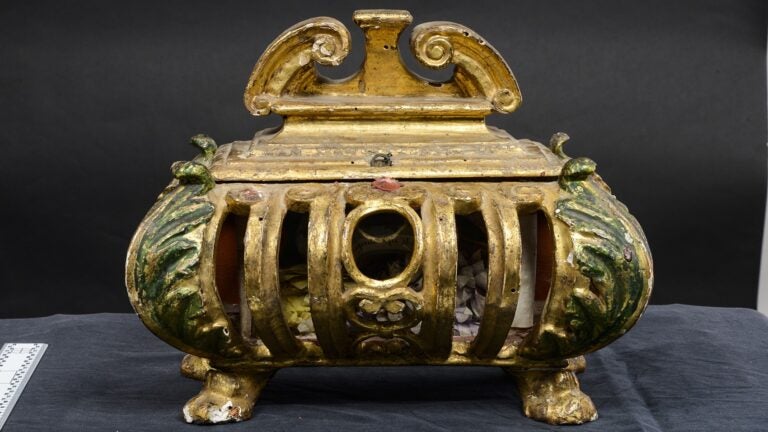
The Boston division of the FBI recovered a 17th-century reliquary urn that was stolen years ago from an Italian church, officials said.
The gilded urn, carved in wood, is believed to be one of 17 ecclesiastical artifacts stolen from the Church of San Michele Arcangelo di Cangiano, the agency announced Thursday. The FBI returned the urn to the Italian Republic, and a formal repatriation ceremony was held Wednesday.
“It’s incredibly exciting when the FBI can recover a piece of history that carries such deep emotional and cultural significance,” Ted Docks, special agent in charge of the FBI’s Boston division, said in the announcement. “This case highlights the power of international cooperation and our collective commitment to safeguard the world’s cultural treasures, no matter where they may be.”
The urn and other artifacts were stolen from the church sometime between August 2012 and August 2022, officials said. The FBI began investigating the urn’s location during fall 2025 in coordination with its Art Crime Team, Law Enforcement Attaché in Rome, and the Italian Carabinieri.
The agency worked with the Italian Ministry of Culture to get the urn back after they discovered that an antiques dealer based in the Northeast had purchased it from an Italian dealer, according to the FBI. The Northeast dealer voluntarily turned over the urn Feb. 11 so it could be returned to the church from which it was stolen.
The urn’s significance to Italian history earned it a registered spot in the Italian Dioceses’ inventory of Historical Artistic Heritage Items, the FBI said. These items are protected by the Italian State and the Vatican City State.
“This reliquary urn is a tangible link to intense religious devotion and a connection to the generations who lived and prayed with it,” Docks said. “It represents the intersection of faith, history, and art — elements that are invaluable to the people of Italy and to humanity as a whole.”
Sign up for the Today newsletter
Get everything you need to know to start your day, delivered right to your inbox every morning.