

“Madame, please, can you stop the armed groups? Can you stop what the gangs are doing to us?”
Her plea captured the reality confronting children across Haiti, where violence has disrupted schools, upended families, and made even the simple act of going to class an act of courage.
As children around the world head back to school, the start of the year in Haiti unfolds once again under the shadow of insecurity, displacement, and hardship. Children must cross gang-controlled zones to reach school, risking crossfire and forced recruitment.
Yet in a country battered by gang violence, school also remains a space of hope – where children can learn, reunite with their classmates and, despite everything, begin to imagine their future.
For Etzer, a father of four, internally displaced and an advocate for the rights of displaced people, returning to class means far more than simply going back to school.
After fleeing their neighborhood because of gang violence, many displaced children are reuniting with friends and rebuilding a social life brutally cut short by the crisis.
“Schooling is like therapy for these children,” he says. But in many areas, learning conditions remain extremely difficult.
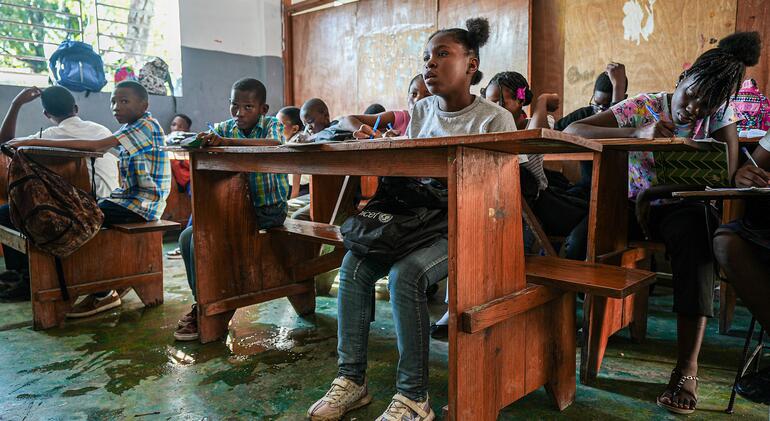
Children attend class in Delmas, Haiti, as escalating gang conflict disrupts the country’s school system.
Hope and fear
Jasmide, mother of seven-year-old Woodayline, is glad classes are reopening. But behind that hope lie the hardships facing many families: hunger, unemployment, insecurity, and the cost of schooling, which weighs particularly heavily on those who depend on private institutions.
“We Haitian parents are in favor of classes reopening – but not under the sub-human conditions being imposed on us,” she says.
Those concerns are widely shared among displaced families and communities scared by violence. Everywhere, Narayan says, she hears the same plea: to see children going to school safely.
“Above all, we want safety and continuity of education,” she adds.
Deadly insecurity
The scale of the crisis is staggering. UNICEF‘s latest figures, for the 2024–2025 school year, show that more than 1,600 schools were affected by insecurity – disrupting the schooling of over 240,000 children and the work of some 7,500 teachers.
Woodayline and Etzer’s four children are among the many for whom a classroom is no longer a given.
A young girl sits in a temporary camp set up for people who have fled their homes due to violence.
In Port-au-Prince, where up to 90 per cent of the capital is under gang control, some schools have closed, become inaccessible, or been destroyed. Others now shelter families with nowhere else to go.
For many children, the danger begins before they even reach the classroom.
“Just yesterday, two young girls were kidnapped on their way to school. It was the day after the school year began,” Narayan recounts.
Such incidents cause “enormous fear and anxiety” among families, she explains – to the point that some parents now hesitate to let their children travel alone.
And the fear does not vanish once students are seated in class. A child who has been displaced or exposed to violence can hardly concentrate the way they used to. The teachers themselves may have fled their own neighborhoods or may no longer be able to reach their schools.
Keeping classrooms open
In response, UNICEF is helping more than 174,000 children this year across the country’s West, Greater North, and Greater South regions.
The work ranges from distributing school supplies and helping children enroll to creating safe learning spaces, providing psychosocial support, training teachers to recognize and respond to signs of trauma, and rehabilitating damaged schools.
It also runs remedial classes and accelerated learning programs for children who have been out of school for months, or even years – a bridge back into the formal system. That support flows through the Ministry of National Education and targets the country’s public schools.
Young Haitian student smiles during a UNICEF spokesperson’s visit to a school in Delmas 45.
‘They were so happy to be there’
At the launch of the school year, Narayan says she was struck by the students’ enthusiasm. “They were so happy to be there.”
Parents want to be able to send them without fear. Teachers want to do their jobs under stable conditions. The children simply want to learn, and to feel normal again.
Despite everything, Haitian families and their children hold onto an aspiration that is as ordinary as it is defiant: to go to school, to learn, to find their friends again, and to imagine a future for themselves.


