HMI Magazine Review: An Ambitious Celebration of Haitian History, Art and Identity
HMI Magazine Cultural Review
Miami — August 15, 2026
There are cultural events that entertain an audience for an evening, and there are productions that attempt something much larger: to tell a people who they are.
Ayiti Bèl Nanm belonged to the second category.
On Saturday, August 15, the Ziff Ballet Opera House at Miami’s Adrienne Arsht Center for the Performing Arts was filled for the presentation of an ambitious contemporary Haitian musical-theater production that brought together music, drama, poetry, dance, history, spirituality and visual art.
For approximately 90 minutes, Haiti was not presented through the familiar international images of political instability, insecurity or humanitarian crisis. Instead, the audience encountered another Haiti—the Haiti of memory, rhythm, resistance, spirituality, beauty, creativity and extraordinary cultural depth.
Conceived and directed by Carole Demesmin, with major creative contributions from Florence Jean-Louis Dupuy, Paula Clermont Péant, and Linda I. François Obas, Ayiti Bèl Nanm assembled an impressive group of Haitian performers and creative professionals around a remarkably ambitious idea:
Tell Haiti’s story through Haiti’s own artistic language.
And for much of the evening, it succeeded beautifully.
More Than a Concert
One of the most important things to understand about Ayiti Bèl Nanm is that this was not simply a Haitian concert presented inside a prestigious theater. It was a theatrical production. That distinction matters.
Rather than presenting a succession of singers, dancers, and actors performing unrelated numbers, the production attempted to create a continuous artistic journey. Music moved into theater. Theater transitioned into dance. Poetry introduced memory. Historical figures and ancestral voices appeared alongside contemporary expressions of Haitian identity.
The disciplines were designed to communicate with one another. This gave the production a sense of purpose that separated it from the traditional cultural showcase. From its opening moments, the audience was invited to travel through different dimensions of Haiti: its ancestral memory, historical struggles, spirituality, artistic traditions, and contemporary identity.
There was pride throughout the production, but importantly, the evening did not feel like a simple exercise in nostalgia. It looked backward to say something about the future.
An Extraordinary Gathering of Haitian Talent
The cast represented one of the production’s greatest strengths.
Among the artists featured were Béatrice Kébreau, Danielle Thermidor, Élisabeth Guérin, Érol Josué, Farah Juste, Jimmy Jean-Louis, Katilé Fuertes, Riva Nyri Précil, Tafa Mi-Soleil and Wood Hyppolite, alongside members of the production’s broader artistic ensemble.
The significance was not simply that recognizable Haitian artists shared one stage. What made the casting effective was the diversity of artistic identities represented. Actors, vocalists, musicians, dancers, and cultural interpreters contributed different textures to the production.
Veteran performers brought authority and historical memory. Younger artists brought another energy and represented cultural transmission, the idea that Haitian identity does not belong exclusively to previous generations.
That generational conversation became one of the more meaningful aspects of the evening. Artists such as Érol Josué naturally carried a strong connection to Haitian spirituality and ancestral traditions. At the same time, performers from different disciplines helped expand the production beyond any single interpretation of Haitian culture.
Jimmy Jean-Louis brought the presence and dramatic experience of an internationally recognized Haitian actor. At the same time, voices such as Farah Juste, Riva Nyri Précil, and Tafa Mi-Soleil represented different generations and expressions within Haitian music. The ensemble worked because everyone did not need to sound, move, or perform alike. That diversity was precisely the point. This was Haiti in the plural form.
Music: The Production’s Emotional Foundation
If theater provided the structure of Ayiti Bèl Nanm, music provided its heartbeat. The production assembled an impressive musical creative team that included Raoul Denis Jr., Yenny Ferdinand, Jaël Auguste, Mushy Widmaier and Fabrice Rouzier, presented as the “Sonic Architects of ABN.”
That description was appropriate. Rather than functioning merely as background accompaniment, the music helped establish atmosphere, transition between periods, and connect the emotional language of one scene to another.
Composer Raoul Denis Jr. created the original score AYITI YUKA YEKE ATABEY for the production, giving the show its own musical identity. The presence of accomplished Haitian musicians and arrangers was particularly important because a production attempting to represent Haiti across historical periods could easily have become musically fragmented.
Instead, the score helped create continuity. Traditional influences could coexist with contemporary arrangements. Spiritual and ancestral elements could move into theatrical passages without making the production feel like several unrelated shows stitched together.
Live music also added something that recorded tracks could never completely reproduce: interaction. The musicians responded to voices, dancers responded to rhythms, and the theatrical action could breathe alongside the music.
For HMI Magazine, this was unquestionably one of the evening’s strongest achievements.
Dance Was Not Decoration
Another major success came from the choreography. Under the choreographic direction of Linda François Obas, movement was treated as part of the storytelling rather than as something placed between musical numbers.
That was an important artistic decision. Haitian culture has always communicated through the body as much as through the voice. Movement carries history. It carries spirituality. It carries celebration, resistance, pain, and freedom.
The choreography understood that relationship. Traditional Haitian movement vocabulary appeared alongside more contemporary theatrical expression, creating sequences capable of communicating even when no words were spoken. At its best moments, the dance did not illustrate the story.
The dance became the story.
That is a considerably more sophisticated approach to choreography and helped elevate Ayiti Bèl Nanm from cultural presentation to multidisciplinary theater.
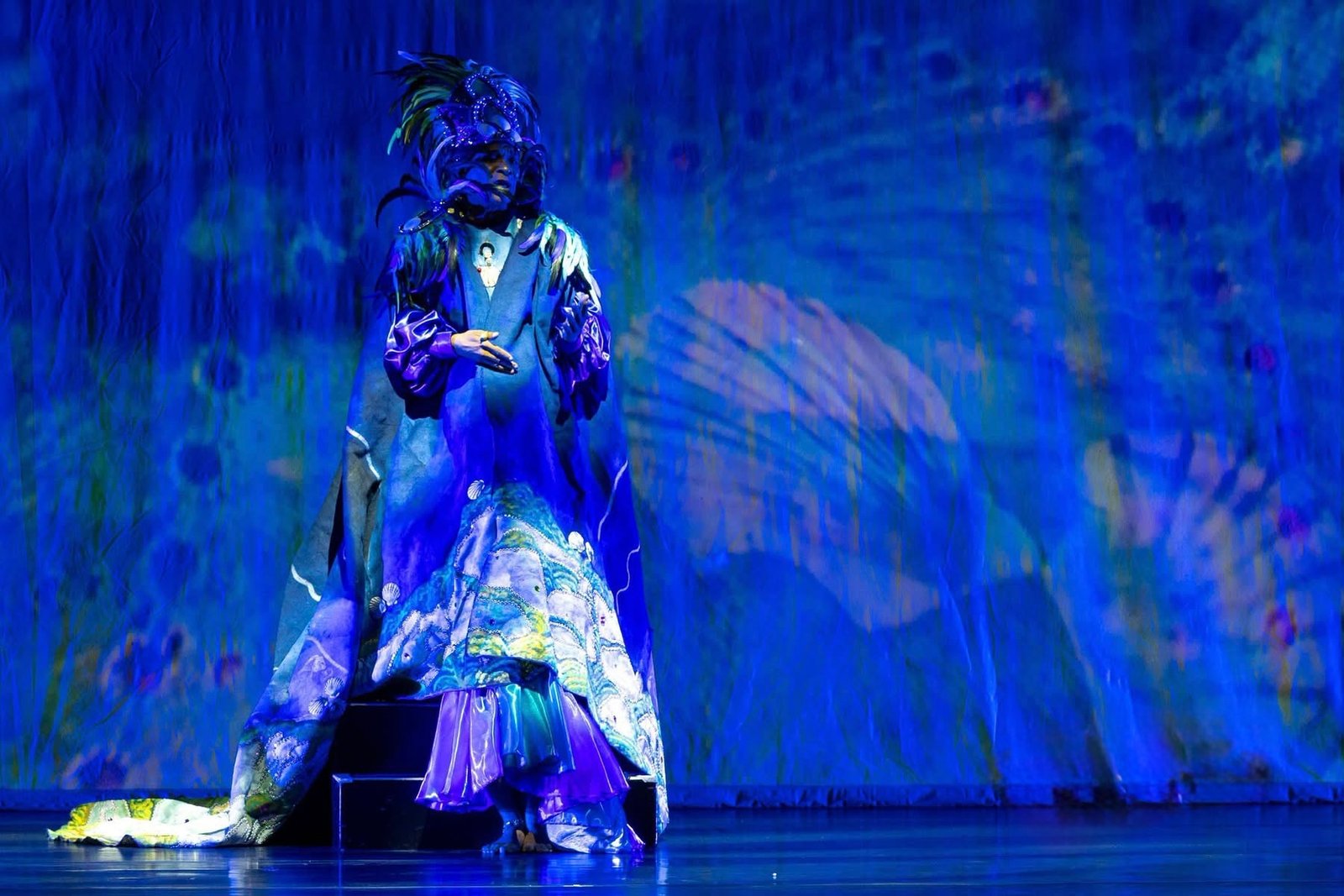
Visually, Haiti Looked Magnificent
The presentation deserves particular recognition.
Scenic projections and digital imagery by Maksaens Denis allowed the environment to evolve without requiring enormous physical scenery to constantly enter and leave the stage. That flexibility was particularly effective for a production moving through history, symbolism, spirituality, and imagination.
The technology generally remained in service of the performers rather than competing with them. Costume design by Maëlle Figaro David provided another important storytelling layer.
Color, texture, silhouette, and historical references helped communicate changes in character and atmosphere. At several points, the costumes themselves became moving pieces of visual art.
Combined with theatrical lighting, projections, and choreography, the production created images that could have stood independently as photographs. And that matters.
A major production should leave audiences remembering not only what they heard, but what they saw.
Ayiti Bèl Nanm produced several of those moments.
Carole Demesmin’s Biggest Achievement: Creating One Vision
Productions of this size are difficult because talent alone does not guarantee coherence. Bring together too many celebrated performers, musicians, dancers, designers, and personalities without a strong concept, and the result can quickly become a variety show.
That did not happen here. One of Carole Demesmin’s most significant accomplishments was establishing a central artistic vision strong enough to contain many different personalities and disciplines. The performers remained recognizable as individuals, but they ultimately served something larger than themselves.
That is direction. The contribution of Production BELAYITI must therefore be recognized not simply for assembling an impressive cast, but for attempting to build an entire theatrical universe around Haitian identity. The ambition was considerable. So was the risk.
Where the Production Can Become Even Stronger
No serious magazine review should confuse admiration with the absence of criticism. Ayiti Bèl Nanm was ambitious, visually compelling, and emotionally powerful, but its enormous artistic scope also presented its greatest challenge.
Many ideas were competing for approximately 90 minutes of stage time: history, spirituality, music, dance, poetry, identity, ancestry, resistance, migration, memory, and contemporary Haiti. At certain moments, the audience had little time to absorb one powerful sequence before being transported into another.
A future version could benefit from allowing some of its strongest scenes more room to breathe. The narrative connections between certain historical or symbolic sequences could also be made clearer for audiences unfamiliar with Haitian history and spiritual traditions.
Haitian spectators may immediately understand references that an American, European, or Caribbean audience encountering Haitian history for the first time may not recognize. That becomes especially important if Ayiti Bèl Nanm intends to tour internationally. These are not arguments for simplifying the production. Quite the opposite. They are arguments for giving its strongest ideas even more space and dramatic clarity.
The Most Important Achievement: Haiti Controlled Its Own Narrative
The cultural significance of the evening extended far beyond the theater. For decades, international representations of Haiti have disproportionately centered on dictatorship, earthquakes, poverty, political instability, gangs, and humanitarian emergencies. Those realities exist and deserve serious reporting. But a country cannot be understood only through its emergencies.
Ayiti Bèl Nanm offered a powerful correction.
Here was Haiti as a civilization.
Haiti as music.
Haiti as spirituality.
Haiti as literature and poetry.
Haiti as movement.
Haiti as resistance.
Haiti as beauty.
Haiti as memory.
And most importantly, Haiti as creator rather than subject.
For one evening on one of Miami’s important cultural stages, Haitian artists were not waiting for outsiders to explain Haiti.
They explained Haiti themselves.
That may have been the production’s greatest triumph.
Should Ayiti Bèl Nanm Go on Tour?
Yes—the concept clearly has life beyond Miami.
New York would be a natural destination. Montreal would be another. Boston, Paris, Atlanta, Washington, Orlando and cities throughout the Caribbean could also provide receptive audiences.
But the larger opportunity extends beyond Haitian communities.
A production becomes internationally relevant when audiences do not need to share the nationality of its creators to understand its emotional themes.
Ayiti Bèl Nanm deals with ancestry, displacement, belonging, spirituality, resistance, memory, family and cultural survival.
Those themes are Haitian.
They are also universal.
With continued refinement of its narrative transitions and appropriate contextualization for non-Haitian audiences, the production has the potential to become something particularly valuable: an international theatrical introduction to Haiti told by Haitian artists themselves.
HMI MAGAZINE ANALYSIS
Evaluating Ayiti Bèl Nanm as a complete theatrical production requires looking beyond applause and emotion.
Artistic Concept — A
The concept was ambitious, culturally meaningful and refreshingly unapologetic about the complexity of Haitian identity.
Music — A
One of the production’s strongest components. The original musical environment and caliber of musicians gave the show considerable emotional and artistic depth.
Cast & Performances — A
A formidable intergenerational ensemble brought experience, personality and cultural authenticity to the stage.
Dance & Choreography — A-
Movement was intelligently incorporated into the storytelling and rarely felt decorative.
Visual Production & Costumes — A
Projections, lighting, costumes and stage imagery combined to create a polished theatrical identity worthy of the venue.
Narrative Structure & Pacing — B+
The production’s enormous scope occasionally worked against it. Some sequences deserved additional breathing room, and certain transitions could become clearer, particularly for international audiences.
Cultural Impact — A+
This is where Ayiti Bèl Nanm distinguished itself. The production challenged one-dimensional narratives about Haiti without pretending that the country’s difficulties do not exist.
International Touring Potential — A
With additional refinement, the production has strong potential for New York, Montreal, Paris and other major cultural markets.
Ayiti Bèl Nanm was not perfect, and an ambitious production should not be evaluated as though criticism diminishes its accomplishment. Its occasional density and pacing issues reveal a production attempting to carry an enormous amount of history and symbolism within a limited theatrical window. But those weaknesses are outweighed by what the production accomplished. It was musically rich, visually sophisticated, culturally intelligent, and emotionally resonant.
More importantly, it demonstrated what can happen when Haitian culture is presented with the scale, professionalism and artistic confidence it deserves.
The filled Ziff Ballet Opera House mattered. The applause mattered. The extraordinary artists onstage mattered. But something larger happened in Miami on August 15. For approximately 90 minutes, Haiti was allowed to introduce itself again. Not through tragedy. Not through statistics. Not through someone else’s interpretation. But through music, movement, memory, history, and beauty. That is why Ayiti Bèl Nanm deserves more than congratulations. It deserves another stage.
HMI Magazine Grade: A
Verdict: A powerful, sophisticated, and culturally important Haitian production with genuine international potential. Ayiti Bèl Nanm did not merely celebrate Haiti—it allowed Haiti to tell its own story.
Haiti’s Beautiful Soul Is Ready for the World
When the final curtain came down at the Adrienne Arsht Center, the production had made its argument. Haiti’s difficulties are real, but they are not Haiti’s complete identity. Behind every headline is an extraordinary civilization whose artists continue creating, remembering and imagining. Miami witnessed that beautiful soul on August 15, 2026.
Because Ayiti Bèl Nanm has more stories to tell.