Local News
A deadlocked rejection vote and arrests in the council chambers marked a dramatic budget season that ended this week.
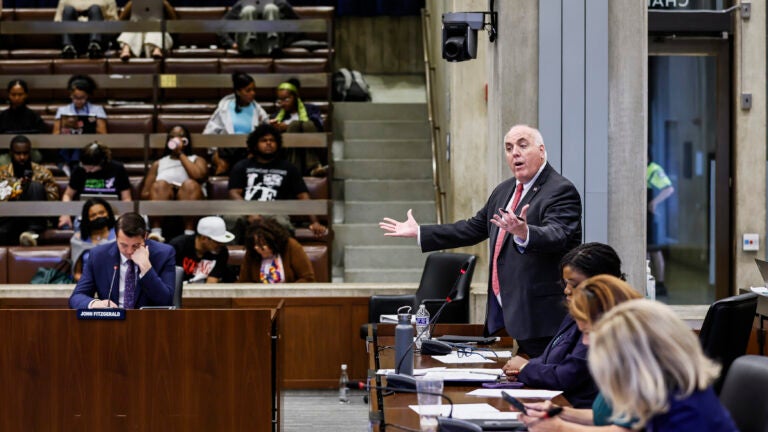
Boston City Councilor Ed Flynn speaks during a meeting in early June where councilors debated Mayor Michelle Wu’s budget proposal. Erin Clark/Boston Globe
On Wednesday, the Boston City Council accepted Mayor Michelle Wu’s amended budget proposal for the next fiscal year, which begins next week.
The adoption of the $4.9 billion budget marks the end of a contentious budget season where emotions often ran high among councilors and activists upset over the mayor’s proposed cuts.
Here are three things to know.
What did the council adopt this week?
The budget adopted this week reflects work the City Council did to reallocate money to restore grant funding, with a slight tweak from the mayor.
The council does not have the power to change the overall spending amount proposed by the mayor, but can amend individual line items. The council submitted an amendment package earlier this month that made $11.8 million worth of changes to Wu’s budget. This included the restoration of $1.8 million for rental vouchers, $750,000 for youth jobs, $500,000 for senior programming, and $100,000 for the Office of Food Justice.
Wu responded to the council’s amendments last week, accepting nearly all of the changes. The only one she pushed back on was a proposed $1.4 million reduction to the Boston Transportation Department’s personnel line item. This would have caused the layoffs of employees such as parking enforcement officers, transportation planners, administrative staff, and workers who install signage, Wu said.
Instead of that cut, Wu proposed a reduction from the Transportation Department’s contracted services line item of the same amount.
“To absorb this cut, the department will seek to amend contract payment schedules, extend timelines, and adjust service levels,” Wu wrote to councilors.
Councilor John FitzGerald, who proposed the initial cut to the personnel line item, said he never intended to back something that would lead to layoffs. According to FitzGerald, the administration told him that the Transportation Department’s personnel budget could absorb the cuts. Then the administration cited a “miscalculation” and told him that the line item change would actually lead to layoffs, he said during Wednesday’s meeting.
“Our intent was always in the way of keeping as many jobs as possible for our city workers. I know we’ve gotten some colorful emails and phone calls in the office from certain departments in the last week or two,” he said. “Just wanted to clarify that miscalculation on the administration’s part to put us in this position.”
Responding to FitzGerald’s comments, Wu’s press secretary Marcela Dwork told The Boston Globe that the potential impacts of the council’s amendments were outlined in a letter the administration sent to the council earlier this month.
“We provided this information in writing several weeks ago to ensure full public transparency, including that cuts to personnel would result in layoffs,” Dwork told the Globe.
No formal vote on the budget was taken Wednesday, but the council effectively adopted the budget because no member moved to override Wu’s change.
The process was contentious
When Wu unveiled her budget proposal in April, she said that the city was facing a “challenging” financial situation due to inflationary pressures, rising costs, and slowing revenues. In particular, the city was feeling the impacts of substantial police overtime pay, snow removal costs, and rapidly rising healthcare costs, officials said at the time.
The budget represented a spending increase of about 2 percent, the lowest year-over-year increase since the aftermath of the global financial crisis in fiscal year 2010. The budget grew last year by about 4.4 percent.
A number of programs stood to be impacted, including one that funds youth employment during the school year. Wu later announced a partnership with several private organizations to secure hundreds of school-year jobs for teens, but discontent remained.
Angry with the proposed cuts, a number of councilors began considering an outright rejection of Wu’s budget in May. One hope was that a rejection could pressure Wu to increase overall spending levels. Wu remained firm, telling the councilors that she could not increase spending and that she would be able to re-submit the budget with no changes if it were rejected.
When the time came to vote on a rejection, the council ultimately deadlocked with a 6-6 vote split between councilors seen as Wu’s allies and those more critical of the mayor.
When the council met in early June to vote on its amendment package, protesters stormed the council chambers and disrupted the meeting for more than two hours.
They chanted “you failed us” at the councilors and held up a sign reading: “Save our youth jobs, city funds now, not empty promises of mythical private jobs and funding.” Eight people were arrested before the council could resume its business.
Frustrations remain
With the financial headwinds facing the city unlikely to abate in the near future, more tough decisions could lay ahead. This year’s budget process exposed tensions between the administration and the council which are also unlikely to disappear.
Councilor Miniard Culpepper continued to criticize Wu’s budget proposal Wednesday. He credited activists, including the protesters who were arrested, for helping to move the city in the right direction.
“This budget restores cuts, maybe not at the level I would have liked to see them, but it does restore cuts that never should have been cut in the first place. The programs and the grants that were placed on the chopping block were not luxuries or extras, they were investments serving some of Boston’s most vulnerable residents,” Culpepper said.
Councilor Julia Mejia also praised activists for pressuring councilors and the administration throughout the process. She called the budget process “broken” and said that councilors should have been more willing to reject Wu’s budget.
Mejia urged her colleagues to exert more pressure on the administration in the future.
“That is the job of the Boston City Council, to stand up and fight for your constituents regardless of who it is that you are fighting against,” she said. “I think we have lost that fight in this chamber and I am going to ask us that we find our ability to stand up and speak up, because that’s what we’ve been hired to do.”
Ross Cristantiello
Ross Cristantiello, a general assignment news reporter for Boston.com since 2022, covers local politics, crime, the environment, and more.
Sign up for the Today newsletter
Get everything you need to know to start your day, delivered right to your inbox every morning.