Boston Marathon
The marathon’s relationship with dogs has covered some ground over the decades.
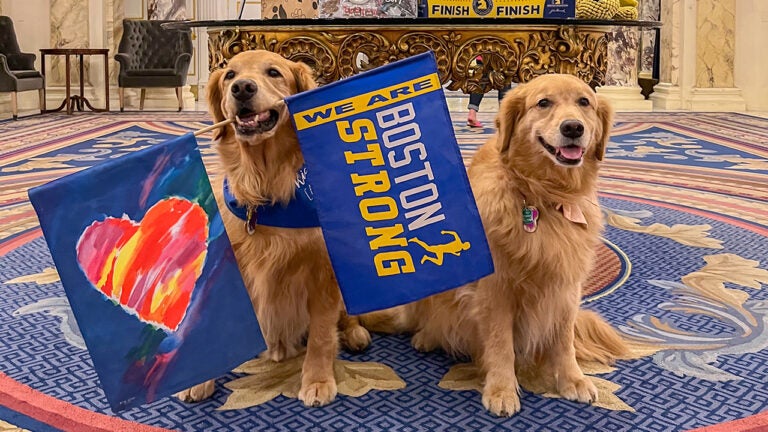
Spencer and Penny, two of the most beloved dogs in the history of the Boston Marathon. Via Boston Athletic Association
April 17, 2026 | 10:05 AM
6 minutes to read
For as long as there have been marathons, there have been dogs nearby trying to run alongside.
This traces back to the actual Battle of Marathon in 490 BC, in which — according to the account of ancient Roman scholar Aelian — a Greek hoplite’s dog accompanied him to the historic clash (and was later honored along with the rest of the victorious Athenians).
Closer to home (and modernity), dogs have been an excitable presence at the Boston Marathon over its many years.
But viewed through the prism of our current time, much of the marathon’s history involving dogs might seem a little harsh. For many years, dogs were viewed almost exclusively as a nuisance, or even a “menace.”
More recently, attitudes have shifted almost entirely to the side of sympathy. This has been especially true in the last decade as spectator dogs have risen to marathon fame.
With that in mind, here’s a clearly necessary history of prominent Boston Marathon dogs:
(Very good) honorable mentions
Before we get to the top dogs, it’s important to cite a few other marathon-adjacent friends who also left their paw prints on (or vaguely around) the event’s history.
One has to be a German Shepherd from 1967, who broke onto the then-fenceless course and galloped alongside that year’s winner, Dave McKenzie.
The dog eventually tailed off, unable (as was every other human) to keep pace with McKenzie that day.
The other notable near-mention actually occurred at Fenway Park the day before the 1965 marathon. Unable to resist the comparison, longtime Boston Globe sports writer Harold Kaese noted with perhaps dated terminology that, “There is something about Patriots Day that stimulates dogs. The hairy shanks of marathoners, usually.”
Though it seems impossible, a black Labrador named Chief wandered into the famous ballpark and onto the outfield, eventually grabbing a ball in its mouth and happily displaying it for excited fans in the bleachers.
“Luckily, Chief knew the rules,” Kaese argued. “He knew it was a ground-rule double once it bounced into the stands, knew the ball was not in play when he snatched it like a raw hamburger.”
20th century dogs
While other dog-related episodes were a periodic occurrence in the early years of the event, the first prominent involvement of a dog in the Boston Marathon appears to have come in 1947. That year, South Korean runner Suh Yun-bok shocked local prognosticators by storming to victory, becoming the first Asian winner in the event’s history.
But it was far from an easy win. Right as he reached the base of Heartbreak Hill, Suh was caught off-guard by an enthusiastic Fox Terrier. Boston Globe columnist Jerry Nason was decidedly less sympathetic with his description, referencing the dog as an “arrogant terrier” who went “buzzing between [Suh’s] legs and knocked him Seoul over teakettle.”
The same prognosticators who had written Suh off before the race were now fully prepared to do so again. Nason cited a fellow member of the press remarking at the time, “That’s it for the Korean, what a lousy break.” But just as quickly as he went down, the 5-foot-1 Suh was back on his feet and attacking the notorious incline.
“Twelve strides later, [Suh] was in the lead, and he tore to shreds this fearsome rise of ground which has broken the hearts of hundreds of candidates before him,” wrote Nason.
Suh not only recovered from his fall, but went on to win in what was then a world’s best time (2:25:39). A day after his historic triumph, he smiled when asked about the terrier that had tripped him.
“Ah, the little dog was excited like everybody else.”
The dog that jumped in to run with the leaders during the 1961 Boston Marathon. – Via Globe Archives
Probably the most famous involvement of a dog in the Boston Marathon came in 1961.
That year, local schoolteacher John J. Kelley (“Kelley the Younger”) dueled Finnish detective Eino Oksanen. Both had already won in Boston, and were hunting for a second victory. It was an elite matchup, challenged also by English runner Fred Norris.
Around Mile Six, a “floppy-eared, mongrel dog” (the description given by D. Leo Monahan of The Daily Record) hopped onto the road and started running alongside. After reportedly staying with the leading pack for approximately 10 miles, the dog eventually swerved a little too sharply toward the runners.
Oksanen was able to dodge, but Kelley was felled by what appeared to be a black Labrador (the dog was never properly identified). Norris, to his immense credit, reflexively stopped and helped Kelley to his feet. Remarkably, Kelley was able to proceed virtually without incident (though it likely cost Norris, as his concentration was broken and he eventually fell back from the leading group).
Oksanen won in the end, but took a brutal tone on the subject of the day’s true protagonist.
“Kelley’s a tough man to beat,” he told reporters. “They should have shot the dog that knocked him down.”
A Boston Globe headline from 1961 after that year’s marathon in which the pictured dog tripped Johnny Kelley. – Globe Archives
Kelley, on the other hand, earned plaudits for chivalrously defending the dog.
“It didn’t cost me the race,” he told the Globe. “He wasn’t a vicious dog. He was just having fun and was sorry when I fell. Did you ever see a dog in such good condition?”
Kelley’s refusal to scapegoat the dog, while an endearing stance from a local legend, was nonetheless the exception in that era. Even as late as 1977, sportswriter Joe Falls’s book, “The Boston Marathon,” included an entire chapter literally titled, “Man’s Worst Friend.”
In it, Falls opened by declaring runners and dogs as “those old archenemies,” and went on to label them as “mutts,” who are “a real menace to runners.”
“Many dogs are basically cowards,” he wrote, “but if they see something running away from them, it bolsters their confidence and brings out the spirit of the hunt.”
He then cited a magazine article written in the 1970s which recommended steps for how runners could deal with dogs. If running away or shouting failed to stop a dog, “try a weapon,” Falls cited.
Whether or not Falls represented a more standard viewpoint in that time — his citing another author of the magazine piece could be seen as further proof of this — his views are dated when compared not only with current practices, but the general public’s view of dogs.
Modern era dogs
As time has progressed, attitudes toward dogs in relation to runners have softened considerably. Off-leash dogs can certainly still be a concern for those out for a jog, but the perception has largely shifted.
Part of this probably has to do with the modern organization of the marathon, which now erects fencing along much of the route (especially the final few miles). The possibility of dogs tripping runners has diminished, leaving local pups to merely be friendly bystanders.
No one occupied this role better than Spencer, a golden retriever therapy dog who went viral in the 2010s for his marathon support. Along with his niece, Penny (a fellow golden retriever), the dogs would stand along the course route impressively holding flags in their mouths.
Spencer quickly became a beloved local figure, and was named the official Boston Marathon dog in 2022.
Sadly, both Spencer and Penny passed away in 2023. Showing just how far the standing of dogs have risen in the eyes of marathoners, a statue was built in Ashland in 2024 to honor Spencer’s contributions. There have also been giant gatherings of golden retrievers on Boston Common in Spencer and Penny’s names to raise money for charity, testament to the marathon’s more positive canine relationship.
Golden retrievers prior to the Boston Common gathering in 2024 honoring Spencer and Penny. – Jessica Rinaldi/Globe Staff
Which brings us to our final prominent marathon dog: Cori. Her full name is Cori Copley, as she’s the official canine ambassador of the Fairmont Copley Plaza (which serves as the marathon’s annual administrative center).
In a way, it’s fitting that Cori’s a black Labrador. She represents the full circle journey of a dog breed that was once shooed off the course by race director Jock Semple now having its own doghouse in a hall of marathon power.
Cori is the third ambassador in a tradition which began in 2004, and has at least partly taken up the mantle of being the Boston Marathon’s dog (she has her own bib).
In a larger sense, Cori is simply the latest in a long line of dogs who — thanks to Aelian — we know have been alongside people at marathons for over 2,500 years.
Hayden Bird is a sports staff writer for Boston.com, where he has worked since 2016. He covers all things sports in New England.
Sign up for the Today newsletter
Get everything you need to know to start your day, delivered right to your inbox every morning.