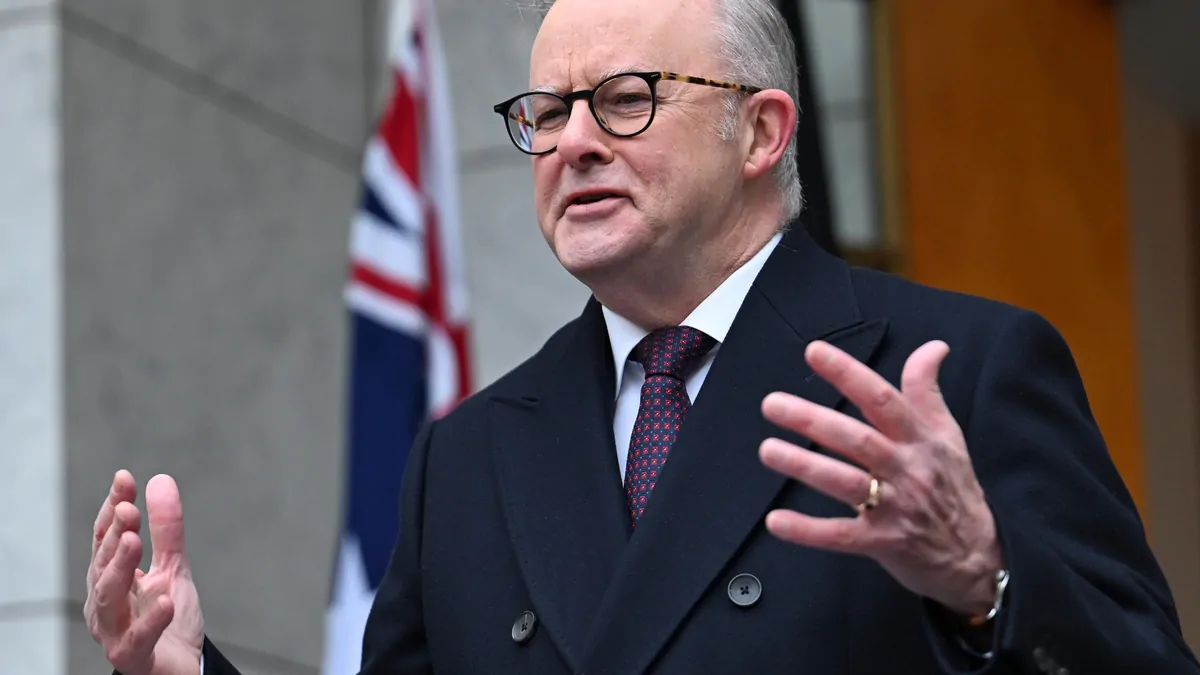
Anthony Albanese has vowed he won’t abandon WA, but a fresh fight is brewing over a new report’s call to dismantle the GST deal it called a “costly mistake” with “perverse” outcomes.
The Prime Minister personally phoned Premier Roger Cook to assure him and publicly dismissed the Productivity Commission’s 124-page report as an “interim report” as he insisted WA deserves a “fair deal” – but he didn’t specify what that is.
“Western Australia deserves a fair deal,” Mr Albanese said.
Sign up to The Nightly’s newsletters.
Get the first look at the digital newspaper, curated daily stories and breaking headlines delivered to your inbox.
By continuing you agree to our Terms and Privacy Policy.
“They contribute to our national economy. They’re a driver of our national economy. This interim report… is just that an interim report.
“This is a report that was commissioned by the Morrison government, not by our government. We’ll wait and see what they say at the end of the year.
“But I assure Western Australians of this: you will get your fair share because your work and what you contribute to the national economy really counts.”
The report was swiftly rejected by some senior Labor MPs as a “unbalanced, incorrect and highly speculative”, but will heap pressure on the Albanese Government internally.
Queensland Senator and Environment Minister Murray Watt said the report’s findings need to be considered.
“We’ll certainly look at it with an open mind,” he said. “What we have said is that WA will get its fair share of the GST. Now we will consider that. That’s the broad principle. We will consider the recommendations”.
Minister for Resources Madeleine King. Credit: Andrew Ritchie/The West Australian
The report insisted the Scott Morrison-era deal, which rescued WA from a record-low GST return of just 30 cents in the dollar, has cost Australian taxpayers $23 billion — more than four times what was originally projected.
It argued WA had been the only state to date to benefit from the changes.
WA’s most senior Labor member Madeleine King and the PM’s assistant minister Patrick Gorman said the report was fundamentally flawed.
“I don’t agree with it. I think it’s unbalanced, incorrect and highly speculative,” the Resources Minister said.
“It targets Western Australia and fails to properly take into account the immense contribution WA makes to the national economy.”
Mr Gorman backed his WA colleagues’ remarks, adding “I’m as confident today as any day since we came to office that WA’s fair share of the GST is rock solid”.
The State’s most senior Liberal in Canberra, Michaelia Cash, and leadership contender Andrew Hastie delivered a fierce warning against any consideration by Labor to reduce WA’s GST share and vowed to be vocal.
“Over our dead bodies will they take a cent from Western Australia,’’ Senator Cash said.
“Western Australians remember what the old formula cost us. At one point we received as low as 30 cents in the dollar while we powered the nation’s economy. We will not let Labor or Canberra bureaucrats drag us back there by stealth.’’
The PM’s Assistant Minister, Patrick Gorman. Credit: Iain Gillespie/The West Australian
The Productivity Commission argued the 2018 reforms, that were negotiated by Scott Morrison and signed by Malcolm Turnbull and Mark McGowan, have failed and cost four times more than was projected.
“The result is a system that is now more complex, less consistent and more costly. If the government wants to support other objectives, they could do so outside the GST distribution system,’Productivity Commission Deputy Chair Alex Robson said.
The report recommended reverting back to the pre-2018 rules that the Productivity Commission had insisted eight years ago needed to be changed.
Under all three options, WA’s GST take would fall.
The “state standard” benchmark that artificially ties WA’s GST share to the stronger performance of NSW or Victoria would be scrapped.
WA’s population share of GST revenue would drop from 82 per cent to a flat 75-cent relativity floor, or even lower.
The first two options, which Commissioner’s described as their “first-best” and “second-best”, proposed completely dismantling the current system by transitioning back to the pre-2018 GST distribution system.
Both options would transition Australia back to the original, full Horizontal Fiscal Equalisation system.
The only difference from the pre-2018 model would be that under the first option, the Treasurer would be urged to direct the Commonwealth Grants Commission to rewrite the rules “in-system” so WA wasn’t heavily penalised for strong iron ore revenues.
And then the second option encouraged the Commonwealth to bypass the GST formula altogether, giving WA direct side-payments to cover the financial hit.
However, WA Senator Dean Smith said that would basically mean that the WA government would have to go “cap in hand to the Federal Government” each year to ask for needed payments.
He insisted that the Productivity Commission had appeared to forget that the 2018 changes were about acknowledging WA’s massive economic contributions rather than penalising it during periods of high mining royalty revenues.
Mr Cook said “east coast whingers” failed to understand that when WA does well the national economy prospers, and attacked the report’s authors.
“It’s a sign that these East Coast clowns simply do not understand Western Australia,” he said. “They have no Western Australian representative, and no idea.”
His sentiment was echoed by Shadow Federal Treasurer, and Victorian, Tim Wilson who said other states should develop their own resources instead of blaming the west.
“We want States to grow the economy first, not start by reaching for the begging bowl,” the Member for Goldstein said.
“Western Australia isn’t in a strong fiscal position by luck. It dug, drilled and backed its own industry to drive the prosperity of the state. That’s the model every state should follow, not a target for punishment.”
Federal Nationals Leader Matt Canavan describe the current arrangement as “perfect” but questioned if the PM could be trusted to keep his promise after controversial Budget changes to negative gearing and Capital Gains Tax.
“It’s a total joke. The arrangements we put in place were great. They’re great. They promote productivity. They do not make any state worse off,” Mr Canavan said.
“The pressure’s on the PM now, he should rule this out. The deal should not change.”
WA Liberal Ben Small reminded Labor of Mr Albanese’s February 2024 stunt when he signed a Perth reporter’s arm “NO CHANGE TO WA GST.”
Mr Small said his constituents in Forrest “would be very happy to dig a fiscal moat at the Nullabor and keep all of our money right here where it is made.”
Independent Member for Curtin Kate Chaney also slammed the report saying it “makes no sense to disincentivise WA’s economic growth, which produces nearly half the nation’s total exports.”
One of her main gripes was over gambling revenue, with east coast able to pocket billions from pokie profits without sacrificing their full share of the GST while WA have banned the electronic machines outside of it’s single casino.
“Billions in combined gambling revenue earned by NSW, Queenslandand Victoria did not affect GST distribution to those states, while WA was penalised for pursuing jobs,” she said.
“Prior to 2018, the GST approach essentially encouraged states to maximise gambling revenue, while disincentivising mining revenue.”
It comes after One Nation leader Pauline Hanson reiterated her full support for WA’s current arrangement with a call for east coast states “to get their act together” and stop “shutting down” industries rather than contributing.
While the word “productivity” appeared 25 times in the report, in all but seven instances the Commission was simply referring to itself.
It claimed on 24 occasions that the top-up deal was “perverse” and has failed to work as intended.
The report, which disclosed that it relied on AI for “editing” and “general research”, was prepared by the Productivity Commission’s senior officials Alex Robson and Angela Jackson.
They framed WA as an over-funded outlier by insisting that the State gets 113 per cent of what it actually needs to run the state, while every other state gets only 98 per cent.
The Commissioners used a natural disaster in New South Wales as an example to illustrate why WA should receive less, insisting that a costly bushfire in the east could prompt a pay rise for WA.
“The 2018 changes tried to achieve too much,” Dr Robson said.
“The system should be brought back to its core purpose: ensuring that all states and territories are able to offer Australians a similar standard of services and infrastructure no matter where they live.”