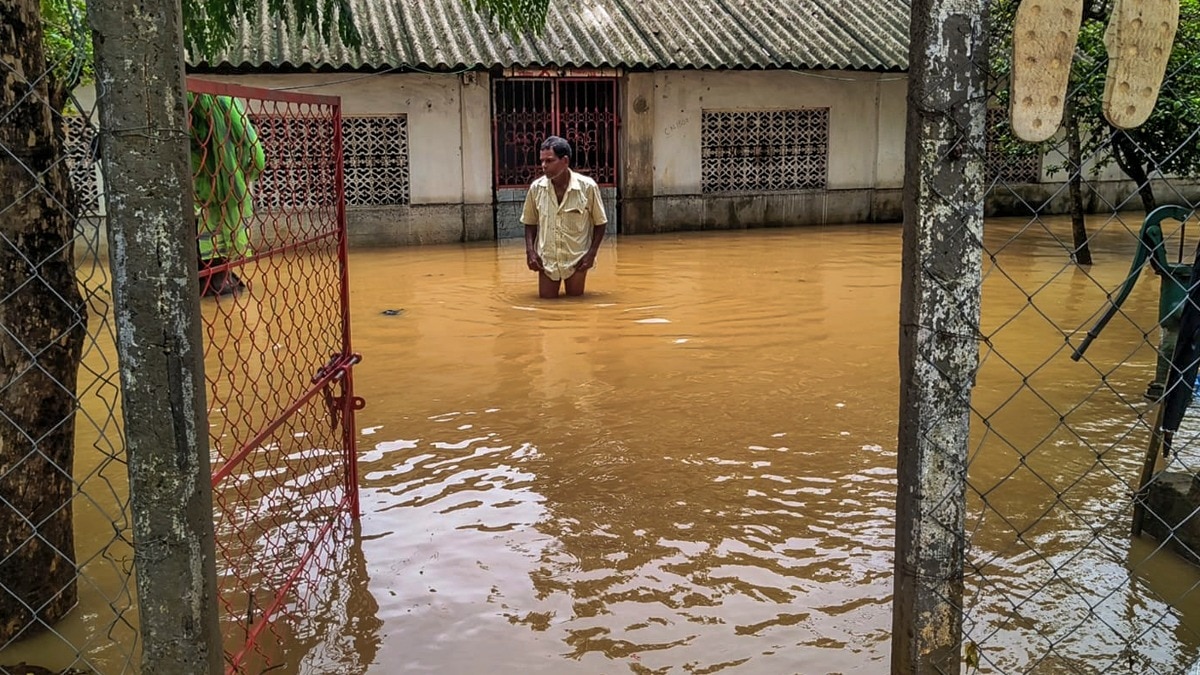
Imagine checking the weather and seeing two different faces of India at once.
In one part, people are wading through flooded streets as rivers rise and homes take in water. In another, farmers are looking at dry fields and waiting for rain that still has not arrived.
This is already playing out during the same monsoon. Assam and Gujarat have seen intense rain and flooding, while parts of Andhra Pradesh have faced prolonged dry spells.
So how can one country have too much rain and too little rain at the same time?
The answer lies in how unevenly rain is falling across India. Some places are getting intense downpours, while others are seeing longer gaps without rain.
To understand why, The Better India spoke to Prof. Rajib Maity of IIT Kharagpur, an expert in hydrology, water resources and climate variability. We also referred to his latest research on changing rainfall patterns and hydroclimatic extremes in India to better understand the science behind this growing monsoon paradox.
Here’s what he had to say about what this shift means for our farms, cities and water security.
Q1. How is it possible that one part of India is battling devastating floods while another is experiencing drought at the very same time? What is happening scientifically?
One of the biggest changes we’re seeing today is that rainfall is no longer spread evenly across India. Instead, we’re getting shorter bursts of very heavy rain in some places, while other regions are going through long dry spells at exactly the same time.
A warming climate has intensified what’s known as the hydrological cycle. In simple terms, a warmer atmosphere can hold more moisture. This is changing how much rain falls, where it falls, how intensely it falls and how long the gaps between rain spells last.
As a result, we’re seeing more hydroclimatic extremes, including floods, flash floods, droughts and flash droughts.
What’s particularly striking is that wet and dry extremes are now happening simultaneously. For example, while many parts of peninsular India have recorded a significant increase in extreme rainfall events, studies also show that dry spells during the monsoon have become more frequent across the country.
For farmers, these prolonged dry periods can quickly become a serious problem. They reduce moisture in the soil, put crops under stress and, when combined with rising temperatures, can dry the land out even faster.
Research also shows that around 20% of India’s land area has become increasingly dry, especially parts of the northeast, eastern and central India. At the same time, around 23% of the country has become wetter, including parts of Telangana, Andhra Pradesh, Maharashtra, Punjab, Rajasthan, Ladakh and Jammu & Kashmir.
So the larger story is about how rain is being distributed. India may receive plenty of rain overall, but where it falls, how heavily it falls and how long the gaps between rain spells last are becoming increasingly important.
Q2. Is climate change the only reason?
Climate change is a major driver, but several other forces also shape India’s rainfall.
Climate change has intensified the hydrological cycle, leading to more frequent and severe floods and droughts. Rising temperatures have also increased the amount of moisture the atmosphere can hold. That creates greater potential for intense rainfall.
But rainfall is also influenced by large weather systems, changes in wind and atmospheric circulation, urbanisation, land-use changes and local weather conditions.
These factors interact with one another, which is why rainfall can vary so sharply across different parts of the country.
Q3. Could you explain how the Indian monsoon actually works? Why doesn’t rainfall spread evenly across the country?
India receives rainfall from two different monsoon systems.
The Southwest Monsoon, which runs from June to September, brings most of the country’s annual rainfall. The Northeast Monsoon, from October to December, mainly affects the southeastern parts of peninsular India.
Even under normal conditions, rainfall has never been distributed evenly across the country because India’s geography plays a huge role.
Peninsular India is surrounded by the Arabian Sea, the Bay of Bengal and the Indian Ocean. The interaction between these water bodies, the monsoon winds and mountain ranges creates major regional differences in rainfall.
A research also points out that regions receiving lower rainfall tend to show much greater year-to-year variability. Photograph: (India TV News)
That’s why the Western Ghats and the northeastern states receive some of the highest rainfall in the country, while northwestern India and areas on the other side of the Western Ghats receive much less rain because the mountains block much of the moisture carried by monsoon winds. These are known as rain-shadow regions.
The research also points out that regions receiving lower rainfall tend to show much greater year-to-year variability.
So uneven rainfall has always been a feature of the Indian monsoon. What is changing is the intensity of these differences and the extremes that come with them.
Q4. Why are extreme rainfall events becoming more common?
Extreme rainfall is becoming more common because several factors are acting together.
The biggest driver is a warming climate. As temperatures rise, the atmosphere can hold more moisture, increasing the chances of very heavy rainfall when conditions are favourable.
Along India’s eastern coast, rainfall intensity has increased partly because of more frequent tropical cyclones in the Bay of Bengal, higher atmospheric moisture, stronger convective activity and the broader influence of global warming, which appears to be increasing rainfall intensity along the eastern coast at a faster rate.
Human activities are also contributing.
Take our cities. As trees, soil and open spaces are replaced by roads, buildings and concrete, urban areas become hotter. This extra heat can make the atmosphere more unstable and, under the right conditions, contribute to intense local rainfall.
Urban areas also produce more aerosols from vehicles and industries. These tiny particles in the air can influence how clouds form and, in turn, affect rainfall.
The research further suggests that changing rainfall seasonality and shifts in large-scale atmospheric circulation have altered regional precipitation patterns, contributing to more frequent and intense rainfall events across peninsular India.
In other words, several processes are coming together to increase the chances that when rain arrives, it can arrive very heavily and within a short period.
Q5. How much influence do climate phenomena such as El Niño, La Niña, the Indian Ocean Dipole (IOD), and the Madden-Julian Oscillation (MJO) have on why some regions receive excessive rain while others remain dry?
Think of these as large climate systems that influence where moisture travels, where clouds build up and when the Indian monsoon becomes stronger or weaker.
These climate systems interact with one another and influence atmospheric circulation, moisture and monsoon behaviour. Depending on how they line up in a particular year, different parts of India can experience very different rainfall. Photograph: (Times Of India)
One of the most important is the El Niño-Southern Oscillation (ENSO), which has a strong influence on rainfall across India. El Niño is often associated with a weaker Indian monsoon, while La Niña can favour stronger monsoon conditions, although their effects can vary from year to year.
The Indian Ocean Dipole (IOD) is another major driver. Positive IOD events have contributed to increased rainfall in several parts of India, especially when they occur alongside ENSO.
Then there’s the Madden-Julian Oscillation (MJO), which affects both the timing and intensity of rainfall by influencing atmospheric convection over the Indian Ocean. Put simply, it is a large moving system of clouds and rainfall that travels through the tropics and can influence when parts of India experience particularly active or weak monsoon spells.
The study also identifies the Southern Oscillation Index (SOI) and the Pacific Decadal Oscillation (PDO) as important influences on India’s rainfall variability.
These climate systems interact with one another and influence atmospheric circulation, moisture and monsoon behaviour. Depending on how they line up in a particular year, different parts of India can experience very different rainfall.
Q6. Apart from global climate change, how much do local human activities such as urbanisation, deforestation, wetland destruction and changes in land use contribute to flooding and drought?
Local human activities play a significant role and often make both floods and droughts worse.
Take urbanisation, for example. When vegetation and open ground are replaced by roads, buildings and concrete, less rain can soak into the soil. Instead, water runs quickly across these hard surfaces. If drainage systems cannot handle it, streets and neighbourhoods can flood.
Prof. Rajib Maity of IIT Kharagpur, an expert in hydrology, water resources and climate variability.
Urban areas also generate higher levels of aerosols from industries and vehicles. These particles act as cloud condensation nuclei, influencing cloud formation and altering rainfall patterns.
The research also highlights that changes in land use and land cover are major contributors to changing rainfall patterns and hydroclimatic extremes.
Vegetation loss creates another problem. Plants and healthy soils help hold moisture in the ground. When vegetation disappears and land becomes degraded, the soil can dry out faster and become more vulnerable during periods of low rainfall.
Wetlands and other natural ecosystems also help store water and slow its movement through the landscape. Losing them can leave an area more exposed to both flooding and water scarcity.
Q7. How accurate are India’s current weather forecasting models at predicting localised extreme rainfall or prolonged dry spells? What improvements are still needed?
Weather forecasting has improved considerably over the years, but predicting highly localised extreme rainfall events is still a challenge.
Forecasters may be able to tell that a region is likely to receive heavy rain. Predicting exactly which neighbourhood, district or small river basin will receive the most intense downpour is much harder.
That’s because these events are influenced by many interacting factors, including large-scale climate drivers, atmospheric circulation, urbanisation and local convective processes. Capturing all of these accurately remains difficult.
The research also points out that better forecasting alone isn’t enough.
A forecast can save lives only when the warning reaches people in time and authorities are able to act on it.
Forecasts need to be integrated more effectively into disaster preparedness, infrastructure planning and water resource management. That way, communities can respond more quickly and prepare better for both floods and prolonged dry spells.
Q8. Are these simultaneous floods and droughts likely to become the new normal over the next few decades? Which regions of India are most vulnerable?
The research suggests that increasing climate variability is likely to continue, which means simultaneous floods and droughts could become more common not only in India but across the world.
Climate change is already increasing aridity across several regions in India too. The study identifies growing dryness across parts of northeast India, eastern India and central India. At the same time, wetter conditions have emerged in parts of Telangana, Andhra Pradesh, Maharashtra, Punjab, Rajasthan, Ladakh, and Jammu & Kashmir.
But a region becoming ‘wetter’ over the long term does not mean it will receive steady rainfall throughout the monsoon. It may get an enormous amount of rain over a few days and then go through weeks with very little.
This is why India will increasingly need region-specific solutions. A place becoming drier will face very different challenges from one seeing heavier rainfall, even though both are experiencing the effects of a changing climate.
As warming intensifies the hydrological cycle, both extreme rainfall and prolonged dry spells are expected to remain major challenges in the coming decades.
The time has come for region-specific adaptation strategies that reflect how differently these changes are playing out across India.
Q9. What should India do differently?
I think India now needs to shift from simply reacting to disasters to preparing for them well in advance.
Floods and droughts are becoming more frequent, and what’s striking is that they’re now happening at the same time in different parts of the country. That means cities, farms, reservoirs and other systems planned around historical rainfall patterns may struggle as the monsoon becomes more variable.
There are a few key areas we need to focus on. Climate adaptation planning has to become a priority, alongside stronger disaster preparedness systems, better water-resource management and infrastructure that’s designed to cope with more frequent extreme rainfall events.
India also needs to think much more carefully about how rainwater is stored and managed when a large share of the season’s rainfall may arrive within a few intense spells.
The research also highlights the importance of protecting land from further degradation, improving vegetation cover, adopting more sustainable land-use practices, strengthening ecosystem resilience and integrating climate adaptation into long-term development planning.
Q10. If you could recommend three scientific priorities for policymakers, city planners and farmers to prepare for this new pattern of weather extremes, what would they be?
I would focus on three priorities.
First, improve climate monitoring and forecasting.
The better we understand how rainfall patterns are changing, the better we can prepare communities for floods and droughts before they happen.
Our cities, roads, drainage systems, reservoirs and other infrastructure need to be designed for a future where extreme weather events are becoming more common, rather than relying on past climate patterns. (Photograph: The New Indian Express)
Second, build climate-resilient planning and infrastructure.
Our cities, roads, drainage systems, reservoirs and other infrastructure need to be designed for a future where extreme weather events are becoming more common, rather than relying on past climate patterns.
Third, protect ecosystems and promote sustainable land management.
Healthy forests, wetlands, vegetation and soils play a crucial role in regulating water, reducing disaster risks and improving resilience. Protecting these natural systems should be seen as a core part of climate adaptation.
Q11. Many people think more rainfall automatically means more water. But your research suggests that isn’t always true. Why does more rain not necessarily translate into better water security?
A place can receive an enormous amount of rain within a few days and still face a water shortage weeks later.
Water security depends on more than the total amount of rain. What matters is when it falls, where it falls, how intensely it comes down and how much of that water can actually be absorbed or stored.
The research shows that rainfall is increasingly arriving in short-duration, high-intensity events instead of being spread evenly across the monsoon season. In fact, peninsular India has seen a significant increase in extreme rainfall events, particularly since 2001, while dry spells during the monsoon have also become more frequent.
When a huge amount of rain falls within a short period, much of it can rush into drains and rivers instead of slowly soaking into the soil and replenishing groundwater. Then, if several dry weeks follow, the same place that recently experienced flooding can begin facing water stress.
So, even if a region receives a large amount of rainfall over a few days, it may still go through long periods with very little rain for the rest of the season.
A region can therefore record ‘more rain’ overall and still struggle with flooded streets, stressed crops or water shortages.
That’s why the timing, intensity and geographical distribution of rainfall have become just as important as the total amount of rain received.
This growing variability has major implications for agriculture, ecosystems, disaster preparedness and long-term water-resource planning.
India’s future water security will increasingly depend on how well we capture rain when it arrives, how effectively our landscapes can hold it and how prepared we are for the longer dry gaps that may follow.