Wickedpedia
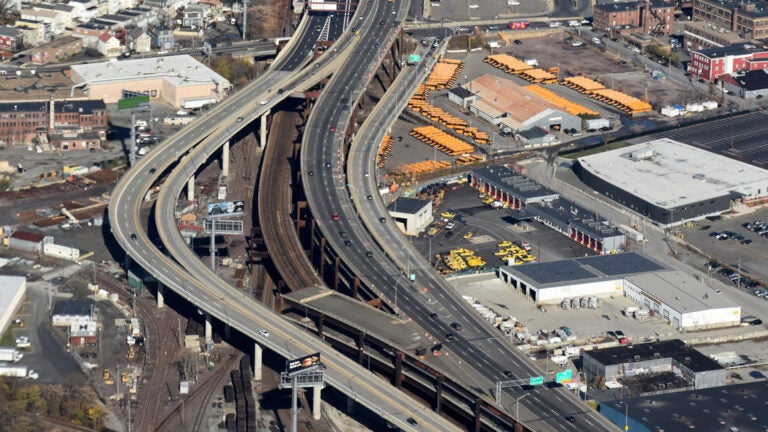
Maybe you’ve spotted the ghost ramp off the highway in Somerville. It’s been sitting unfinished for decades.
I-93 corridor in Somerville. Nick Allen/Wikimedia Commons
Have you ever driven along I-93 in Somerville, perhaps double-checking you’re getting off at the correct exit, and cruised past what can only be described as an “off-ramp to nowhere”? Also known as a stub ramp or a ghost ramp, this unfinished chunk of highway near the Mystic Ave. northbound exit is actually a symbol of victory in a once hotly contested controversy.
The ramp is a vestige of the abandoned I-695 Inner Belt, an eight-lane highway that would’ve connected I-93 to I-90 and I-95. It was proposed to slice through parts of Cambridge and Somerville, then cross the Charles over to Brookline, meandering past Fenway and the MFA toward Roxbury, where it would meet the Southeast Expressway. The goal, brought forward in 1948 by the state’s commissioner of public works, William Callahan, was to create a belt around the city, channeling traffic toward the perimeter of metro Boston.
“The thinking is that traffic in the rest of the city is going to benefit because trucks and people passing through on their way to and from the city can go on the expressway and not have to clog up residential streets,” said Beth Folsom, program manager at the Cambridge Historical Society.
At the time, just three years after the end of World War II, the car had become king, Folsom explained. People had just begun to envision their lives as car-centric, and the U.S. highway system was expanding before their eyes, allowing them to access new and different parts of the state. I-695 was simply a part of that expansion.
The only problem? Constructing the Inner Belt would mean razing scores of homes and neighborhoods in the process. Opposition built up gradually, beginning in the 1950s and extending into the early 1960s. Cambridge residents in particular were loath to see a highway destroy Central Square, effectively cutting their working-class neighborhood in half. In Cambridge alone, thousands of people would have been forced to move, their homes seized by eminent domain.
A group of activists—largely led by women and stay-at-home mothers—saw how communities of color in Boston were dealing with similar issues. Taking cues from their organizing, they formed a movement to oppose the Inner Belt project in Cambridge.
“It’s a radical act for these women, first of all, to be there as housewives and going and protesting this seemingly political topic,” Folsom said. “And also bringing their children with protest signs as well.”
Picketers protesting the planned Inner Belt during the inauguration of MIT President Howard Johnson in 1966. – Courtesy of the Boston Public Library’s Brearly Collection via Digital Commonwealth
As their movement grew, so did a political push for investing in mass transit in the late 1960s. Then, in 1970, Governor Frank Sargent put a moratorium on all new expressway construction inside the 128 corridor. “He’s been listening to the protests of how this should be executed, and how it should go or not go through the middle of neighborhoods in the city,” Folsom said. “So he really pumps the brakes and says ‘Let’s slow down. Let’s think about other options.’”
By the end of 1972, Sargent vetoed the entire program, and when Michael Dukakis took office in 1974, he continued to champion pro-public transportation legislation.
As for the “ramp to nowhere,” construction was halted during Gov. Sargent’s moratorium, never to resume. It’s only still there because it’d be complicated and expensive to remove it.
“As there is no reason, structural or otherwise, to remove the ramp, the associated costs to do so would far outweigh whatever potential benefit there would be,” said Marshall Hook, a spokesperson for MassDOT.
Thankfully, starting and stopping construction on a ramp like this isn’t the kind of thing that would happen today, since methodologies for the planning and execution of projects have evolved since the mid-1900s. Now, MassDOT has a formal process to involve the public in projects from conception through completion.
Still, blocking the Inner Belt continues to be a source of pride for Cantabridgians, urban planners, and many others. In 1980, artist Bernard LaCasse painted a 75-foot-long “Beat the Belt” mural depicting the community’s opposition on the side of the Cambridge Micro Center building at 730 Memorial Drive. Aside from celebrating collective action, the mural still resonates today — echoing a sentiment about the Inner Belt that one Reddit user put so well: “Wow. Thank god that didn’t happen.”
-
What makes a ship a ‘tall ship’?
-
Why is haggis illegal?
Madeline Bilis is a freelance journalist based in Boston, where she covers real estate, travel, and design. She will always defend the city’s brutalist buildings.
Sign up for the Today newsletter
Get everything you need to know to start your day, delivered right to your inbox every morning.