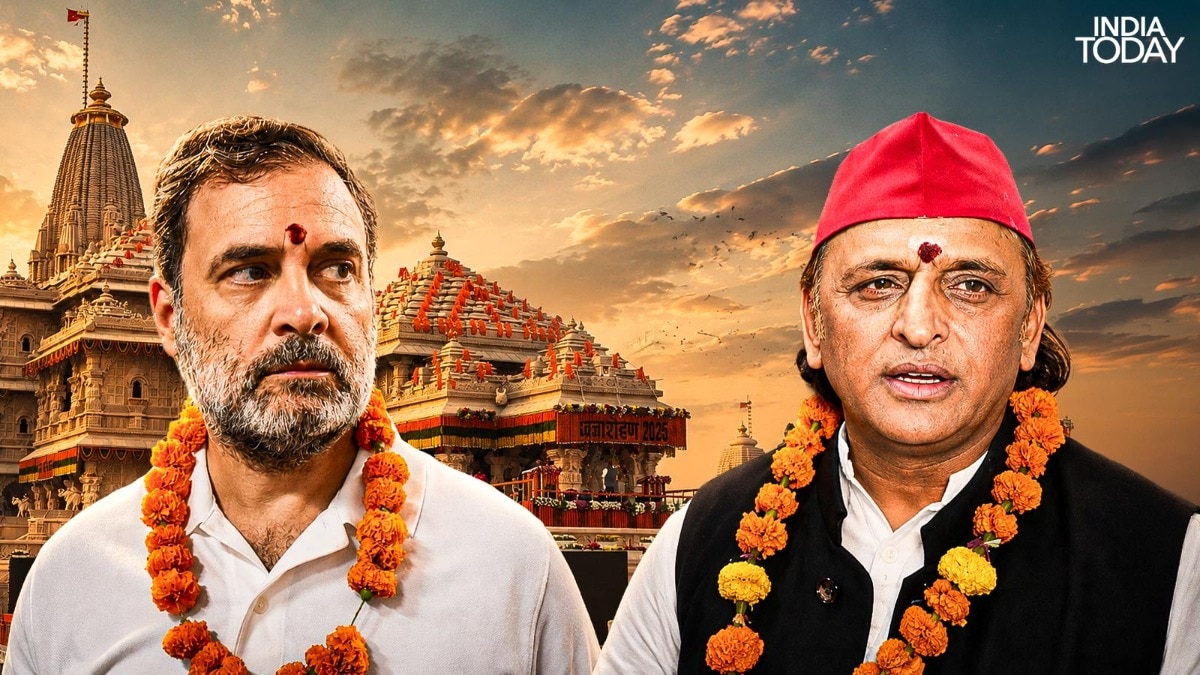
The road to power in Lucknow in 2027 is not only passing through villages, caste equations and welfare schemes, but it is winding through the temple town of Ayodhya. There’s an addition to the chants of “Jai Shri Ram” and the stories of karsevaks — the alleged donation embezzlement at the Ram Mandir. Uttar Pradesh’s upcoming Assembly election is still months away. The political vocabulary is taking shape. Now, even the opposition in the state, the Samajwadi Party (SP), and the Congress are speaking about Sanatan Dharma. The only question remains who is going to get to define it.
The Bharatiya Janata Party (BJP) has treated Hindutva as an emotional thread that stitches together welfare, governance, and political identity. From the construction of the Ram Mandir in Ayodhya to the revival of pilgrimage centres, from projecting Yogi Adityanath as a saffron-clad administrator to presenting Uttar Pradesh as the epicentre of India’s civilisational resurgence, the BJP has successfully shifted the state’s political conversation. The opposition stood firm and opposed the BJP’s ideology for decades, but they were forced to engage with it.
The very parties that the BJP has spent years portraying as hostile to Hindu aspirations, after witnessing the BJP’s success in the West Bengal Assembly elections, are increasingly invoking the language of Sanatan Dharma.
One of the reasons could also be the routing of the Mamata Banerjee-led Trinamool Congress (TMC) in West Bengal in the recent Assembly elections. Among several other factors that contributed to the BJP’s victory, is that it managed to mobilise and consolidate Hindu votes with its primary weapon, Hindutva. The BJP painted Mamata’s outreach to the Muslims, one of her core vote banks, as anti-Hindu. Experts believe there was a counter-consolidation in the BJP’s favour.
SP chief Akhilesh Yadav increasingly speaks of temples, astrology, lord Hanuman and the Ram Mandir. Akhilesh is soon undertaking a rath yatra of his own, something long identified with the mandir movement of the 1990s. Congress leaders insist they are “Sanatanis from Kashi”. All these developments by the SP and the Congress are difficult to snub with the BJP’s rising success with one primary agenda.
Both the SP and the Congress have turned the alleged Ram Mandir donation theft into their sharpest political weapon, arguing that the issue is not about faith but accountability. Yet in choosing this line of attack, knowingly or unknowingly, the Samajwadi Party and the Congress are also acknowledging that faith itself has become the centre around which the 2027 elections in Uttar Pradesh appear to be revolving around.
The controversy surrounding the Ram Mandir has undoubtedly given the Opposition a political weapon to attack the BJP’s moral authority on an issue it once owned exclusively. But closely observing the developments, there is an irony. The allegations of Ram Mandir chanda chori (donation theft) have also handed the BJP another chance to remind voters of the question of where these parties (Congress and Samajwadi Party) were when the Ram Mandir movement was at its peak? In trying to corner the BJP over Ram, the Opposition has ended up talking about Ram every single day.
This perhaps is precisely the terrain on which the BJP has always been most comfortable. However, the Ram Mandir embezzlement issue is a tightrope for the BJP, as it has pushed the saffron camp to a defensive spot.
THE RAM MANDIR ISSUE: EVERY PARTY HAS THEIR OWN VERSION
UP has been at the centre of the BJP’s movements of regaining disputed temple lands in Mathura, Kashi and Ayodhya in the 1990s. It gained immense support after LK Advani started the Rath Yatra in 1990. The movements helped the saffron party become a dominant political party, in UP, and also in the Centre.
After nearly 15 years of rule by governments led by the SP and the Mayawati-led BSP, the BJP, with Yogi Adityanath in power, altered the political landscape of the state. The Ram Mandir, from being a promise, became a completed political project in 2024. Kashi Vishwanath was redeveloped. Ayodhya witnessed unprecedented infrastructure expansion. Pilgrimage towns became symbols of development as much as religion. The BJP maintained that Hindu identity and economic growth could move together.
This narrative has now encountered a complication. The controversy surrounding the alleged theft of donations made at the Ayodhya Ram Mandir has provided the Opposition with an opening to challenge the BJP on an issue long considered its turf.
The Congress and the Samajwadi Party have sought to separate faith from alleged financial wrongdoing, insisting that questioning the handling of devotees’ money cannot be equated with questioning Lord Ram himself.
For Chief Minister Yogi Adityanath, however, the controversy has become more about political memory. Rather than allowing the debate to remain confined to the alleged theft case, he has repeatedly shifted the conversation back to the Opposition’s historical positions on Hindu religious issues.
YOGI ADITYANATH INVOKES MOST DISTURBING PHASE OF RAM MANDIR MOVEMENT
This was highlighted by Adityanath recently at AajTak Panchayat, an India Today Group event.
“Those who used to ban the Kanwar Yatra, those who prevented Ram Navami processions, those who did not allow Janmashtami celebrations, and those who stopped Durga Puja pandals during Navratri are today talking about faith. How ironic,” Yogi said at the AajTak Panchayat event on July 15.
Yogi, in his address, added another reminder that directly invokes one of the most disturbing episodes associated with the Ayodhya movement. “Those who ordered firing on Ram devotees in Ayodhya are today speaking about faith,” he said.
The Chief Minister of Uttar Pradesh also defended the government’s handling of the embezzlement case, stating that the state acted immediately after the temple trust sought an investigation. “As soon as the SIT report came, the Trust initiated action. The six people who were caught on camera stealing were arrested. Those who assisted them were also arrested,” he said.
This strategy allows the BJP to move beyond defending itself against allegations. Every discussion on the Ram Mandir donation controversy also becomes an opportunity to revisit the history of the Ram Janmabhoomi movement, the firing on karsevaks during the Samajwadi Party government of Mulayam Singh Yadav, the legal battle over the temple, and the BJP’s claim that it fulfilled a promise that its rivals had opposed for decades.
SAMAJWADI PARTY AND AKHILESH YADAV’S HINDU VOTER MOBILISATION
After 10 years of being out of power in Uttar Pradesh, recognising the shift in the political landscape, Akhilesh Yadav has seemingly embarked on a political repositioning. The Samajwadi Party chief no longer wants his party to be viewed through the narrow prism of a Muslim-Yadav (MY) coalition. Instead, he is attempting to build what political observers describe as a “soft Hindutva” image. Many political experts believe that this positioning of Yadav is one that embraces religious symbolism without abandoning the party’s PDA (Pichhda, Dalit and Alpsankhyak) social coalition.
Akhilesh’s political arithmetic for years has been about consolidating Pichhda (backward), Dalits and Alpsankhyak (minorities).
Akhilesh has read verses from the Hanuman Chalisa during Bade Mangal celebrations this summer, publicly spoken about his faith in astrology, joked that he now consults priests before taking important political decisions, and credited astrological advice for the Samajwadi Party’s 2012 electoral victory.
Yadav has openly supported Jyotirmath Shankaracharya Swami Avimukteshwarananda during his dispute with the Uttar Pradesh government, raised questions over alleged irregularities linked to temple affairs, and highlighted issues concerning religious figures that would not have featured prominently in the Samajwadi Party’s political messaging in the 1990s.
Samajwadi Party President Akhilesh Yadav has emerged as the key architect of the party’s PDA (Pichhda, Dalit, Alpsankhyak) social coalition. (Image: PTI)
AKHILESH YADAV’S RATH YATRA TO TEMPLE INAUGURATION SYMBOLISM
Akhilesh Yadav’s politics is now extending beyond symbolism into an organisation aimed at mobilising Hindu votes. In September, the Samajwadi Party is planning to launch the “Samajwadi PDA Rath Yatra”. It could reportedly begin at one of Uttar Pradesh’s most significant religious centres, Ayodhya, Mathura or Kashi.
Simultaneously, Akhilesh is preparing to inaugurate the newly-constructed Kedareshwar Mahadev Temple in Etawah city of Uttar Pradesh, which would be a shrine inspired by Kedarnath. The timing, just months before the Assembly election, leaves little doubt that religion is becoming as much a campaign tool for the Opposition as it has long been for the BJP.
Samajwadi Party MP Dharmendra Yadav has declared that the party will carry the Ayodhya donation controversy across Uttar Pradesh through the proposed Rath Yatra. “The Samajwadi Party will take this issue to the people. We will hold a Rath Yatra across Uttar Pradesh and expose how the donations offered by Ram devotees were allegedly looted,” Dharmendra Yadav said at the AajTak Panchayat on July 15.
“The people deserve to know where every rupee collected in the name of Lord Ram has gone,” he added.
CONGRESS’ HINDU VOTES AND SOCIAL JUSTICE AGENDA FOR UTTAR PRADESH
The Congress, which is eyeing a stronger position in the alliance with the Samajwadi Party in the state, too, has sensed the political weather.
For years, the Congress allowed the BJP to portray it as uncomfortable with overt expressions of Hindu faith, while foregrounding constitutional secularism.
But with the 2027 Uttar Pradesh Assembly election approaching, the Congress is attempting to redraw that image. It is no longer ceding the language of Sanatan to the BJP.
The Congress leaders insist that faith and accountability are not mutually exclusive. Uttar Pradesh Congress president Ajay Rai, during an interaction at AajTak Panchayat, argued that the Ram Mandir donation controversy is “not about faith, but about theft.”
Questioning the BJP’s stewardship of the temple, Rai said, “They came to power saying, ‘Those who brought Ram will be brought back.’ But the question is, did they bring Lord Ram, or did Lord Ram bring them? If they are true devotees of Ram, they should answer this.”
“We are not Sanatanis for show. We are the people of Kashi, and we are Sanatanis,” Ajay Rai said.
THE POLITICS REVOLVING OVER RAM MANDIR: WHO WILL GAIN?
The proposed Rath Yatra of the SP is expected to carry precisely this message across Uttar Pradesh. It hopes to deny the BJP the opportunity to portray it as anti-Hindu while simultaneously attacking the ruling party on an issue that directly concerns faith.
For the BJP, however, this strategy plays into a larger political script that it has refined over the last decade. Every allegation surrounding the temple allows the party to pivot back to the Ram Janmabhoomi movement itself.
Yogi Adityanath has repeatedly employed precisely this line of argument. Responding to the Opposition’s attacks, he asked how those who “tried to prevent the construction of the Ram Temple” and “engaged lawyers to oppose the Ram Mandir” could now claim to speak for faith.
In effect, both sides are trying to occupy the same political space, albeit from different directions. The Opposition hopes to convince voters that it can defend Sanatan values and seek transparency.
The BJP seeks to remind those very voters that cultural ownership cannot be separated from historical memory.
EVERY PARTY ON THE VERGE TO MOBILISE HINDU VOTES
This convergence is perhaps the most significant political development ahead of the Uttar Pradesh Assembly election. Not long ago, the ideological divide appeared much sharper. The BJP spoke unapologetically about Hindutva, while its opponents preferred to foreground secularism, caste arithmetic and economic issues.
Today, that distinction is fading. Akhilesh Yadav invokes Lord Hanuman and inaugurates temples. Congress leaders proudly describe themselves as Sanatanis from Kashi. The INDIA bloc continues to speak of the Constitution and social justice, but increasingly wraps that message in the language of faith.
That does not necessarily mean the BJP’s electoral challenge has disappeared. The Ram Mandir donation controversy has given the Opposition a potent issue through which it can question the ruling party’s credibility on an emotive subject. Combined with caste calculations, anti-incumbency, unemployment and local grievances, it could shape the political contest in important ways.
Elections are rarely won only by convincing people to support a party, they are also won by deciding what the election is about. And in Uttar Pradesh, the conversation continues to revolve around Ram, Sanatan, temples, yatras and religious identity.
Whether it is Yogi Adityanath invoking the memories of the Ram Janmabhoomi movement, Akhilesh Yadav seeking blessings at temples while preparing a Rath Yatra, or Congress leaders proclaiming themselves authentic Sanatanis, all roads seem to lead back to the same political vocabulary. That is perhaps the BJP’s biggest gain heading into 2027. Its rivals are fighting the election in a language the party spent years making mainstream. The contest might determine who governs Uttar Pradesh next, but the battle over the agenda appears, at least for now, tilting towards the BJP.
– Ends
Published By:
Avinash Kateel
Published On:
Jul 20, 2026 11:12 IST